Editor’s Note: This is Part 6 of a series by Olasee Davis on the St. Croix Hiking Association’s recent trip to Belize. Read Part 1 here, Part 2 here, Part 3 here, Part 4 here, and Part 5 here.
Some members of the St. Croix Hiking Association took the Jaguar Trail to the mountains of the Tiger Fern Cockscomb Basin Wildlife Sanctuary. The trail started off level, and eventually we began to climb. (Photo by Olasee Davis)
This is the sixth in my series on the St. Croix Hiking Association’s adventures in Belize, one that hikers will never forget due to our emotional connection with the Mayan people, the hiking, and camping in the mountains. That morning at Pals on the Beach hotel in Dangriga, we ate breakfast and packed our backpacks with hiking gear, sleeping bags, bug spray, and other camping equipment for an overnight camp in the mountains of the Tiger Fern Cockscomb Basin Wildlife Sanctuary. Believe me, that morning everyone looked forward to visiting the sanctuary. It would be the adventure of all adventures, especially camping in the mountains and exploring the wildlife sanctuary trails, waterfalls, and animal life.
Olasee Davis (Submitted photo)
In 1984, Cockscomb Basin Wildlife in Belize was declared a forest preserve. Later, the forest preserve became known as the Cockscomb Basin Jaguar Preserve, which was established in 1986. It was the world’s first sanctuary for jaguars, the largest cat in the Americas. The preserve was created after wildlife biologist Dr. Alan Rabinowitz discovered a large population of jaguars in the Stann Creek district, the south-central mountain range of Belize. The wildlife preserve has grown from 3,600 acres to over 125,000 acres of primarily rainforest with an annual rainfall of 100 to 150 inches of rain per year.
Besides jaguar protection, the wildlife sanctuary is home to other mammals such as cougars, monkeys, otters, wild pigs, deer, tapirs, ocelots, and more. There are more than 300 different species of native and migratory birds including parrots, hawks, toucans, and the majestic scarlet macaw, which became extinct on St. Croix hundreds of years ago. The wildlife sanctuary is also home to a very large number of insects, frogs, toads, snakes, bats, and many others.
The dominant tree species in the reserve are cedar and mahogany with dense and thick vegetation that includes orchids, bromelias, and other jungle forest vines. There are many trails and several waterfalls to visit. The sanctuary is well established with cabins, running water, a visitors’ center, museums, pavilions, and many other facilities, such as a research lab for wildlife and forest studies.
This is one of the cabins where some hikers stayed for the night at the wildlife sanctuary while others hikers camped overnight in the mountains. (Photo by Olasee Davis)
When we got to the wildlife sanctuary headquarters from our long drive, we were greeted by staff members informing us of our activities for the next day and a half in the wilderness, and the surrounding Mayan village communities. After we ate lunch, hikers were separated into groups. Some would be hiking to the mountains to an overnight camp with tents and hammocks, and others would be staying in the cabins at the wildlife sanctuary facilities. Ben, a wildlife biologist and Maya descendant was our tour guide to the mountains with two other helpers. We took the Jaguar Trail, which started off level, and eventually we began to climb. As Ben began to talk about the forest, conservation, and the history of the site, it was interesting, especially about wildlife in the area and how the area became a sanctuary for the preservation of jaguars, other wildlife and the natural and cultural resources of the site.
As Ben continued, he spoke about his people who once lived for thousands of years in the area, practicing traditional conservation and their way of life in the forest. What touched our hearts was when Ben mentioned how the government kicked his people off their own land. “What! You mean the government kicked your people (Mayans) off the land?” He went a step further by sharing, the government gave them 90 days to move off their land so the wildlife sanctuary could be expanded.
Believe me, that touched our hearts. As hikers we felt a connection with the Mayan people not just physically and because of what happened to them with their land, but also spiritually and emotionally. As a result of the force of action, the Mayan people in that area have become squatters. Even Ben himself, who lived not too far from the wildlife sanctuary headquarters. No other lands were set aside for them by the government, according to Ben.
Before we knew it, we arrived on top of the mountain. Oh, what beauty to behold almost touching the heavenly sky. It was a spectacular 360-degree panorama view on top of the mountain. In the distance, we saw Victoria Peak, the second-highest mountain in Belize of over 3,675 feet above sea level. For those of us who would be camping for the night, the mountain was going to be our temporary home. Before nightfall, we explored the two waterfalls in the mountains. I tell you, what a hike! It was a deep valley hiking down and you’d better hold on for your life. At times, your foot felt like it wanted to give away. There were cliffs along the way with a rope to hold on to. In some parts of the trail, there were steps. The trail to the waterfalls was more difficult than hiking to the mountain. You had to keep your balance and weight on your way down to make sure you didn’t tumble down into the valley. As seasoned hikers, we love challenges like this.
Julie Beberman, a member of the hiking association, was one of the first hikers to enter the beautiful waterfall in the mountains. It was billions of gallons of water flowing from steep slopes high on clifts over a vertical drop or a series of steep drops falling into a clear crystal pool of water and running over rocks into the river. (Photo by Olasee Davis)
At last, we heard the water running down into the pools of the waterfalls. Eventually, we arrived at the falls. Believe me, it was a journey hiking down into the valley. Imagine coming back up! Oh, God help us! Once we saw the waterfalls, it was heaven on earth. We forgot all about how hard it was coming down into the valley. How can I describe the waterfalls for you?
It was billions of gallons of water flowing from steep slopes high on cliffs over a vertical drop or a series of steep drops falling into a clear crystal pool of water and running over rocks into the river. The adventure of a lifetime in nature at Cockscomb Basin Wildlife Sanctuary on the mountain top begins in the last of the series that is coming up next.
— Olasee Davis is a bush professor who lectures and writes about the culture, history, ecology and environment of the Virgin Islands when he is not leading hiking tours of the wild places and spaces of St. Croix and beyond.
Board members of the Virgin Islands Waste Management Authority met Tuesday to discuss wastewater and dumping issues across the territory. (Screenshot from Zoom meeting)
Board members of the V.I. Waste Management Authority learned of the dire conditions controlling wastewater flow, the constant dumping of used tires throughout the territory, difficulty with contractors and enduring financial problems at Tuesday’s board meeting.
To begin the litany of problems, Keith Smith, territorial manager of Wastewater Operations, reported the system is only performing at 20 percent capacity. Only one pump is working at the Charlotte Amalie station on St. Thomas and it will take eight to 12 weeks to get new pumps. There is standing water behind the Windward Hotel, even when it hasn’t rained, and wastewater is running through the streets of Frenchtown.
The board members agreed that replacing 32 pumps is “a main priority.” Smith said funds are being moved around to try to make ends meet. There are “a lot of high priority, emergency projects,” he said, including Vessup and Cruz Bay on St. John.
“You can’t function with 61 percent of the pumps off-line,” Jean-Pierre Oriol, board member and commissioner of the Department of Planning and Natural Resources, said.
One reason water lines may be clogged is the increased dumping of oil by restaurants, food trucks and others on St. Thomas. They should have the oil picked up and disposed of, several employees said.
Also being dumped in great numbers are used tires left at various places on the islands, according to Daryl Griffith, interim chief executive officer and chief financial officer. Griffith said they need access to the $2 million set aside from Act 8370, which put regulations in place to assist the territory in disposing of used tires.
“We easily could have over a million that were illegally dumped,” he said.
On another subject of illegal dumping, Griffith said people have been identified on cameras placed at dumps and several have been fined.
Griffith and staff said they are dealing with inflow and outflow problems on St. Croix, specifically at the entrance to Questa Verde and road repair at the intersection of Basin Triangle and Northside Road is delayed due to an issue with the contractor.
“The authority doesn’t follow its own procedural practices and that’s why we’re in the place we’re in,” Derek Gabriel, board president, said.
Griffith said trash collectors needed a raise and a disposal fee for trash should be considered by a team of board members. Gabriel agreed and added that procedures need to be put in writing for staff, board and contractors.
Board members at the meeting were Oriol, Gabriel, Conn Davis Jr. and Lindel Williams.
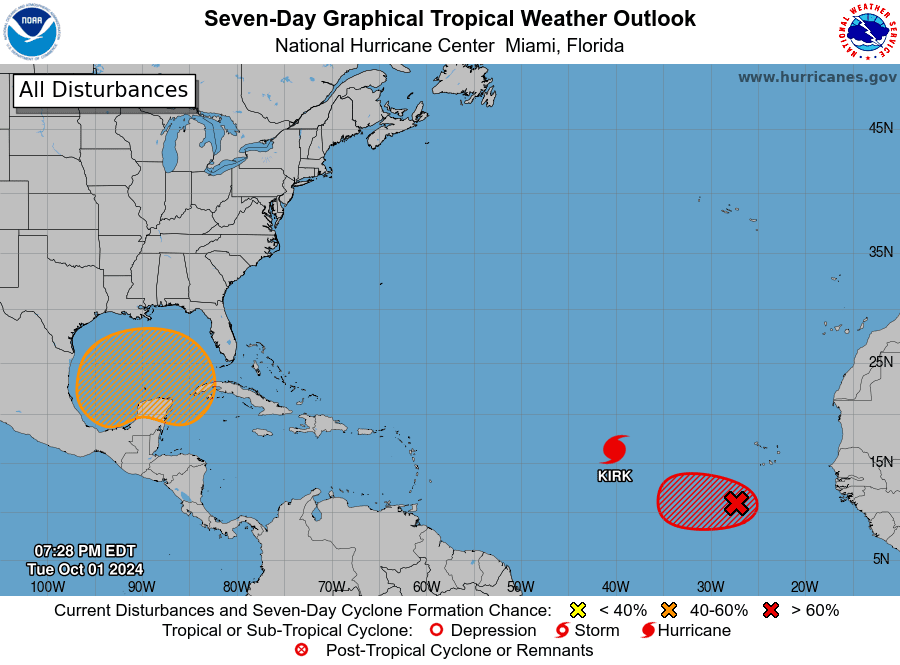
The National Hurricane Center is monitoring several areas regarding cyclonic development, including Hurricane Kirk and two additional areas of possible intensification. (Photo courtesy NHC and NWS)
The National Hurricane Center is watching active areas of cyclonic development across the Atlantic Basin, including Hurricane Kirk in the Atlantic and two additional disturbances that have a chance of strengthening over the next seven days.
Kirk, a tropical cyclone that formed in the Eastern Atlantic on Monday and intensified into a hurricane on Tuesday, is expected to become a major hurricane later this week. Fortunately, the latest forecast track keeps the system out to sea and away from landmass.
Another tropical wave called Invest 91L, located behind Hurricane Kirk has a high chance of development over the next seven days, and a tropical depression is likely to form in the next couple of days. Currently, most computer forecast models also show the cyclone passing to the northeast of the USVI, but this is not guaranteed, and the storm track will become more evident in the coming days. (An “invest” is an area under investigation by the NHC for possible cyclonic development.)
The National Weather Service in San Juan, Puerto Rico, has noted that powerful swells generated by the two tropical disturbances may create rough seas across the local waters later this week.
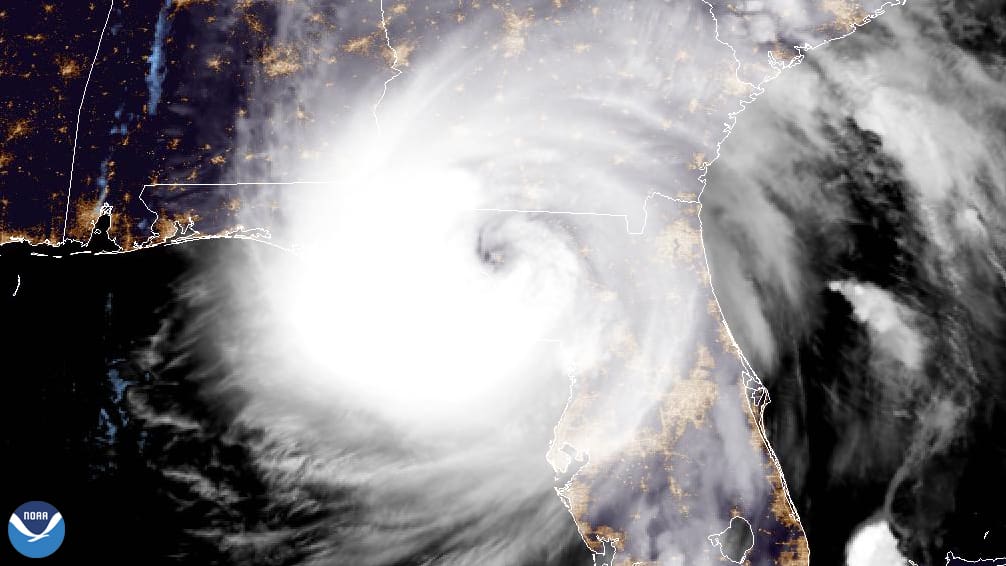
Major Category 4 Hurricane Helene made landfall over the Big Bend region of Florida on Sept. 26, 2024, causing catastrophic damage across the southeastern U.S. (Photo courtesy NOAA)
The 2024 Atlantic Hurricane Season has already been busy, and the remainder of the season, which officially ends on Nov. 30, is forecast to continue to be active.
Hurricane Season Expected to Remain Active
The Source contacted Matt Rosencrans, NWS lead hurricane seasonal forecaster, to obtain an update on what may occur regarding tropical development for the rest of the season. Rosencrans explained that meteorologists anticipate additional cyclones forming across the Atlantic and Caribbean.
“[Tropical] development is expected to continue through October,” Rosencrans stated. “The latest outlooks continue to indicate enhanced odds of tropical storm formation in the Western Caribbean and even higher odds out in the central and eastern Main Development Region (MDR) [which is an area of the Atlantic located between the west coast of Africa and the Lesser Antilles] through the next couple of weeks,” he said.
“Typically, [cyclonic] activity does ramp down quickly in the latter half of October, but during La Niña years, activity can extend further, [and] typical La Niña years have double the activity of El Niño years during November,” Rosencrans added.
During a La Niña cycle, the ocean waters across the equatorial Pacific Ocean cool significantly, affecting global weather. During La Niña, wind shear – a change in wind direction and velocity with height in the atmosphere – also typically decreases in the Atlantic Ocean. A reduction in wind shear can favor cyclone development. This pattern is the opposite of “El Niño,” a warming of the equatorial Pacific, which usually increases wind shear in the Atlantic Ocean, helping to rip apart storms and preventing hurricane formation and intensification. A cycle of El Niño has been occurring since June 2023.
“Scientists call [the two opposing climate patterns of El Niño and La Niña] the “El Niño-Southern Oscillation” (ENSO) cycle. El Niño and La Niña can both have global impacts on weather, wildfires, ecosystems, and economies,” according to NOAA.
Rosencrans explained the current chances of a La Niña developing, which has been predicted to occur for months.
“La Niña is favored to emerge [between] September [and] November [with a] 71 percent chance,” Rosencrans stated. “Some [of the] measures [that have been recorded] of ocean temperatures already have [indicated] La Niña conditions, [while] others are borderline,” Rosencrans continued.
“Typical La Niña years have double the [amount of tropical] activity of El Niño years during November,” he said. “Coupled with the warmer [than average] waters of the Atlantic, we are likely to have a more active October and November than in past years.”
Climate Prediction Center Anticipates More Cyclones
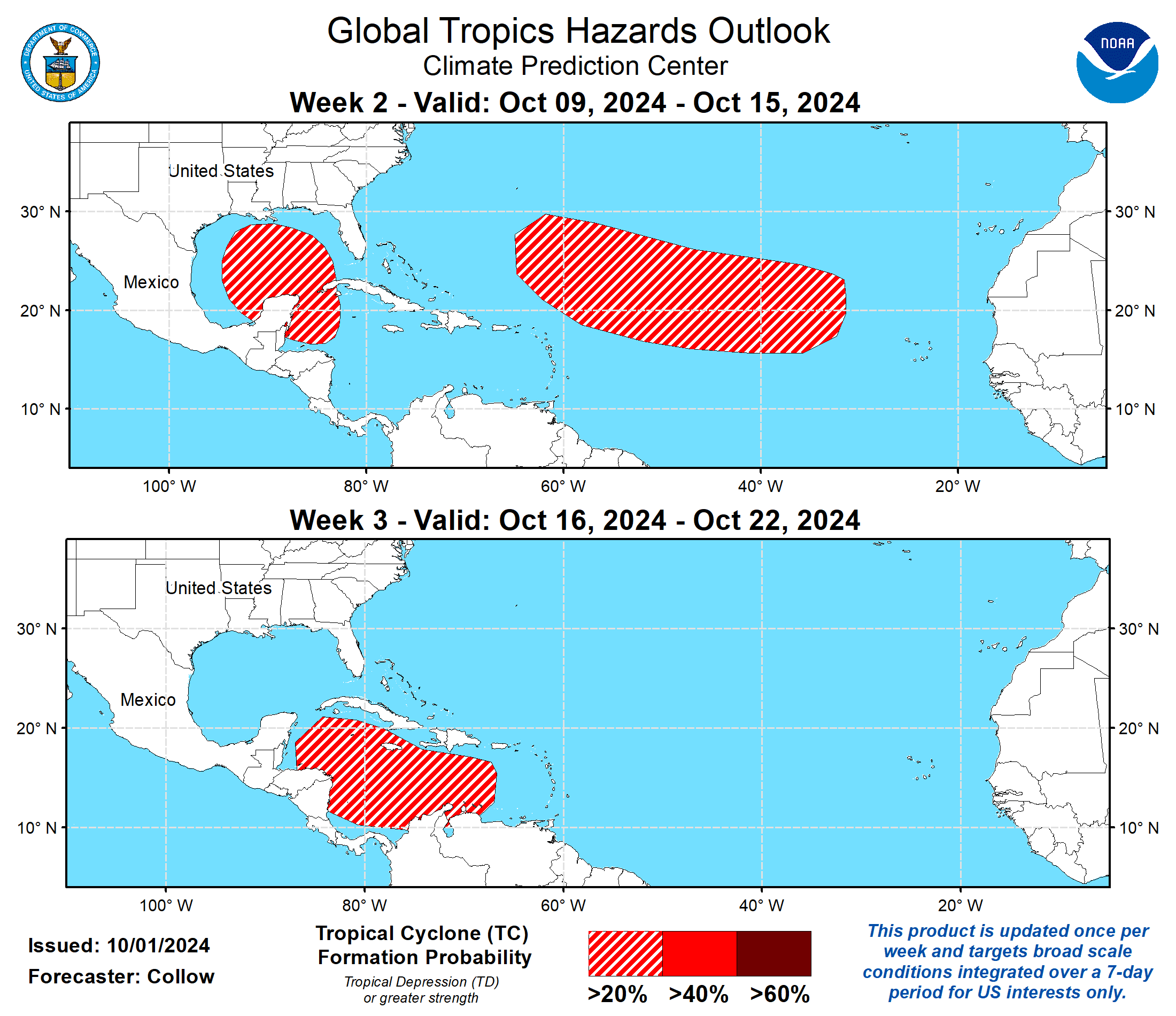
The Climate Prediction Center’s Global Tropics Hazard Outlook calls for an increased potential for cyclonic development over the next couple of weeks. (Photo courtesy CPC and NOAA)
“Tropical Storm Kirk [which has now intensified into a hurricane] developed on Sept. 29 and is forecast to become a powerful hurricane over the open waters of the Atlantic,” according to the CPC. “The easterly [tropical] wave behind Kirk is strongly favored to develop into a tropical cyclone during [the period of Oct. 2 through Oct. 8],” the CPC said. “The NHC continues to monitor a tropical disturbance over the northwestern Caribbean that may develop into a tropical cyclone during [the same period or slightly later in the month],” the CPC continued.
“While tropical cyclone development in the MDR is favored to slow down due to the October climatology along with a more suppressed convective environment aloft, it is plausible to get an additional easterly wave to spin up into a tropical cyclone given how active it has been recently, favoring 20 to 40 percent chances for tropical cyclone development [from Oct. 9 through Oct. 15] over the MDR,” the CPC explained. “[From Oct. 16 to Oct. 22,] tropical cyclone development is most favored in the Caribbean, where a 20 to 40 percent chance is [expected], the CPC noted.
Remain Prepared Through Hurricane Season
“The hurricane season runs through Nov. 30, and in busy years, [storms can form] even beyond [the end of November],” Rosencrans warned. “[Therefore,] staying prepared will be key to helping stay safe,” he added.
“Hurricane Helene reminded us that we all need to stay prepared [for disasters], even those inland or at higher terrain, as hurricanes can impact [individuals] in many ways [and across many areas],” Rosencrans concluded.
Tyler Smith, 35, also known as Tyley Smith, was sentenced on Sept. 30 to 30 years in prison for the June 2021 homicide of 58-year-old Nancy Nieves, V.I. Attorney General Designee Gordon C. Rhea announced Tuesday.
V.I. Superior Court Judge Alphonso G. Andrews Jr. sentenced Smith, whose attorney had
requested a sentence of just 10 years. Smith had previously entered a plea to murder in the second degree on July 22 on the eve of trial, according to the release.
In the early morning hours of June 2, 2021, the body of an unknown woman was found by
the side of the road in Estate St. John, St. Croix. Her injuries were so severe that she had to be identified through the use of DNA. Detectives from the Virgin Islands Police Department began the process of gathering evidence. Smith, however, left the territory shortly after a search warrant was executed at his residence. A warrant was issued for Smith’s arrest in February 2022. Law enforcement tracked Smith to Ankeny, Iowa and then to California, where he was captured in April 2022. Evidence against Smith included video of him following Nieves as she walked along the road, as well as Smith’s DNA under the fingernails of Nieves, the press release stated.
Ceestra Burgess, 23, of Irvington, New Jersey, was charged with conspiracy to possess with intent to distribute narcotics and possession with intent to distribute narcotics, United States Attorney Delia L. Smith announced.
According to court documents, on Sept. 27, Burgess arrived on St. Croix on a
Spirit Airlines flight from Fort Lauderdale. During an inspection of Spirit Airlines luggage, a
Customs and Border Protection canine alerted to the presence of narcotics in Burgess’ checked bag. The luggage was then placed on the baggage claim carousel and later removed by Burgess. A search of Burgess’ luggage revealed several vacuum-sealed packages wrapped in Christmas paper, which contained approximately 12 kilograms of marijuana. If convicted, Burgess faces a maximum penalty of five years in prison. A federal judge will determine any sentence after considering the U.S. Sentencing Guidelines and other statutory factors.
Danny Dennevil, 34, of Tortola, British Virgin Islands, will remain in federal custody pending trial on charges related to a human smuggling operation. On September 26, 2024, Dennevil was charged with illegally bringing aliens to the United States and failure to heave to law enforcement, United States Attorney Delia L. Smith announced.
According to court documents, on Sept. 25 at approximately 7 p.m., Customs
and Border Protection Air and Marine Operations and United States Coast Guard officers
intercepted a vessel crossing the international border from the BVI into United States territory. The unlit vessel, operated by Dennevil, traveled from Tortola, BVI, to Leinster Bay, St. John, where it offloaded two individuals on the beach. Dennevil immediately departed Leinster Bay and headed back towards Tortola. Officers were forced to disable Dennevil’s vessel after he refused to comply with orders to stop the vessel. Thereafter, officers detained Dennevil and two Dominican Republic nationals who were found on the Leinster Bay trail. Dennevil later admitted to the officers that he smuggled the two Dominican nationals from Tortola to St. John, knowing that it was illegal for him to do so. United States Magistrate Allan Teague detained Dennevil and the two Dominican nationals following today’s detention hearing.
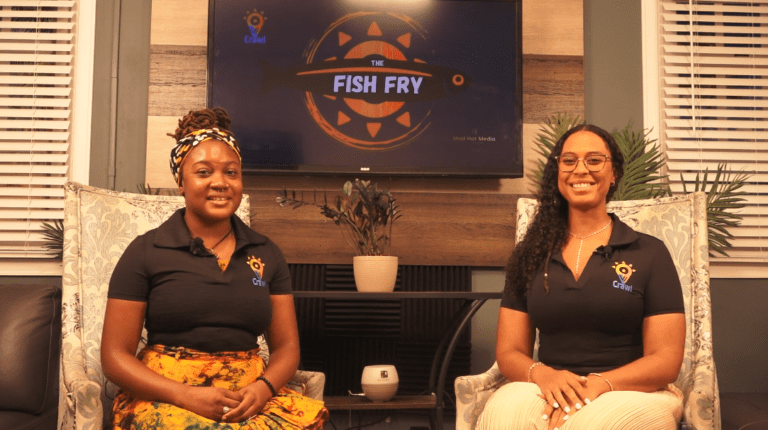
Fish Fry host Imani Daniel sits down with Sen. Alma Francis-Heyliger to share her views on pressing community issues, kicking off this exciting third season. The Fish Fry is produced by The VI Crawl, and powered by Mad Hot Media and the Virgin Islands Source – catch new episodes on Tuesdays, Thursdays and Saturdays this October.
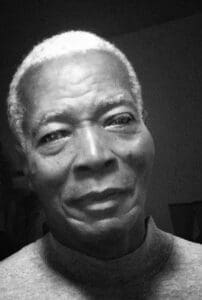
He was preceded in death by his mother, Edith Tuitt; father, Nicholas Cook; brothers: Sylvester, Michael and Lincoln Daly; and sisters: Olive “Brownie” Laudat, Ina Ann Tuitt-Pieters, Vera Tuitt, Linda Daly and Maudelin Daly.
He is survived by his spouse, Rosetta M.M. Tuitt; daughter, Valencia Vanessa Tuitt; son, Lennox Nathaniel Tuitt; grandson, Chad Nequan Joseph Tuitt; great-granddaughter, Seriyah Tuitt; brother, Phillip (United Kingdom); sister, Mary Harris; aunt, Josephine White; uncle, the late Brother Rainey; and nieces:Sharon Laudat (New York), Valarie Tuitt (St. Croix) and Nurse Brenda Daly (Montserrat).
He is also survived by nephews:Emerson Malcolm Tuitt and family (Hawaii), Sydney Knight and family (Canada), Rudolph (Rudy) Pieters, Joseph Craig Hepburn (United Kingdom), Bertand Daly and family (United Kingdom), Studley Daly and family (United Kingdom), Brendon Tuitt (United Kingdom), Elvin Daly and family (Antigua) and cousins: Chris Weekes and family (Montserrat), Children of the late Pastor Kingsley Meade, Nymphus Meade, Luke Meade and Ruel Tuitt.
Other survivors include special friends: Bert Daly and Ernie Daly (New York), the entire Harris Community of Montserrat, West Indies, Blondina Meade and family, Carol Richardson and family, Esperanza Frances and family, Ernie Sweeney and family, Eunice Hurdle, Beverly Andrews and family, Sacky and family, Mr. Connor and family, Mr. George and family, Mr. Alphonso and family, Monica Sadoo and family, Hovensa family and Flemings transport family; family; friends and other relatives and loved ones too numerous to mention; as well as Cardy and family, Mr. John Woodson, Mr. Mack, Mr. Sam Taylor and family, Rev. Edwards and family; and well as aliases: Barry Cooks, Montserrat, Yankee, Tom and Spree Boy.
The viewing will be held from 4:30 p.m. to 5:30 p.m., Friday, Oct. 4, at Kingshill Funeral Home Chapel, Clifton Hill, 303 Kingshill St. Croix. The funeral service will be held from 9 a.m. to 10 a.m., Saturday, Oct. 5, at Ebenezer Methodist Church, Estate Richmond. Interment will be at Kingshill Cemetery.
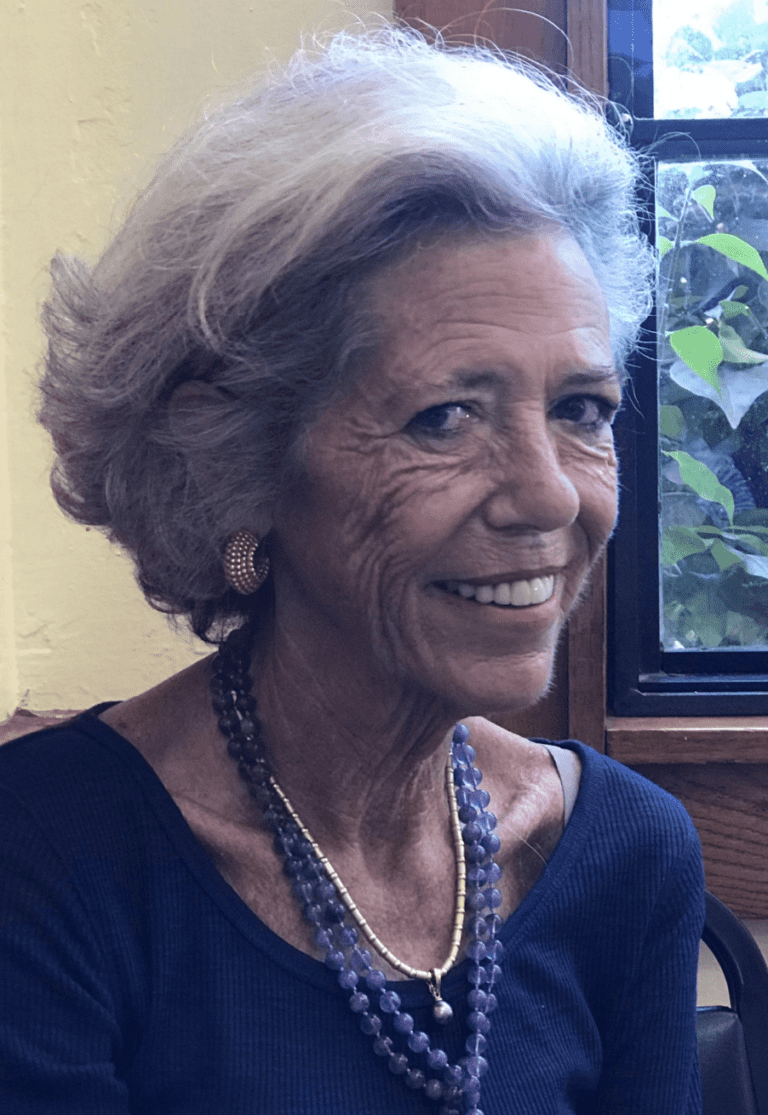
On Sept. 10, Courtney Brown Gabrielson was gathered into the Universe.
Courtney was born in Tokyo, Japan, on April 29, 1954, to his father, Alston Law Brown, a career Air Force officer who was a Japanese linguist serving in Japan after World War II as the assistant air attache to help re-establish that country’s Air Force, and his mother, Jean Jorgensen Brown, who was working for the English language Asahi Evening News as a reporter.
In 1961, recently widowed Jean moved Courtney and her three sisters, Derryle, Brooks and Tracy, to St. Thomas. She attended Antilles School, graduated from Oakwood Friends School in Poughkeepsie, New York, in 1972 and attended Denver University until returning to St. Thomas in 1976.
She worked in the family business Caribbean Travel Agency/Tropic Tours, and, except for a time while owning and managing the Frenchtown restaurant Portofino, became the president/CFO. She was married to Ron Gabrielson, who was the owner and trainer at Tropic Training on Solberg until he died in 2016, and has one son, Egon Gabrielson.
She worked tirelessly in the family business, established in1961 by Jean, along with her sisters and many long-time co-workers who through the decades were considered family members as well.
In 2020, following changes within the travel and tourism industries, multiple hurricanes with constant rebuilding and a decline in her health, Courtney reluctantly decided to leave her beloved St. Thomas and its people and friends to move to Venice, Fla. Without the care provided by family and longtime St. Thomas friend Lisa Berger, she may have left us earlier, but Courtney was formidable in her unwavering courage, spirit and acceptance of things to come, always with a smile and love for those around her.
Courtney is preceded in death by her father Alston Brown; her mother, Jean Brown Hendricks; stepfather, Jens Hendricks; sister, Brooks Brown; and husband, Ron Gabrielson. She is survived by her son, Egon Gabrielson, his wife, Beth, and their two children: daughter, Charlie and son, Bohdi; her sisters: Derryle and her husband David Berger and Tracy Brown and her husband, Tom Wiggins; and special friends: Lisa Berger and Suzy Berecz.
Her many friends and her family will always remember Courtney for her intelligence, warmth and irrepressible sense of humor. She was a joy to know and will be sorely missed.
An announcement of a celebration of the lives of Courtney and Brooks to be held on St. Thomas will be provided at a later date.
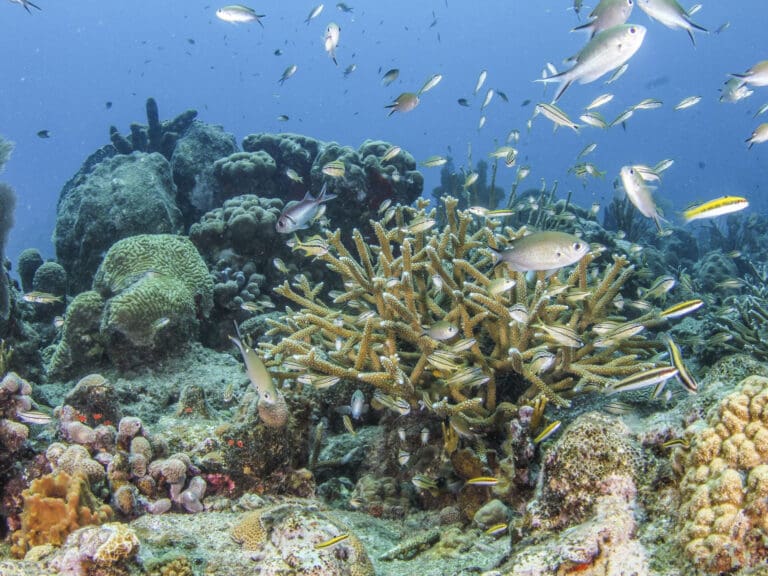
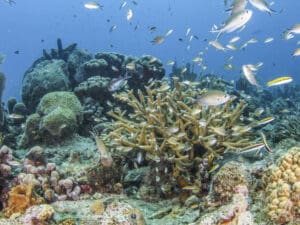
Coral in St. Croix, Virgin Islands (photo by John Melendez)
The U.S. Department of the Interior’s Office of Insular Affairs has awarded a grant of more than $406,000 to The Nature Conservancy in the U.S. Virgin Islands This funding will directly support coral restoration efforts in historically mined areas around St. Croix, a practice that once removed large sections of reef and left habitats struggling to recover.
“This grant will allow us to increase the success of our current coral restoration efforts through targeting resilient coral stock to add to our resources,” said Jessica Ward, Virgin Islands Coral Program director. “The project will focus on the identification and use of resilient corals in our restoration work that is essential to increasing reef health and resistance to impacts like disease and climate change.”
For three centuries, coral mining removed large amounts of living coral from the reefs around St. Croix in order to build the coral stone buildings of Christiansted, Frederiksted and the more than 150 windmills used to process sugar cane. Removal of the coral leads to habitat loss for marine species and weakens the overall health of the reef. These damaged ecosystems have faced slow recovery and are facing the increasing threats of the climate crisis, including bleaching and other coral-related diseases.
As coral reefs are integral to the health of the marine environment, tourism, fisheries and shoreline protection in the U.S. Virgin Islands, this award represents a long-term investment in both the environmental and economic future of the region.
“The grant allows us to bolster the long-term success of our restoration efforts, ensuring the reefs can continue to support marine life, protect coastlines, and recover at a faster rate than before,” said Matt Davies, field project supervisor. “These funds will also support the establishment of a coral gene bank, to safeguard the survival of diverse genetic lineages. We are excited by this opportunity to enhance our restoration work while continuing to develop local capacity to support a sustainable future for the coral reefs and communities of St. Croix.”
As one of the first areas of the Caribbean where The Nature Conservancy began its coral restoration work, USVI’s efforts have been pivotal to rebuilding damaged reefs. By partnering with local stakeholders, scientists and federal agencies, the team’s ongoing commitment is essential for a healthy ocean and its reefs that act as natural barriers, protecting coastal communities from storm surges and erosion, and enhancing their resilience to ongoing climate-related stressors.











Op-Ed, Part 6: Belize Adventure Takes Hikers High Into the Mountains
Editor’s Note: This is Part 6 of a series by Olasee Davis on the St. Croix Hiking Association’s recent trip to Belize. Read Part 1 here, Part 2 here, Part 3 here, Part 4 here, and Part 5 here.
This is the sixth in my series on the St. Croix Hiking Association’s adventures in Belize, one that hikers will never forget due to our emotional connection with the Mayan people, the hiking, and camping in the mountains. That morning at Pals on the Beach hotel in Dangriga, we ate breakfast and packed our backpacks with hiking gear, sleeping bags, bug spray, and other camping equipment for an overnight camp in the mountains of the Tiger Fern Cockscomb Basin Wildlife Sanctuary. Believe me, that morning everyone looked forward to visiting the sanctuary. It would be the adventure of all adventures, especially camping in the mountains and exploring the wildlife sanctuary trails, waterfalls, and animal life.
In 1984, Cockscomb Basin Wildlife in Belize was declared a forest preserve. Later, the forest preserve became known as the Cockscomb Basin Jaguar Preserve, which was established in 1986. It was the world’s first sanctuary for jaguars, the largest cat in the Americas. The preserve was created after wildlife biologist Dr. Alan Rabinowitz discovered a large population of jaguars in the Stann Creek district, the south-central mountain range of Belize. The wildlife preserve has grown from 3,600 acres to over 125,000 acres of primarily rainforest with an annual rainfall of 100 to 150 inches of rain per year.
Besides jaguar protection, the wildlife sanctuary is home to other mammals such as cougars, monkeys, otters, wild pigs, deer, tapirs, ocelots, and more. There are more than 300 different species of native and migratory birds including parrots, hawks, toucans, and the majestic scarlet macaw, which became extinct on St. Croix hundreds of years ago. The wildlife sanctuary is also home to a very large number of insects, frogs, toads, snakes, bats, and many others.
The dominant tree species in the reserve are cedar and mahogany with dense and thick vegetation that includes orchids, bromelias, and other jungle forest vines. There are many trails and several waterfalls to visit. The sanctuary is well established with cabins, running water, a visitors’ center, museums, pavilions, and many other facilities, such as a research lab for wildlife and forest studies.
When we got to the wildlife sanctuary headquarters from our long drive, we were greeted by staff members informing us of our activities for the next day and a half in the wilderness, and the surrounding Mayan village communities. After we ate lunch, hikers were separated into groups. Some would be hiking to the mountains to an overnight camp with tents and hammocks, and others would be staying in the cabins at the wildlife sanctuary facilities. Ben, a wildlife biologist and Maya descendant was our tour guide to the mountains with two other helpers. We took the Jaguar Trail, which started off level, and eventually we began to climb. As Ben began to talk about the forest, conservation, and the history of the site, it was interesting, especially about wildlife in the area and how the area became a sanctuary for the preservation of jaguars, other wildlife and the natural and cultural resources of the site.
As Ben continued, he spoke about his people who once lived for thousands of years in the area, practicing traditional conservation and their way of life in the forest. What touched our hearts was when Ben mentioned how the government kicked his people off their own land. “What! You mean the government kicked your people (Mayans) off the land?” He went a step further by sharing, the government gave them 90 days to move off their land so the wildlife sanctuary could be expanded.
Believe me, that touched our hearts. As hikers we felt a connection with the Mayan people not just physically and because of what happened to them with their land, but also spiritually and emotionally. As a result of the force of action, the Mayan people in that area have become squatters. Even Ben himself, who lived not too far from the wildlife sanctuary headquarters. No other lands were set aside for them by the government, according to Ben.
Before we knew it, we arrived on top of the mountain. Oh, what beauty to behold almost touching the heavenly sky. It was a spectacular 360-degree panorama view on top of the mountain. In the distance, we saw Victoria Peak, the second-highest mountain in Belize of over 3,675 feet above sea level. For those of us who would be camping for the night, the mountain was going to be our temporary home. Before nightfall, we explored the two waterfalls in the mountains. I tell you, what a hike! It was a deep valley hiking down and you’d better hold on for your life. At times, your foot felt like it wanted to give away. There were cliffs along the way with a rope to hold on to. In some parts of the trail, there were steps. The trail to the waterfalls was more difficult than hiking to the mountain. You had to keep your balance and weight on your way down to make sure you didn’t tumble down into the valley. As seasoned hikers, we love challenges like this.
At last, we heard the water running down into the pools of the waterfalls. Eventually, we arrived at the falls. Believe me, it was a journey hiking down into the valley. Imagine coming back up! Oh, God help us! Once we saw the waterfalls, it was heaven on earth. We forgot all about how hard it was coming down into the valley. How can I describe the waterfalls for you?
It was billions of gallons of water flowing from steep slopes high on cliffs over a vertical drop or a series of steep drops falling into a clear crystal pool of water and running over rocks into the river. The adventure of a lifetime in nature at Cockscomb Basin Wildlife Sanctuary on the mountain top begins in the last of the series that is coming up next.
— Olasee Davis is a bush professor who lectures and writes about the culture, history, ecology and environment of the Virgin Islands when he is not leading hiking tours of the wild places and spaces of St. Croix and beyond.