Home Blog Page 405

Governor Issues Statement Defending Public Official Pay Raises

0

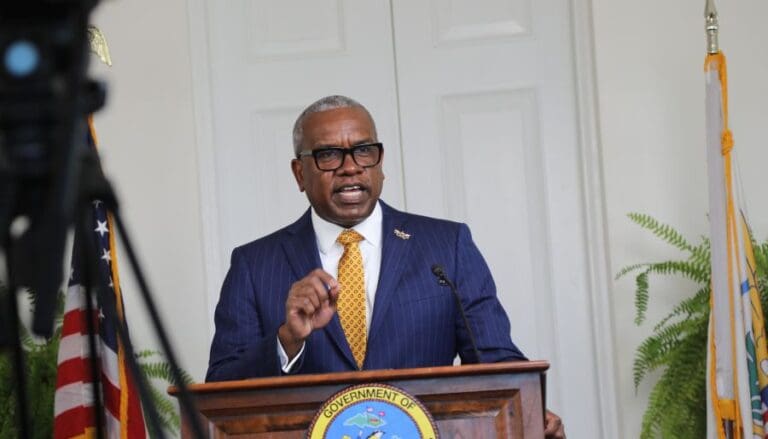
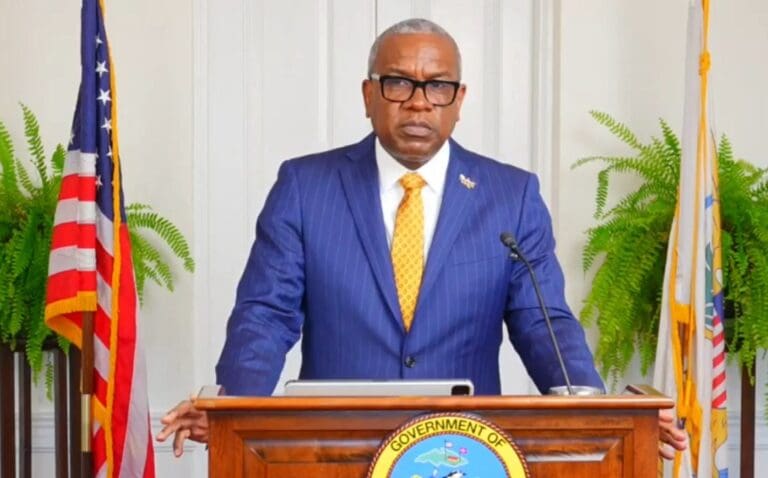
Gov. Albert Bryan Jr. on Wednesday issued a statement pushing back against calls to rescind recent pay raises for top government officials, defending the process as legal and transparent and criticizing attempts to discredit the independent commission behind the recommendations.

The statement comes amid continued scrutiny over salary increases that took effect on Jan. 1, following a report submitted by the Virgin Islands Public Officials Compensation Committee. The raises were implemented after a 90-day period passed without legislative action, as outlined in law, though the timeline, transparency of the process, and the role of the executive branch remain points of debate.

The governor’s full statement is below:

“The issue of public official compensation has long been a difficult and often contentious subject, which is why the Legislature chose to establish an independent body to take on the responsibility of addressing it fairly and transparently.

Through Acts 7878 and 8384, the Legislature created the Virgin Islands Public Officials Compensation Committee and clearly outlined the roles and responsibilities of all branches of government in the process. The law also provided the Legislature with the authority to accept, amend, or reject the Committee’s recommendations. At the same time, it included a provision – added through amendment – that allowed those recommendations to take effect automatically if the Legislature took no action within 90 days. That provision was not imposed by the executive branch. It was drafted and passed by the Legislature.

I believe in accountability, transparency, and following the law. In this case, the law was followed exactly as written.

What is disappointing is that this matter has drawn attention away from the work this administration is doing every day to improve the lives of Virgin Islanders. We are tackling long-standing challenges, advancing infrastructure projects, expanding access to affordable housing, and keeping our commitment to pay long-overdue retroactive wages. That is where our focus should remain.

It is equally disheartening to hear commentary that seeks to discredit the process and question the integrity of those who served on the Commission. The law called for nine members to be appointed – three by the Governor, three by the President of the Legislature, and three by the Chief Justice of the Supreme Court. These were Virgin Islands professionals who answered the call to serve in a process created to rise above politics. They carried out a difficult and thankless task, and their work should be respected. The Commission completed its report, submitted it to the legislature on Aug. 13, 2024, in accordance with the law, and the legislature took no action within the time period mandated. Up to that point, there was no involvement from the Office of the Governor.

There have also been unfair attempts to politicize the appointment of Dr. Haldane Davies, one of the Commission members, who now serves in this administration. Based on his educational background, work ethic, leadership qualities and professional experience, Dr. Davies was selected to fill the vacant position of Director of the Bureau of Economic Research. Notably, these same professional qualifications are exactly the reason he was chosen in 2022 by the then-senate president to serve on the compensation commission.

The entire purpose of creating the VIPOCC was to prevent the kind of political maneuvering that occurred in 2006 with the passage of Act 6905, when the Legislature increased salaries for the Governor by $70,000; the Lieutenant Governor by $50,000, and its own members by $20,000 without public input or independent review. That moment called for reform, and the VIPOCC was the Legislature’s solution.

To now turn away from that reform and cast doubt on those who served in good faith is a step backward and suggests that we are willing to go back to a process that brought about Act 6905. It reflects a reluctance to take responsibility and a willingness to erode public trust for political convenience.

I remain committed to doing the work the people elected me to do. That includes standing by the laws we enact, defending the integrity of public servants who serve with honor, and continuing to move the Virgin Islands forward through action, not distraction.”

Older Americans Take the Floor in Mock Legislative Session

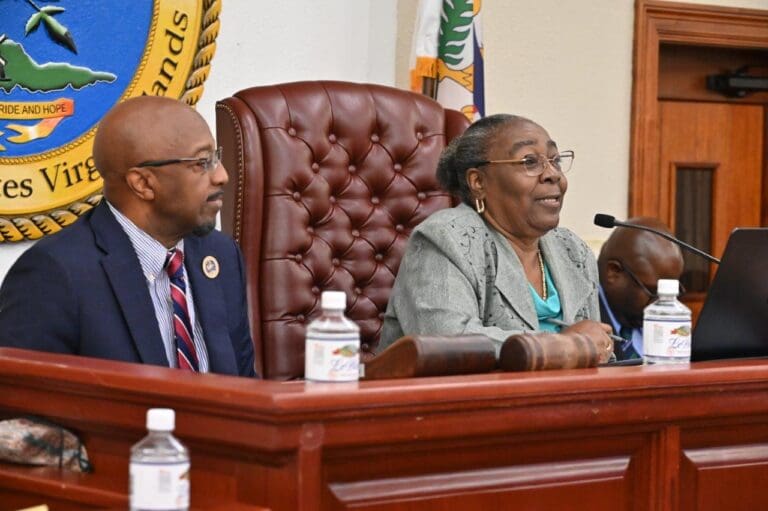
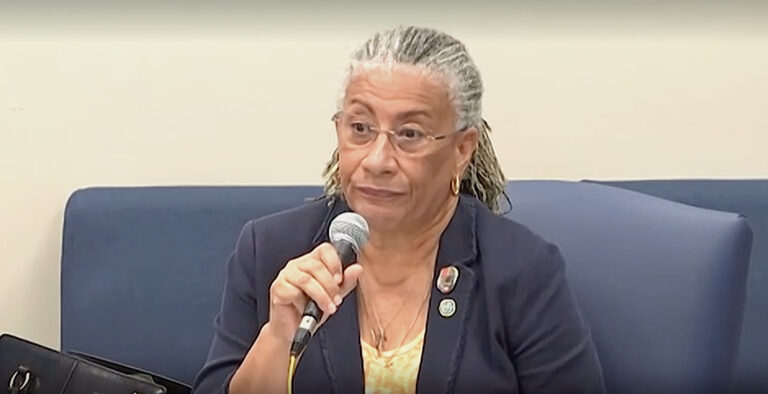
Lydia Lettsome portrayed Senate President Milton Potter at Wednesday’s mock legislative session. (Photos by Delta Malone and Barry Leerdam, Legislature of the Virgin Islands)

The 36th Legislature of the Virgin Islands hosted a mock legislative session Wednesday in honor of Older Americans Month, giving senior citizens the opportunity to step into the role of lawmakers and vote on a bill designed to improve accessibility in public buildings, a press release announced.

The event, held at the Earle B. Ottley Legislative Hall, was led by Senate President Milton E. Potter and featured 23 older residents acting as senators, legal personnel, and support staff. Participants deliberated and passed Bill No. 36-0000a, which amends Title 29 of the Virgin Islands Code to require adequate access and designated resting areas in public buildings for senior citizens and physically disabled individuals. The measure was sponsored by Potter, according to the press release.

“This mock session is a testament to lifelong civic engagement,” Potter said in a statement.

The session commemorated the origins of Older Americans Month, which dates back to 1963, when President John F. Kennedy met with the National Council of Senior Citizens to designate May as a month of recognition. At the time, nearly one-third of Americans over 65 lived in poverty. The celebration was later renamed after the passage of the Older Americans Act in 1965, the press release stated.

The seniors who portrayed members of the 36th Legislature included:

  • Mary Harley (acting as Sen. Marvin A. Blyden)
  • Jeanette Smith Barry (acting as Sen. Carla J. Joseph)
  • Wilma Phillip (acting as Sen. Dwayne M. DeGraff)
  • Lydia Lettsome (acting as Sen. Milton E. Potter)
  • Rosalia Payne (acting as Sen. Alma Francis Heyliger)
  • Esther Merla Phillips (acting as Sen. Ray Fonseca)
  • Gwenavire Hyndman (acting as Senator-At-Large Angel L. Bolques, Jr)
  • Celia Hermon (acting as Sen.Avery L. Lewis)
  • Clefrin F. Delande (acting as Sen. Novelle E. Francis Jr.)
  • Iva Brandy (acting as Sen. Marise C. James)
  • Phillipa Smith-Tyler (acting as Sen. Kenneth L. Gittens)
  • Geneva Rodriguez (acting as Sen. Franklin D. Johnson)
  • Pearl Flax (acting as Sen. Clifford A. Joseph, Sr.)
  • Eloi Sylvester (acting as Sen. Hubert L. Frederick)
  • Merlene A. Felicien (acting as Sen. Kurt Vialet)
  • Gladys Jurgen (acting as the Post Auditor)
  • Maxine Fleming (acting as the Legal Counsel)
  • Edna Freeman (acting as the Journal Clerk)
  • Urline Lettsome (acting as the Stenographer)
  • Lillian Garfield (acting as the Archive Clerk)
  • Janet Smalls (acting as the Timekeeper)
  • Barbara Heyliger & Lloyd Watts (acting as the Sergeants at Arms)
  • Father Anthony Abraham (acting as the Chaplain)
  • Lynett Fahie (acting as the Page)
  • Delta Malone (acting as the Photographer)

Senators present at today’s mock session included Sens. Milton E. Potter, Kenneth L. Gittens, Marvin A. Blyden, Angel L. Bolques Jr., Dwayne M. DeGraff, Novelle E. Francis Jr., Hubert L. Frederick, Ray Fonseca, Marise C. James, Avery L. Lewis, and Kurt A. Vialet.

Judge Declares Compliance on VIPD Consent Decree Heading ‘Towards the Home Stretch’

0
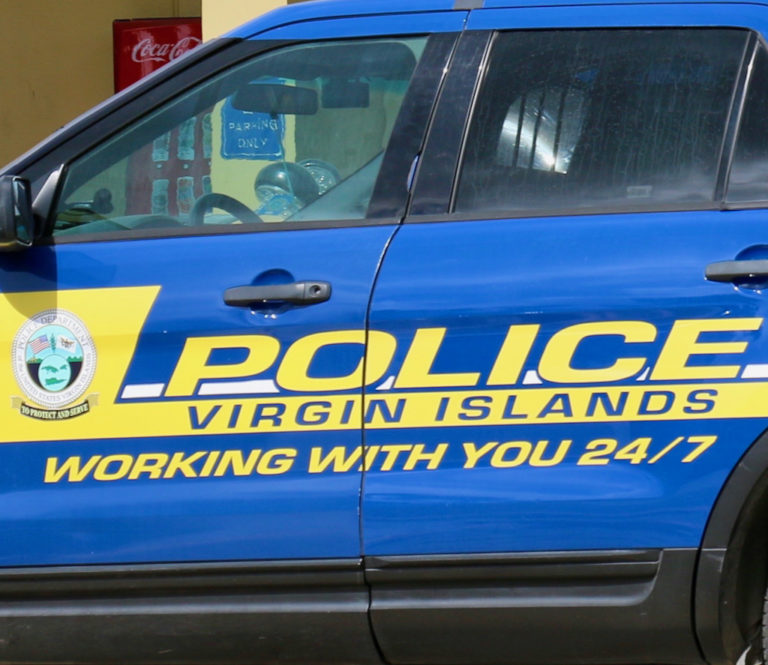
VIPD patrol car. (Linda Morland photo)
On Wednesday, Chief District Judge Robert Molloy declared VIPD’s efforts to resolve its consent decree heading toward “the home stretch.”. (Source file photo by Linda Morland)

Top officials of the Virgin Islands Police Department heard hopeful words from a federal judge Wednesday at the end of the latest hearing on a 16-year-old consent decree.

Chief District Judge Robert Molloy took testimony from VIPD officials tasked with overseeing compliance; he also heard from court-appointed experts who track the department’s progress in meeting the decree’s demands.

By the time Wednesday’s hearing was finished, the judge said he agreed with the assessment given by independent monitor Sydney Roberts.

Roberts said that if VIPD stays consistent in its current efforts, it “could reach substantial compliance by the end of this calendar year.”

Molloy asked witnesses and attorneys for the department and the U.S. Justice Department on resolving seven outstanding compliance matters raised in the last hearing held in March. Among those matters was resolving a backlog of use-of-force cases; resolving outstanding civilian complaints; improving reporting practices and timely follow-ups; and demonstrating the ability to forecast compliance stumbling blocks.

VIPD Internal Affairs Director Vivienne Newton and Deputy Police Commissioner Jason Marsh testified about steps taken to resolve those matters since the last hearing. Marsh heads the Professional Standards Division.

The judge stated that the department’s efforts, as evidenced at the hearing, had shown significant improvement. “It represents a substantial shift from where you were this time last year,” Molloy said, “We are on the home stretch.”

Officials from the U.S. Justice Department sought and won a consent decree against VIPD in 2009 after investigators pointed out a pattern and practice of police use of force against civilians. After nearly a decade of effort, the department won a substantial compliance declaration in December 2018, but failed to maintain that status for two years.

Since then, VIPD added an Office of Professional Standards and held a two-day consent decree compliance summit in December 2024.

Police Commissioner Mario Brooks praised the standards officers and overall department effort as a new declaration appears imminent.

“We are excited. This is the culmination of very good work by the Office of Professional Standards and the overall work by members of the VIPD. Our goal is to close out with substantial compliance at the end of the year and to ensure the performance of constitutional policing in the Virgin Islands,” Brooks said.

If that milestone is achieved and maintained for the required period of time, the federal court is expected to declare the matter resolved.

Governor Bryan Issues Statement on Calls to Rescind Wage Increases as Recommended by the Public Officials Compensation Process

Governor Albert Bryan Jr. today issued the following statement in response to public discussion surrounding the implementation of salary adjustments for public officials, as recommended by the Virgin Islands Public Officials Compensation Committee (VIPOCC):

“The issue of public official compensation has long been a difficult and often contentious subject, which is why the Legislature chose to establish an independent body to take on the responsibility of addressing it fairly and transparently.

“Through Acts 7878 and 8384, the Legislature created the Virgin Islands Public Officials Compensation Committee and clearly outlined the roles and responsibilities of all branches of government in the process. The law also provided the Legislature with the authority to accept, amend, or reject the Committee’s recommendations. At the same time, it included a provision—added through amendment—that allowed those recommendations to take effect automatically if the Legislature took no action within 90 days. That provision was not imposed by the executive branch. It was drafted and passed by the Legislature.

“I believe in accountability, transparency, and following the law. In this case, the law was followed exactly as written.

“What is disappointing is that this matter has drawn attention away from the work this administration is doing every day to improve the lives of Virgin Islanders. We are tackling long-standing challenges, advancing infrastructure projects, expanding access to affordable housing, and keeping our commitment to pay long-overdue retroactive wages. That is where our focus should remain.

“It is equally disheartening to hear commentary that seeks to discredit the process and question the integrity of those who served on the Commission. The law called for nine members to be appointed—three by the Governor, three by the President of the Legislature, and three by the Chief Justice of the Supreme Court. These were Virgin Islands professionals who answered the call to serve in a process created to rise above politics. They carried out a difficult and thankless task, and their work should be respected. The Commission completed its report, submitted it to the legislature on August 13, 2024, in accordance with the law, and the legislature took no action within the time period mandated. Up to that point, there was no involvement from the Office of the Governor.

“There have also been unfair attempts to politicize the appointment of Dr. Haldane Davies, one of the Commission members, who now serves in this administration. Based on his educational background, work ethic, leadership qualities and professional experience, Dr. Davies was selected to fill the vacant position of Director of the Bureau of Economic Research. Notably, these same professional qualifications are exactly the reason he was chosen in 2022 by the then-senate president to serve on the compensation commission.

“The entire purpose of creating the VIPOCC was to prevent the kind of political maneuvering that occurred in 2006 with the passage of Act 6905, when the Legislature increased salaries for the Governor by $70,000; the Lieutenant Governor by $50,000, and its own members by $20,000 without public input or independent review. That moment called for reform, and the VIPOCC was the Legislature’s solution.

“To now turn away from that reform and cast doubt on those who served in good faith is a step backward and suggests that we are willing to go back to a process that brought about Act 6905. It reflects a reluctance to take responsibility and a willingness to erode public trust for political convenience.

“I remain committed to doing the work the people elected me to do. That includes standing by the laws we enact, defending the integrity of public servants who serve with honor, and continuing to move the Virgin Islands forward through action, not distraction.”

Dinner with a Doctor: Measles Preparedness

In response to a rise in measles cases across the United States, Schneider Regional Medical Center (SRMC) is taking proactive steps to prepare for the potential of local transmission in the U.S. Virgin Islands.

Dr. Reva A. Richardson, MD Pediatrician and Internal Medicine, will present. (Submitted photo)

Measles is a highly contagious viral disease spread through coughing, sneezing, and close contact.

The virus can remain in the air or on surfaces for up to two hours. Infected individuals can spread measles before they even know they’re sick—typically four days before through four days after the appearance of a rash.

Measles can lead to severe complications, especially among:

Children under age 5

Adults over age 20

Pregnant women

Individuals with weakened immune systems

Serious health outcomes include pneumonia, encephalitis (swelling of the brain), hearing loss, and even death. According to the CDC, one in five unvaccinated people in the U.S. who get measles will require hospitalization.

As part of its public outreach, SRMC will host a Dinner with a Doctor event on Thursday, May 29, featuring Dr. Reva Richardson, Internal Medicine and Pediatric Specialist. Dr. Richardson will provide crucial information about measles symptoms, the importance of immunization, and SRMC’s local preparedness strategies.

Event Details:

Date: Thursday, May 29, 2025

Time: 6:00 PM

Location: SRMC Sunroom, 2nd Floor

Speaker: Dr. Reva Richardson

RSVP: Call (340) 776-8311 ext. 2286 or email socialmedia@srmedicalcenter.org

“SRMC is taking a proactive approach to ensure our community is informed and protected. This forum gives parents, caregivers, and residents the facts they need and the reassurance that SRMC is ready,” said Tina Comissiong, Esq., MPA, Chief Executive Officer of SRMC. “Dinner with a Doctor is part of our ongoing commitment to keeping our community informed and helping ensure their health and safety.”

For more information, visit www.srmedicalcenter.org

Summer Sewing Program at My Brother’s Workshop

0

Virgin Islanders 16-24 year old are invited to apply to MBW’s Summer Sewing Program!

Participants will learn foundational sewing skills such as threading needles and bobbins, measuring, cutting, ironing, sewing seams, seam ripping, and finishing. Participants will be paid during this program and will learn to sew product for MBW’s Paradise Point retail location.

Students will learn a variety of basic sewing skills and will be paid hourly to make sewn products for MBW’s retail store at Paradise Point.

PROJECTS INCLUDE: bookmarks, keychains, tea towels and bags
Space is limited

Dates: Monday – Thursday, June 23- July 18

Times: 8:30-11:30 a.m.

Address: 1-6 Estate Donoe

Op-Ed: Prevention Over Punishment: A Public Health Approach to Youth Violence in the USVI

Gun violence continues to be the leading cause of death among boys and young men in the U.S. Virgin Islands. It is a heartbreaking and urgent issue that touches nearly every family, school, and community. But to truly make a difference, we need to stop treating youth violence like an isolated “crime problem” and instead start addressing it for what it really is: a public health crisis.

According to the KIDS COUNT USVI Op-ED: The Biggest Threat to Our Youth? Gun Violence, 61% of all deaths among youth ages 16 to 24 in the USVI in 2023 were homicides. This rate is far above the national average. While other U.S. communities are also grappling with youth violence, our small islands are facing a particularly severe and deadly crisis. And this crisis does not begin with a gun in someone’s hand. It begins much earlier — with missed opportunities, broken systems, and untreated trauma.

The Root of the Problem

Many children in the USVI start off behind due to developmental and educational gaps, which have been highlighted in a number of our KIDS COUNT databooks and in our public, online KIDS COUNT USVI Data Dashboard. Because the territory does not have a universal, public early childhood education program, those children in lower-quality care environments may enter kindergarten already behind their peers. Without targeted support, those gaps widen year after year. By high school, many students are struggling academically and emotionally, with some choosing to drop out (for the past five years, an average of 143 students have dropped out of high school per year).

These young people, disconnected from school and often without access to steady work or support, become part of a group known as Opportunity Youth — those ages 16 to 24 who are not in school and not working. There are Bright Spots, too, which include incremental improvements for this age group in some domains. In 2023, for example, over 950 young people were reached through summer jobs and internship programs run by the Virgin Islands Department of Labor. Another 89 received mentoring, counseling, and paid job training through My Brother’s Workshop, a local nonprofit. These efforts matter, AND they only scratch the surface of what’s needed.

What a Public Health Approach Looks Like

If we really want to reduce youth violence, we need to look at it the way public health professionals look at other community-wide problems, like infectious disease or drug addiction. That means asking not just what happened, but why did it happen — and how can we prevent it?

Youth violence doesn’t just “happen.” It follows patterns; it reflects underlying emotional distress and unmet needs; and it is deeply influenced by things like poverty, family instability, neighborhood disinvestment, and a lack of mental health support.

In response, a public health framework offers a proactive, multi-level approach that focuses on prevention, early intervention, and systemic change.

Primary Prevention focuses on stopping violence before it starts. That means investing in early childhood education, supporting families, creating safe community spaces, and addressing poverty and inequality.

Secondary Prevention targets youth who are at risk of becoming involved in violence. Programs like mentoring, job training, conflict resolution, and school-based behavioral health support can help steer them in a different direction.

Tertiary Prevention helps those who have already been involved in violence to heal and build new lives. That might include restorative justice programs, trauma-informed therapy, and reentry support for those leaving juvenile detention or prison.

This is not about making excuses for violent behavior — it’s about understanding the conditions that allow it to grow and doing something to change those conditions. Because if we don’t, the cycle just repeats.

The Cost of Inaction

Youth violence has real and lasting consequences — not just for those directly involved, but for all of us. The ripple effects strain hospitals and mental health providers, keep neighborhoods on edge, and contribute to business closures and family relocations. These disruptions also shrink the size and strength of our future workforce. In short, youth violence weakens the very fabric of our community.

We also can’t ignore the emotional toll. Every young life lost is a tragedy, and every family grieving a son or brother is a reminder that we are failing to protect our most vulnerable.

A Call to Action: Invest in Data and Data-driven Strategies

There are promising strategies to address youth violence, reducing crime rates and improving outcomes in communities that have made long-term, coordinated investments. We’ve seen glimpses of that potential here in the Virgin Islands, too — in small programs, isolated initiatives, and individual success stories. But to understand what will work here, at scale, and for the long term, we need something foundational: accurate, timely, and detailed data.

Public health crises require real-time information to drive effective solutions. Just as we wouldn’t tackle an infectious disease outbreak without knowing where cases are rising and who’s most at risk, we can’t expect to reduce youth violence without a clear, data-informed understanding of the conditions that fuel it.

But even as we push for better coordination and smarter investments, we’re still missing a crucial piece of the puzzle: comprehensive, reliable data about our most vulnerable youth. We lack regular, detailed reporting on when, where, and why violent incidents occur — and on which interventions are actually making a difference. We need more robust tracking of key indicators in areas such as: youth involvement in the justice system, rate of school suspensions and dropout, unmet mental health needs, and challenges to accessing support services. Without this kind of consistent, actionable information, we’re operating in the dark — reacting after tragedy strikes instead of building systems that prevent it in the first place.

While different agencies collect information at various points in a young person’s life, that data is often fragmented, outdated, or incomplete. Gaps persist—especially when it comes to understanding the mental health needs of youth, their involvement in the justice system, and the support services they are (or aren’t) receiving. We often don’t know enough about where (and with whom) these young people live, what risks they face, or what protective factors might already be in place.

As part of the 2024 KIDS COUNT USVI Data Spotlight, we took a bold step — not just to share what we do know about Opportunity Youth, but also to name the critical data that remains out of reach. We highlighted the missing indicators that, if collected and shared consistently — such as demographic breakdowns from police and court systems — could help us better understand who is most at risk, and when and where interventions are most needed.

Addressing youth violence as a public health crisis demands this level of clarity. Without it, we can’t align resources, measure outcomes, or design solutions that respond to the real conditions our youth are facing. Filling these data gaps isn’t just a research goal — it’s a moral imperative.

— St. Croix Foundation’s KIDS COUNT USVI Team

Editor’s Note: Opinion articles do not represent the views of the Virgin Islands Source newsroom and are the sole expressed opinion of the writer. Submissions can be made to visource@gmail.com

Op-Ed: A Retirement Windfall for the Few, a Burden for the Many

Dear Editor:

Brilliant strategy: express outrage at a pay raise in front of the public to sell them on capping pensions at the current salaries of $150,000 and $125,000, all while quietly keeping the Governor and Lieutenant Governor’s fat pension checks ($120,000 and $100,000 annually) for the rest of their lives untouched. Masterclass in smoke and mirrors.

When it comes to retirement benefits, what’s legal is not always what’s fair. Today, we face a glaring injustice in how we compensate our public servants in retirement: elected officials are granted extraordinary pensions while ordinary government employees must labor under rigid, capped, and often insufficient rules.

In any democracy, public compensation—especially pensions funded by taxpayers—must reflect fairness and equity. Yet in the U.S. Virgin Islands, retirement laws are skewed to favor those at the top. Under current law, the Governor and Lieutenant Governor receive 80% of their salaries—$150,000 and $125,000, respectively—as an annuity for life after just eight years of service. No age requirement. No waiting period. Vesting for senators attaches upon completion of three (3) terms but receipt of the annuity begins at age 60. For the record, I opted out of the GERS at the beginning of my first term.

Compare that to our everyday public servants: teachers, janitors, clerks, and nurses. These workers must contribute to the Government Employees’ Retirement System (GERS) over decades, meet minimum age thresholds, and accept modest payouts—if the system remains solvent at all.

For example:

  • A Tier I employee earning $40,000 after 30 years of service receives $2,500 per month.
  • A Tier II employee with the same record receives $1,750 monthly.
  • A senator, after serving just six years at $85,000 annually, receives $1,487.50 per month
    beginning at age 60.
  • A lieutenant governor, after serving just four years at $125,000 annually, receives
    $4,167.00 per month. And after eight years, he receives $8,333.33 monthly.
  • A governor, after serving just four years at $150,000 annually, receives $5,000 per
    month. And after eight years, he receives $10,000 monthly.

The system sends a disturbing message: elected service is rewarded far more generously than the hard, often invisible work of keeping our communities running.

While our senators lecture the public about fiscal responsibility and accountability, they remain silent about the cost of this lucrative retirement perk under the current law. Let’s be clear: these gubernatorial pensions are not merely generous—they are outsized.

Imagine this: if a Governor and his Lieutenant Governor are elected at age 42 and serve two terms, they begin collecting at 50. If they live to 85, that’s $7.7 million in pension payments. Multiply that by multiple former governors and lieutenant governors, and the public cost balloons into the tens of millions. In January 2027, we may have four former top officials who served two terms eligible for a combined $440,000 annually in pensions—not counting those who served only one term which will take it over half a million! It’s the law and so they all must be paid for the rest of their lives. But continuing to funnel six-figure pensions to a small group of former officials while average workers worry about their future is not just unsustainable—it’s unjust.

Even more troubling is the potential for “triple-dipping.” A Virgin Islander could work in government from age 21, serve as a senator, then as governor—and retire with three pensions. It’s legal. But is it just? While at the Senate, he can receive his regular employee pension but if he was appointed as a judge after serving as a governor, he is ineligible to receive any gubernatorial pension benefits while serving as a judge. Make sense out of nonsense.

A Distraction Wrapped in a Pretext

Bill No. 36-0032 came before the Budget, Appropriations, and Finance Committee of the 36th Legislature on Friday, May 23, 2025. The bill proposes to cap the retirement annuity for the governor and lieutenant governor at their current salaries of $150,000 and $125,000, respectively—even if salaries increase in the future.

I gave the bill to my summer intern to analyze, and I posed this basic but essential question: What is the problem to be solved? The answer was simple—there is no problem.

The hearing on May 23rd was nothing more than a pretext. Before any substantive questioning began, three senators asked for points of information: Do the Governor and Lieutenant Governor pay into the Government Employees’ Retirement System (GERS) or the Elected Governors and Lieutenant Governors’ Retirement Fund? What is their contribution rate? And—have the raises been implemented? All these questions except the last are already codified in law (Title 3 § 718 and Title 33 § 3080). The hearing served one purpose: to confirm what many already suspected—that the Governor and Lieutenant Governor are indeed moving forward with accepting the raises recommended by the Virgin Islands Public Officials Compensation Commission (VIPOCC). Nothing more. This amendment does not improve our hospitals, fix our schools, pay our employees on time,
protect our children, care for our elderly, or ease the burdens of daily life for the people of this territory. It solves nothing but continues the practice of giving governors and lieutenant governors hefty pensions of $120,000 and $100,000 every year.

Suggesting that the salary increases should simply take effect after the next general election in November 2026 means two things: (1) you agree the VIPOCC’s proposed salary increases are legal, and (2) you have no objection to the Governor and Lieutenant Governor receiving salaries of $192,088 and $168,231, respectively. If the members of the Legislature truly believe that the increases are unlawful, the Legislature should act now to amend Title 3, Sections 1 and 31 of the Virgin Islands Code to reset the salaries to $150,000 for the Governor and $125,000 for the Lieutenant Governor. This is not just a legal correction—it is a moral and ethical one.

It’s worth noting that five years ago, five sitting senators were among those who amended the law that established the VIPOCC—an action taken despite no measurable improvements to the lives of our people, the conditions in our hospitals and schools, or the stability of payments to employees and vendors. Yet, the legislature chose to activate the VIPOCC in 2022, two years before the 2024 gubernatorial election.

And now, here we are again— less than two years before another gubernatorial election—and instead of prioritizing recovery, resilience, or reform, we are once again talking about salaries. Not the pressing needs of our community. Not accountability. Not better outcomes for Virgin Islanders. Just salaries.

We can either continue down this path of performative governance, or we can call this what it is: a distraction, wrapped in a pretext, designed to benefit the few at the expense of the many. Section 20 of the Revised Organic Act of the Virgin Islands empowers the Legislature to set the salaries and allowances of public officials—including the Governor, Lieutenant Governor, department heads, and Senators. Power is not something that is held, but something that is exercised. It’s an active process, not a passive possession.

The Moral and Fiscal Imperative

The current policy is morally indefensible and fiscally irresponsible. It reflects a system in which power protects itself and rewards its holders with benefits denied to those who perform the daily labor of governance. At a time when the Government Employees’ Retirement System faces financial instability, continuing to enrich high-ranking officials at this level is unsustainable and sends a damaging message to the public: those at the top make the rules to serve themselves, not the people.

I am not a career government employee, and I am acutely aware that I am a political outsider. I am not deeply embedded in the political elite, Virgin Islands institutions, or traditional power structures. I am a voracious reader and I love reading autobiographies and biographies. Like President Carter, I lack deep ties to political people and party. Like President Obama, I am new to the Senate and not part of the old Democratic Party order. And like Bernie Sanders, I have become an ideological outlier in the Senate; I received no support for my government candidacy bill that would allow government employees to run for office without having to take leave. This outsider/outlier status has proven to be both my strength and my burden. So for me, the most disturbing part is that legislators—particularly those who harbor ambitions of becoming Governor or Lieutenant Governor one day—are the ones protecting and perpetuating this policy.

They are voting to preserve a golden parachute ($120,000 and $100,000 for life) that they hope to claim in the future. It is a cynical and calculated move: pass laws today that will pay off tomorrow if they reach higher office. This is the definition of self-serving governance. This retirement policy is not about honoring public service. It is not just unfair; it is a prime example of self-dealing and political opportunism masquerading as public service. Our top elected officials are walking away with six-figure annual pensions for what amounts to eight years of work. Meanwhile, the regular government workers continue to pay into a system that may not be there when they retire. Their pensions are capped. Their retirement age is fixed. And their contributions are mandatory. The disparity is not only unsustainable—it’s immoral.

Reform Must Begin Now—Before the 2026 Election

I propose we reduce the gubernatorial annuity percentage of the salaries. Reducing the
percentage from 80% to 50% reduces the annual pension for both retired officials from $220,000 to $137,500. A savings of $82,500 yearly! Reduce it to 40% like the state of California and we save $110,000 every year!

Interestingly, in response to my proposal to reduce the percentage, when the sponsor of the amendment said that it would be “unfair” to reduce the pension for Governor Bryan because Governor DeJongh was collecting 80% of $150,000, I didn’t disagree. A prospective approach is not only fair—it’s constitutionally required. The current Governor and Lieutenant Governor were elected with the understanding, codified in law, that completion of two terms would result in an annuity equal to 80% of their respective salaries. Retroactively reducing them could violate the U.S. Constitution’s Contract Clause and Due Process protections.

But nothing prevents us from doing what is right for future generations. The people who process our tax returns, teach our children, and clean our streets deserve better. We must pass legislation that reduces the annuity percentage going forward—before another election locks in another outsized annuity. My bill request to reduce the annuity percentage is preempted by a similar request submitted by Senator Alma Francis Heyliger. I am looking forward to working with her and any other senator to change the law.

A Call to Action

In a just and equitable society, no one is above the rules—especially those who write them. The Virgin Islands’ retirement policy for the Governor and Lieutenant Governor exemplifies a systemic unfairness that must be corrected. If the government is truly committed to fiscal responsibility, then it should start with the top. It is time for lawmakers to realign the system to reflect the values of fairness, equity, and fiscal responsibility by ensuring that all public servants, regardless of rank or title, are treated with the same standards and respect. Reforming this unjust policy would not only demonstrate a commitment to fairness but also free up financial resources that could be used to improve services for all our people.

Public service is not meant to be a path to privilege but a calling to serve with integrity and
humility. Public office is not supposed to be a gateway to personal wealth. It’s a trust. And that trust is broken every time another official quietly benefits from a system they refuse to reform. The people of the Virgin Islands deserve better. We deserve leaders who put service before self, and who lead by example—not by exploitation.

—Senator Marise C. James, Esq., is a second-term senator in the 36th Legislature of the U.S. Virgin Islands, proudly representing the island of St. Croix. An attorney and former JAG officer with the Virgin Islands National Guard, she currently serves as Chair of the Committee on Disaster Recovery, Infrastructure and Planning. Senator James is a steadfast advocate for education reform, housing access, good governance, and community-centered economic development across the Virgin Islands.

Editor’s Note: Opinion articles do not represent the views of the Virgin Islands Source newsroom and are the sole expressed opinion of the writer. Submissions can be made to visource@gmail.com


Updated: Bryan Says Raises Are Law; Roach Says Trust at Stake

0

Updated 10 p.m. | Tuesday, May 27, 2025

Gov. Albert Bryan Jr. confirmed Tuesday that he will not rescind the executive pay raises that quietly took effect earlier this year — including increases for himself and Lt. Gov. Tregenza Roach — despite public and political concerns that the raises were implemented without clear legal authority or proper legislative oversight.

“You can’t rescind the law,” he said in an exchange with the Source Tuesday. “The law is the law. I didn’t make it. I just follow it.”

The raises were based on recommendations from the Virgin Islands Public Officials Compensation Commission, which was established to review and adjust salaries for top government officials. Although the commission was statutorily required to submit its report by May 2022, the final recommendations were not delivered until August 2024. Triggered by the submission of that report, Government House announced the raises on Jan. 5 — five days after they had already taken effect retroactively on Jan. 1.

Bryan confirmed to the Source on Jan. 8 that the government had already begun processing the paperwork to implement the raises, which Personnel Director Cindy Richardson said in a Senate committee meeting last week were fully executed the week before. In subsequent questioning from Sen. Marise James, it was also said that the higher salary would also be factored into the officials’ average annual annuity payments.

From the Jan. 5 announcement, the timeline and implementation have raised the public’s ire, as did the governor’s May 19 appointment of Haldane Davies, who led the commission during that period, to head the Bureau of Economic Research. While Bryan has said this is not prohibited by law, as Davies is not an elected official, the appointment of the commission chair to a Cabinet-level position shortly after the raises took effect prompted further legislative inquiry.

Asked after the announcement about why Davies was chosen, Bryan said the previous BER head was acting for nearly four years because an extensive search for a replacement had come up short.

“We have been looking for years for a chief economist,” he said to the Source. “Dr. Davies was a twist of good fate. He has economic as well as research experience. Ultimately, we need people who can build economic models that predict taxes, employment, and economic output. The usual data we put out is good, but using that data to develop good information that drives policy is a lot more intricate.”

However, Roach said in a sharply worded statement Tuesday that while he did not take issue with the commission’s work, Davies’ appointment “taints the work of the Commission and now makes the wage increases appear an instance of quid pro quo.” He has also called for the raises to be rescinded. In response, Bryan told the Source that Roach had been informed of Davies’ appointment and at the time, raised no objections.

Meanwhile, on the legal side, a January opinion from Legislature Chief Legal Counsel Amos Carty Jr. concluded that even if the governor had authority under Title 3 to implement raises for executive branch personnel, the enabling statute governing the Compensation Commission states that if the Legislature takes no action within 90 days, the recommendations take effect only after the next general election – meaning the raises should apply to future officeholders, not current ones.

Bryan, however, told the Source Tuesday that the 35th Legislature effectively ratified the raises by failing to act. “It is the 36th Legislature that is prohibited from giving a raise in the same Senate,” he said. “The 35th ratified it by non-vote.” He also defended the timing, adding, “Why would you do a salary study and implement it two years later? It would be stale.”

Former Sen. Positive Nelson, who authored the legislation that created the Compensation Commission, offered further context earlier this year when he told the Source that the law gave the Senate clear options, but they failed to use them. “They could reject it, agree with it or amend it, but the biggest issue I see here is that they didn’t have a public hearing where they discussed the recommendations,” he said. “Senators were to take a vote on it, and they did not do that – they allowed it to become law without any action and this is where I think the big fiasco comes in.”

In an interview with the Source Tuesday, Senate President Milton Potter said that even if Bryan’s interpretation was correct, it doesn’t change the Legislature’s concern over how the raises were handled. According to Potter, lawmakers were repeatedly told in early 2025 that the raises had not been processed, and only learned in May that they had taken effect.

“We had strong legal footing, public opposition, and specific budget language outlining the salary of the governor and lieutenant governor,” Potter said. “Then suddenly we find out it was implemented, with no warning, no written response, and no respect for the Legislature.”

Potter said the Senate has launched a formal legal review to determine next steps and noted that the raises raise broader questions about the limits of executive authority and the role of legislative oversight. “This is about ensuring decisions of this scale follow the law and are subject to appropriate checks and balances,” he said.

Efforts to reverse the raises have been ongoing since January by the legislative minority, when Sen. Dwayne DeGraff petitioned the Senate to convene a special session to repeal them but failed to garner enough support. More recently, Sen. Alma Francis Heyliger attempted to special order, during a legislative session, a bill to the floor that would rescind the raises. The motion was denied, with majority senators stating that the bill should be assigned to committee.

Speaking Tuesday, Francis Heyliger said the bill has since been “preformed” — formally drafted and introduced – and assigned to the Committee on Finance. She said she was informed this week that it may be the subject of a Committee of the Whole hearing on June 2, though that format does not allow for a vote. “That’s where it is right now,” she said. “And from there, they will either forward it to the full body, or not.”

Francis Heyliger added that she plans to reintroduce two additional bills focused on executive compensation, including one that would cap the annuity paid to the governor and lieutenant governor at a fixed percentage, similar to models used in other U.S. states.

4:00 p.m. | Tuesday, May 27, 2025

Editor’s Note: The office of Lt. Gov. Tregenza Roach issued the following press release Tuesday afternoon, calling on Gov. Albert Bryan Jr. to rescind their wage increases that were implemented on the recommendation of an independent compensation commission but have come under fire from the Senate as well as the public they serve. 

Lt. Gov. Tregenza A. Roach (Source file photo)

Lieutenant Governor Roach announces that he has written to Governor Albert Bryan, Jr. asking for the wage increases granted to him and to the Governor by the Virgin Islands Public Officials Compensation Commission to be rescinded. Lieutenant Governor Roach says that although he has made no criticism of the work of the Commission, the appointment of its Chair to a high-level Cabinet position has tainted the work of the Commission and now raises questions about its impartiality.

Lieutenant Governor Roach who has just returned from a United Nations sponsored trip to the Pacific, said he learned of Dr. Haldane Davies’ appointment while there through the media and was never consulted by the Governor about his decision to appoint Davies to head the Bureau of Economic Research. Such an appointment, Lieutenant Governor said, taints the work of the Commission and raises questions about the integrity of its recommendations.

Lieutenant Governor Roach said he wants to make it clear that he supported the legislation creating the Compensation Commission because he believed that it was an acceptable means of removing the authority from the legislative and executive branches to determine their own salaries. The Commission, whose membership consists of private and public sector representatives and human resources professionals, is charged with determining salaries for specific public officials.

“As far as I was concerned, the Commission did the task that was before it without any interference from either you or me. In fact, I had only one single interaction with the Commission after it was formed which was via a Zoom meeting in which the members essentially interviewed me about the job of Lieutenant Governor. They deemed that a necessary step because the job of lieutenant governor differs greatly from state to state. As an example, the Lieutenant Governor of Rhode Island has four employees under her command while I started in 2019 with almost 145 positions, spread over 9 locations on three islands. Other lieutenant governors have no statutory responsibilities and do essentially only the work that their Governor assigns to them,” Lieutenant Governor Roach said in his letter to Governor Bryan.

“Therefore, because I had no issue with the process, I felt the wage increases were appropriate and would clear the way for higher salaries in the executive branch, and eventually, all branches of Government. We both know that our ability to attract and keep the best talent has been compromised by the relatively low salaries that we are able to offer here,” Lieutenant Governor Roach continued.

Lieutenant Roach told the Governor that he is extremely dismayed by the appointment of Dr. Davies, the Compensation Commission’s Chair, to head the Bureau of Economic Research. “Had you and I consulted about this appointment, I would not have agreed to such a move, as it taints the work of the Commission and now makes the wage increases appear an instance of quid pro quo — wage increase for job appointment.”

“Thus, although I have before consented to the wage increases, I am afraid that this circumstance makes me now unwilling and unable to accept an increase in my salary. In fact, I am asking you to take the necessary steps now to rescind the wage increases and restore our salaries to the previous levels. I believe that implementing these raises will further erode the public trust in Government, and while trust lost may not necessarily be restored by the recission of the wage increases, I believe it a step in the right direction,” Lieutenant Governor Roach said.

St. John Rotary: Join Us at Peace Pole Installation 

Date: Saturday, May 31

Time: 10 a.m.

Location: Our Place, Coral Bay

This initiative aligns with the Global Peace Pole Project, which has planted over 250,000 Peace Poles in 180 countries, serving as a universal symbol of hope and unity as part of Rotary International’s Peace and Conflict Prevention/Resolution Initiatives.

What the Peace Pole Represents: For St. John, the Peace Pole will serve as a visible commitment to peace and justice on the island, create opportunities for cross-cultural and interfaith dialogue, inspire residents and visitors alike to engage in peace-building initiatives and act as a gathering space for reflection, education, and community events. https://www.facebook.com/share/p/1HcwcvXYRg/

Honoring Diverse Languages and Cultures:
Each Peace Pole features the phrase “May Peace Prevail on Earth” in multiple languages. The St. John Rotary Club engaged local historians, cultural leaders, and community elders to determine the languages that will be honored, ensuring they reflect the diversity of St. John’s community.

About Our Place & Its Role in the Community:
Our Place is a cherished gathering space in Coral Bay, serving as a hub for community engagement, cultural events, and social connection. With a mission to bring people together in collaboration, support, and celebration, Our Place is an ideal location for a Peace Pole—a permanent reminder of our community’s commitment to harmony and dialogue.

Why Join the Peace Pole Movement?
As a humanitarian service organization, Rotary International is dedicated to fostering peace worldwide. By installing a Peace Pole, St. John Rotary seeks to unite local organizations, faith groups, artists, educators, and community leaders in a shared vision of peace, tolerance, and inclusivity. This initiative is not just symbolic; it’s an active call for dialogue, connection, and collective impact.

Call for Community Partnerships:
The Peace Pole dedication ceremony will be a collaborative event, and we invite organizations and individuals to take part: We are all doing our best to find and make peace on our community, so we welcome schools, nonprofits, artists, and local leaders to join this initiative by participating in the event or supporting the project in any way that makes sense to them! Feel free to bring your organization’s material and promote your mission!

Join Us for the Peace Pole Dedication Ceremony:
This momentous occasion will feature community readings, interfaith blessings, and a collective reflection on peace. The press and public are encouraged to attend. All nonprofits and organizations who want to promote their peace-loving mission are welcomed to join with any information on their mission and needs! You will be welcomed to

Date: and time: Saturday, May 31, 10 a.m.

Location: Our Place, Coral Bay

For more information, to RSVP, or to collaborate, please contact:
Celia@Accountability.Support  340-643-0019
Together, let’s affirm: MAY PEACE PREVAIL ON EARTH.

Celia Kalousek
Program Manager | UVI St. John CRDC
Business Consultant | SBDC & CEKA Ventures, LLC
Instructor & Project Coordinator | Peak Potential, LLC

Cell: 340-643-0019  Cell: 340-643-0019 Toll Free: 1-833-STJ-USVI (833-785-8784)
UVI STJ CRDC Office: 340-693-1107 | 2nd Floor, St. John Marketplace
Email: celia.kalousek@uvi.edu | Celia@Accountability.Support

Jobs - Click Here