


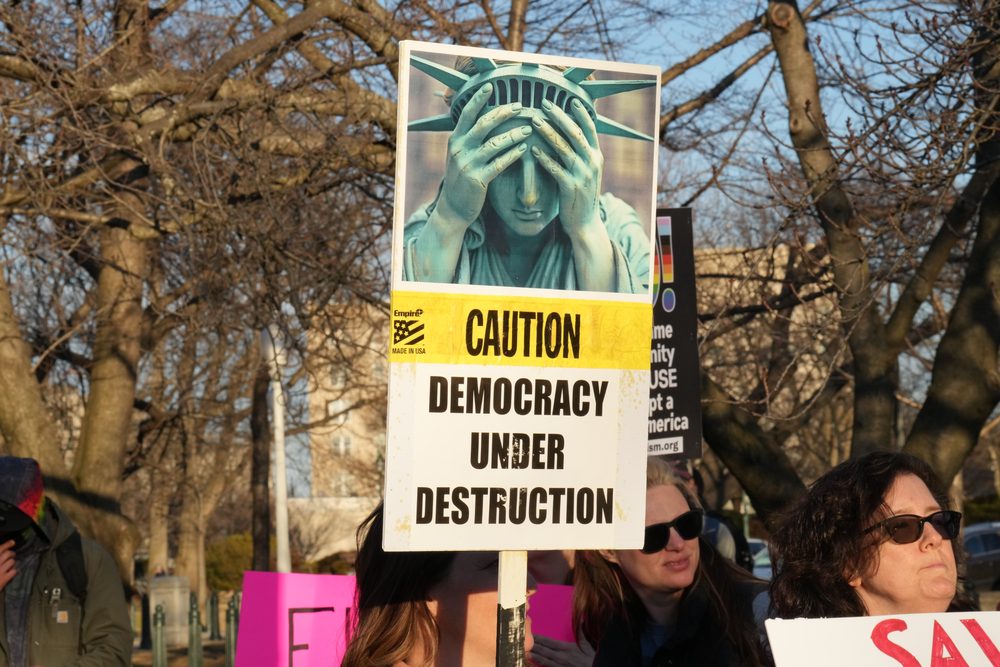
In 2025, I found myself talking with more young people than ever before in my community, all wondering if the United States was now under a dictatorship. I explained that the country has never actually had a dictatorship. Still, some presidents have been accused of acting like dictators, especially during crises or when they used their power forcefully. For instance, during the Civil War, Abraham Lincoln allowed arrests without quick trials, including for political opponents and those suspected of supporting the Confederacy. He also put the military in charge of certain areas, used military courts for civilians, called up state militias, and blocked Southern ports, sometimes without first getting Congress’s approval. Franklin D. Roosevelt, during the Great Depression, launched the New Deal and often used executive orders and emergency powers to act quickly. In World War II, Franklin Roosevelt made major wartime decisions, such as putting Japanese Americans in camps and making military plans, sometimes without Congress’s approval.
Dictatorship, a forceful style of rule with roots in Europe, has shaped history in dramatic ways. In ancient Rome, leaders were granted sweeping authority during emergencies, revealing how concentrated power can swiftly change the course of events. Ortega y Gasset, the influential Spanish philosopher, believed that when society is led by the “mass man,” someone who follows rather than questions, people often crave a commanding leader. In such times, the desire for stability and safety can tempt citizens to trade away their freedoms for the illusion of order.
Modern dictators stand alone at the top, wielding immense authority and making decisions without input from others. Often, their pursuit of power is personal, not driven by any grand vision. This unchecked control allows them to create laws at will, impose severe punishments, and command both government and military forces.
Such leaders skillfully manipulate public emotions and perceptions to tighten their grip on power. They mold beliefs, spread fear, and often disregard the well-being of others. By examining their tactics, we gain insight into the dangers of unchecked authority and are reminded why defending democracy and encouraging civic engagement are so vital.

Authoritarian rulers frequently oppress minorities, attack the press, crush opposition, and use intimidation to escape responsibility. In contrast, constitutional monarchies typically operate with restricted, inherited authority.
Benito Mussolini, founder of Italian Fascism, ruled Italy from 1922. He ended democracy in 1925 and became dictator. He promoted racism, especially against Jews, and used propaganda to support his policies. Mussolini’s regime expelled thousands of Jews and pushed for strict racial boundaries and colonial expansion.
From 1935 to 1939, chemical weapons were used in Libya and Ethiopia despite international bans. Around 250,000 Ethiopians died, showing the horrors of chemical warfare and the need for international agreements.
In 1939, Mussolini and Hitler signed the Pact of Steel, agreeing that Italy and Germany would help each other in war, showing their shared goals of expansion by force.
Adolf Hitler, born in Austria in 1889, wanted to unite all German-speaking people. He gained support by appealing to German anger and hopes, became Nazi Party leader, and rose to power as chancellor in 1933 and later as Führer in 1934. Hitler was grandiose, sought admiration, and lacked empathy. He pushed for territorial expansion and racial supremacy, held grudges, and rejected criticism. He led the persecution and murder of over six million Jews, Roma, homosexuals, and people with disabilities. Hitler reportedly had psychological disorders. He died by suicide in 1945, after which the Nazi movement quickly collapsed.
Joseph Stalin was born in 1878 in the Republic of Georgia. He became known for both the fear and admiration he inspired. Stalin often put his own interests first, controlled those around him, and changed historical records to make himself look better. As General Secretary, he gathered power, ordered mass arrests, and silenced his opponents. He was known for being suspicious and distant, and he often threatened those he saw as rivals. Propaganda made him appear flawless. Between the 1920s and his death in 1953, he pushed aside many ethnic groups. Stalin died at the age of 74.
Mao Zedong was born in 1893 and led China from 1949 until 1976. His Great Leap Forward resulted in a major famine and the deaths of millions. The Cultural Revolution, which aimed to strengthen communism, caused many people to be targeted, led to violence, and destroyed cultural traditions. Mao favored the Han Chinese, which caused harm to minority groups.
Hugo Chávez was born in 1954 and became a leader in Venezuela after a failed coup and time in prison. He started the Fifth Republic Movement and won the presidency in 1998 by promising change. Chávez was reelected in 2000, survived a coup attempt in 2002, and won a recall vote in 2004. He died of cancer in 2013 at the age of 58.
Nicolás Maduro was born in 1962 and became Venezuela’s president in 2013 after Chávez. Early in his time as president, the opposition won back parliament and tried to remove him, but they did not succeed. His second term started in 2019 after an election that many boycotted. Maduro has faced accusations of harming democracy and violating rights. He later apologized for using homophobic language against opposition activists.
When colonial rule ended, dictatorships began to spread in many parts of the world. In Africa, leaders such as Gnassingbe Eyadema, Charles Taylor, Sani Abacha, José Eduardo dos Santos, and Teodoro Obiang Nguema Mbasogo came to power.
Dictatorships take away people’s rights and create fear that lasts for generations. These leaders prioritize their own interests, silence anyone who disagrees, and target people who are vulnerable. People often believe promises of national pride and safety, but as these leaders gain more control, they break trust and hurt people’s mental health.
Many people stick with dictators because they are afraid and because these rulers tightly control what people know and learn. Yet, Jose Ortega y Gasset reveals that dictators thrive when their followers do not question them and are willing to give up their freedom for what seems like order. He believed most people go through life stuck in routines and rarely question how things are. Ortega y Gasset saw little hope in a world led by people who do not care, warning that without the guidance of scientists and thinkers, society would fall into darkness.
Sources:
Charles Whiting, “The Madman of the Mountain: Adolf Hitler’s Personal Life,”https://warfarehistorynetwork.com/article/the-madman-of-the-mountain-adolf-hitlers-personal-life;
Italy and the Holocaust Foundation, “Italian Racial Laws,” http://www.italyandtheholocaust.org/italian-racial-laws.aspx;
José Ortega y Gasset, The Revolt of the Masses, (New York: W. W. Norton & Company, 1994);
Roy Temple House, “Reviewed Work: The Revolt of the Masses by José Ortega y Gasset”;
The Virginia Quarterly Review, Vol. 9, No. 1 (January 1933), pp. 123-127;
“Venezuela’s Nicolás Maduro: Dictator or defender of socialism?”https://www.bbc.com/news/world-latin-america-20664349;
The York Historian, “Stalin’s Cult of Personality,” https://theyorkhistorian.com/2015/09/18/stalins-cult-of-personality-its-origins-and-progression/.
— Otis D. Alexander, PhD, a retired music teacher at St. Croix Central High School, has taught at the Sprauve and Guy Benjamin schools on St. John. He is an alum of the Harvard Graduate School of Education Leadership for Academic Librarians. He can be reached at od.alex1972@gmail.com.