

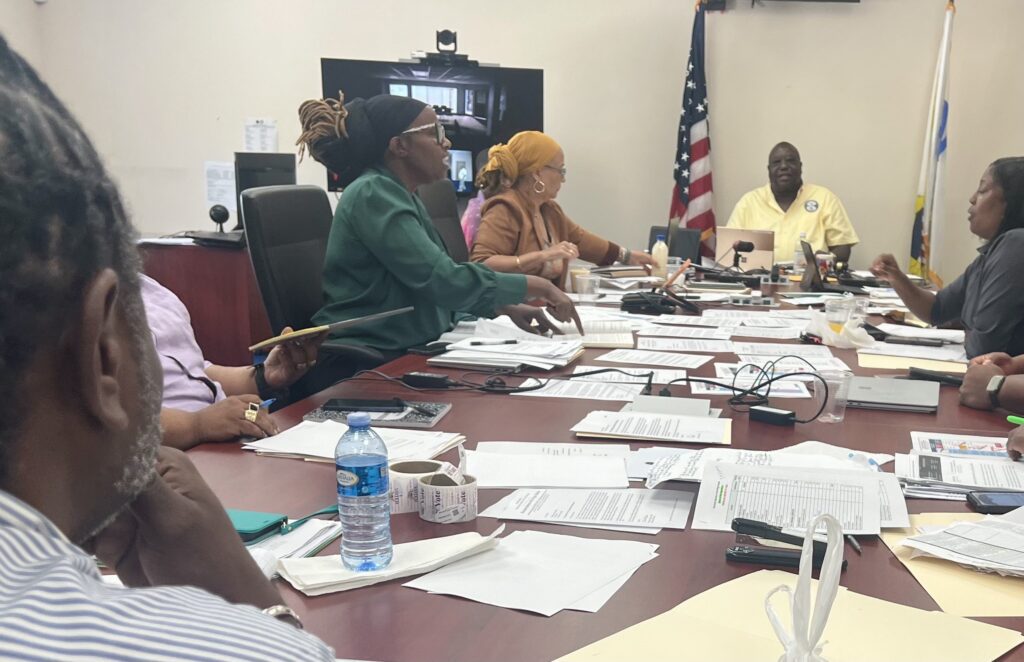
The Virgin Islands Board of Elections voted Wednesday to continue using a single ballot for federal and territorial races, while spending much of a lengthy meeting debating candidate eligibility, residency disputes, and a failed effort to remove Elections Supervisor Caroline Fawkes.
The decision came after board members emerged from an hourlong executive session, where representatives of Election Systems & Software confirmed the Elections System has the capability to produce separate paper ballots for federal and territorial contests and still meet the June 17 deadline for military and overseas voters. Board Chair Raymond Williams said no action was taken during the closed-door session, which also included updates from the Office of the Attorney General on pending election-related litigation.
Despite confirmation that separate ballots could be produced, the board voted 6-3 to continue using a combined ballot for the 2026 election cycle.
The issue stems from a long-standing debate over whether federal and territorial races should appear on separate ballots. While board members were advised Wednesday that separate ballots could still be produced in time for military and overseas voters, a majority ultimately chose not to alter the format for the current election cycle, arguing that broader compliance questions could be addressed after the 2026 election.
Board member Kareem Francis, who introduced the motion, argued the board could move forward with the current ballot format while continuing discussions about future compliance with election laws.
“We can ensure future elections follow the law to the letter,” Francis said.
Board members Cleopatra Peter and Barbara LaRonde disagreed, arguing that election officials have had ample time to prepare for separate ballots and that voter education efforts could address concerns surrounding the transition.
“We’ve had two years to figure it out,” Peter said.
“It was already identified that it can be done,” LaRonde added.
The ballot issue served as a backdrop for broader concerns raised throughout the meeting about election administration, candidate qualifications, and compliance with election law.
Much of the discussion centered on a complaint filed by Delegate to Congress candidate Ida Smith, who accused Fawkes of improperly requiring documentation related to a St. John address listed on her nomination papers.
Smith contends the request exceeds the supervisor’s authority and effectively imposes additional qualifications beyond those required under federal law for candidates seeking the office of Delegate to Congress.
The dispute mirrors a similar controversy during the 2024 election cycle, when Fawkes moved to disqualify Smith’s congressional candidacy and the Board of Elections later voted to place her on the ballot after receiving an opinion from Attorney General Gordon Rhea concluding that Delegate to Congress candidates are governed by federal qualification requirements.
Fawkes defended the latest request, telling board members the issue differs from questions raised during the 2024 election cycle.
According to Fawkes, the previous dispute focused on Smith’s residency within the Virgin Islands, while the current matter concerns the residence listed on Smith’s nomination papers and whether the structure identified on St. John is, in fact, her place of residence.
Fawkes cited a 2025 ruling by Chief District Judge Robert Molloy in explaining why additional documentation was requested.
Board member Harriet Mercer later introduced a motion directing Fawkes to withdraw the request. The motion failed on a 3-5 vote.
The board also revisited recurring concerns about candidate notification procedures and due process protections.
Several members questioned whether candidates whose nomination papers are found defective are being notified in accordance with Virgin Islands law, which references notification by “special messenger.” Members debated whether modern communication methods such as email and telephone calls satisfy that requirement.
Fawkes said her office typically contacts candidates through multiple channels, including telephone calls and email, and emphasized that the Elections System does not publicly announce candidate disqualifications.
Questions about candidate filings extended to challenges involving congressional candidates James Weber and Jed JohnHope, whose appeals are expected to be addressed when the board reconvenes Friday.
Williams said Weber’s disqualification stemmed from filing nomination papers in the wrong district.
“The law is clear,” Williams said.
According to Williams, Weber’s filing error leaves little room for interpretation under election law, though the matter is expected to be revisited when the board takes up candidate appeals later this week.
The board also reviewed a complaint involving JohnHope, who was disqualified on May 26 by the Elections System. Under 18 V.I.C. § 381(b), candidates for offices elected territorywide must submit nomination papers signed by at least 100 qualified electors from each of at least two election districts and at the time, Fawkes said JohnHope did not meet that requirement, noting that his filing fell short of the district-based signature threshold.
Responding to questions about petition signatures, Fawkes displayed color-coded filing forms and said additional signatures submitted by JohnHope were provided on white paper rather than the official petition forms. She described the color coding as a quality-control measure used by the Elections System.
In other business, board members approved the Elections System’s proposed Fiscal Year 2027 budget request, which Fawkes and her staff are expected to present before the Senate Finance Committee later this summer.
Fawkes also discussed funding allocated for the current election cycle, telling members that $275,000 has been designated for the primary election and approximately $400,000 for the general election, though supplemental funding may ultimately be required.
The board approved the supervisor’s report after making several amendments and corrections during public discussion.
Members also addressed the status of board member Lawrence Boschulte, whose May 27 resignation letter was read into the record. Boschulte recently filed to run for a seat in the 37th Legislature and was previously determined, and ultimately disqualified about a week ago, by Elections officials to be ineligible to remain on the Board of Elections while seeking another public office. During the casting of the lots on May 29 for the Democratic Primary, Fawkes told members of the media that Boschulte would be replaced by former Elections board member Lydia Hendricks.
Under Virgin Islands law, Board of Elections members may not be candidates for another public office during the term for which they were elected and must resign from the board as a condition of seeking office.
Williams declined to accept Boschulte’s resignation Wednesday, noting that the letter submitted to the board was unsigned.
Tensions escalated near the end of the meeting when LaRonde introduced a motion seeking Fawkes’ removal, citing what she described as “numerous violations of law.”
Williams immediately ruled the motion out of order.
LaRonde challenged the ruling, but a majority of board members sided with the chairman, effectively preventing debate on the proposal and stopping the motion from advancing.
With several St. Croix board members needing to return home, the meeting adjourned shortly after 2 p.m. Members agreed to reconvene Friday to continue reviewing appeals and correspondence from candidates challenging their disqualification from the 2026 ballot.