


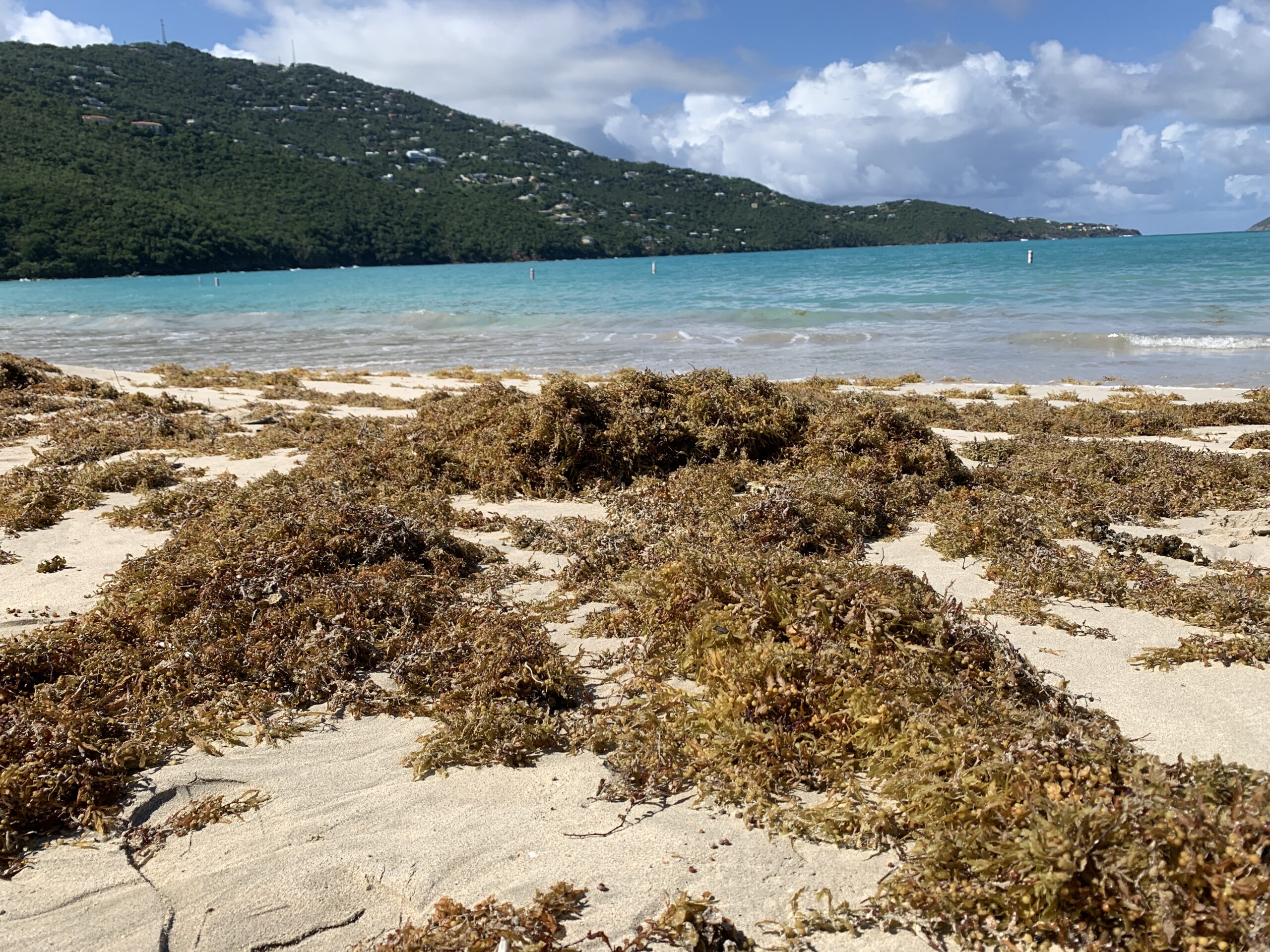
An inundation of sargassum seaweed is crossing the Atlantic from the east to the west, and the U.S. Virgin Islands may be in the path of this unwelcome visitor.
Sargassum, a brown seaweed that can pile up along the beaches and bring an unpleasant stench, has been spotted in the USVI on multiple occasions over the years. However, this time the sargassum in the ocean headed in our direction has reached a record-high amount.
Monitoring Sargassum Seaweed
The Source interviewed Yuyuan Xie, Ph.D., a research scientist at the University of South Florida. Xie is involved with the university’s “Optical Oceanography Laboratory (OOL)” within the College of Marine Science. The group monitors the oceans for events that impact coastlines, including sargassum seaweed.

“The USF Optical Oceanography Lab has been using optics and remote sensing to address coastal problems, with sargassum inundation being one of them,” said Xie. “Other problems the OOL has been working on include red tides, oil spills, and coastal water quality changes,” he added.
Satellite Tracking
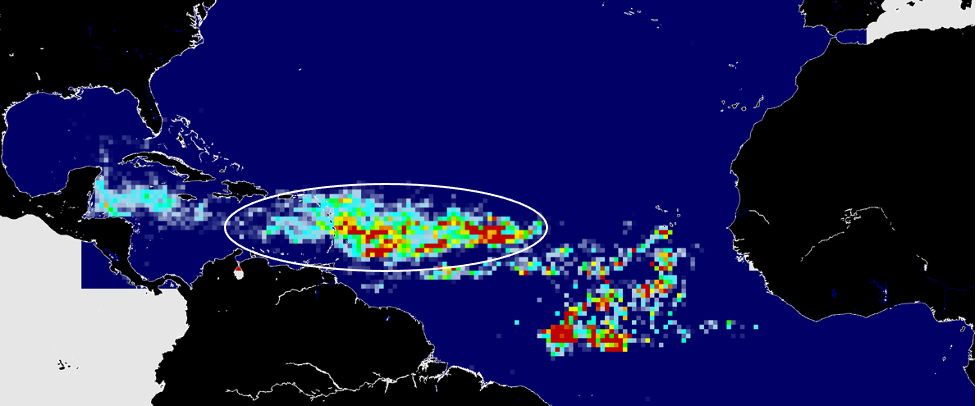
A system of satellites is utilized to track the seaweed from above.
“We have developed a Satellite-based Sargassum Watch System (SaWS) to monitor sargassum seaweed using satellite data. I am in charge of operating the system every day, including data processing, quality control, analysis, data sharing over our web portal, and addressing questions,” said Xie.
“We use several satellites to produce sargassum maps every day. These satellites take photos everywhere in the ocean, and we have developed special ways to interpret the photos and make sargassum maps. We also combine ocean surface currents to track their movement,” Xie explained. “We put all maps and other data in our SaWS Web portal for people to use to meet their needs — either finding sargassum, avoiding sargassum in the ocean, or preparing for major beaching events.”
Sargassum — Explained
For those who are unfamiliar with sargassum, Xie offers the following information. Interestingly, the algae were first observed hundreds of years ago.
“Pelagic Sargassum seaweed is a brown macroalgae floating on the ocean surface. It was first reported in the 15th century by Christopher Columbus, and a regional sea in the north Atlantic Ocean, the Sargasso Sea, was named after this plant. It serves as a habitat for many marine animals, such as turtles, fish, shrimp, crabs, and so on. These macroalgae can grow to a length of several meters and form floating mats on the ocean surface,” Xie said.
Sargassum Arriving in the USVI
A record amount of sargassum has been detected in the ocean, and the territory may see more seaweed than usual.
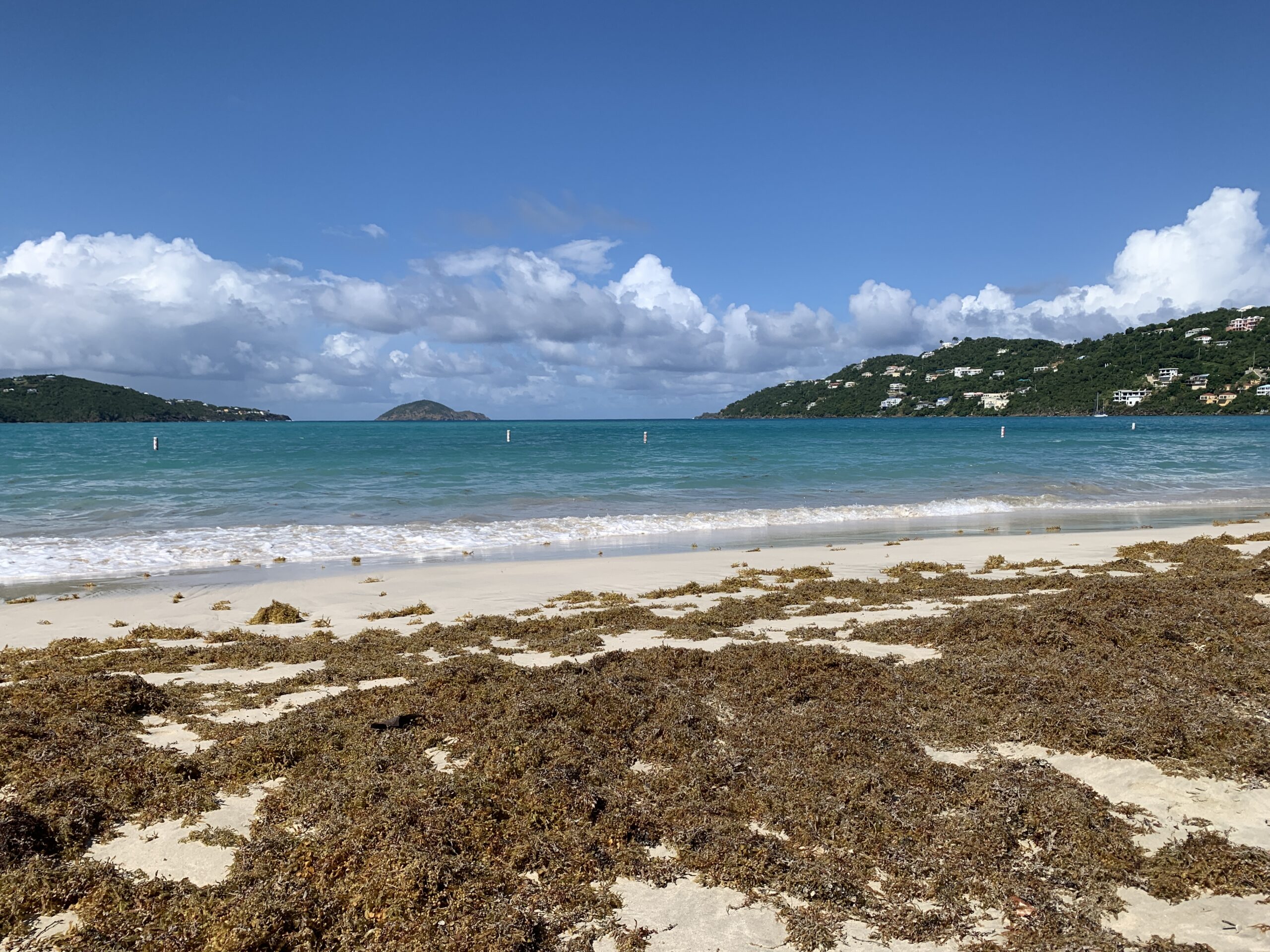
“Sargassum amounts fluctuate every year. This past January (2023) saw a record high amount, suggesting a major sargassum year in 2023 for the Atlantic Ocean as a whole,” stated Xie.
“At this time of year, sargassum in the western central Atlantic moves to the west, meaning that the Caribbean Sea will experience increased sargassum in the coming months.”
“From the sargassum maps of this week, the U.S. Virgin Islands may have seen some small to moderate amounts of sargassum from the south, and the amounts may increase in the following months. But it’s difficult to predict when the USVI will start to see major beaching events, and it’s also difficult to predict whether the amount will exceed the normal,” noted Xie.
“This is because many factors (winds, currents, tides) can all change the story of a local region, and we cannot predict those factors in the future. One thing is certain: The Caribbean Sea will see increased amounts of sargassum as a whole, and 2023 will be another major sargassum year for the Caribbean Sea,” he said.
Health Impacts on Virgin Islanders
Sargassum has both positive and negative benefits for the environment. Fortunately, the arrival of the algae is not extremely dangerous or toxic to human beings. Still, there are several significant health risks.
“Most of the time, some moderate amounts on beaches would not represent a risk factor for humans. However, there are some exceptions,” cautioned Xie. “After a couple of days onshore, sargassum starts to decompose and release noxious and stinking gases such as ammonia and hydrogen sulfide. The bad smell can cause respiratory problems. There are reports that in some of the Caribbean Islands, the hospitalization rate has gone up during the sargassum season,” he said.
“Sargassum can be both good and bad for the environment. In the ocean, it is a critical habitat for many animals, so they should like to see increased sargassum. Sargassum on beaches can also stabilize sand dunes, thus helping to avoid beach erosion. But too much of a good thing can also make it bad — excessive amounts of sargassum can also cause environmental and economic problems,” Xie added.
“There is no scientific consensus on exactly what caused the sargassum increases in the past decade in the Atlantic Ocean, but climate change may be part of the reason, as it affects precipitation, ocean circulation, and dust events, among others. This is still a research topic.”
Sargassum Amounts: Preparing for “A New Normal”
“It is actually too soon to predict when large amounts will arrive in the continental USA, and the same can be said for the USVI,” Xie continued. “But Virgin Islanders should be prepared, in general, to encounter sargassum on a more frequent basis in the coming years, because large amounts of sargassum in the Atlantic represent a new normal as compared to 10 years ago.”
Monthly Updates
Visitors and residents in the USVI can follow the progression of the current mat of seaweed traversing the Atlantic and stay up to date each month on where sargassum may be headed.
“For the general audience, we’re generating a sargassum outlook bulletin on a monthly basis, which can be downloaded via accessing our SaWS page. This bulletin provides a general picture of the current bloom conditions and future bloom probability for the regions under watch. The SaWS system also provides satellite imagery every day for the current sargassum situation, where a user can download the images and surface currents,” noted Xie.
“However, our monitoring system does not predict exactly where and when a beaching event will occur. We are working toward that end, but it won’t happen overnight,” Xie added.