Anne Marie Philip, also known as “Eiya” or “Ma Linus,” of Walter I.M. Hodge, died on Tuesday, Sept. 17. She was 85 years old.
She was preceded in death by her mother, Winifred Emanuel; and father, Henry Emanuel.
She is survived by her daughters: Catherine A. Philip, Valerie C. Philip, Cecilia A. Philip Spencer, Beverly A. Philip and Prisca B. Philip; sons: Ernest Damian Augustin, Vincent A. Philip, Linus Philip Jr. and Ferry I Philip; and grandchildren: Ginelle Augustin, Staceyann Augustin, Kenisha Johnhope, Shevonne Philip, Shanell Lewis, Siana Parris, Jashawn Philip, Troy Philip, Roy Philip, Justice Philip, Autum Philip, Ebony Philip, Vincent Philip, Fernisha Philip, Crystal St. Brice, Shala Tutein Norfleet, Divonté Jones, Dominique Joseph, Greggory Joseph, Rayla Philip, Alexis Philip and Hailey Philip.
She is also survived by adopted grandchild, Jonesha Ledesma; adopted great-grandchild, Francely Martinez; 20 great-grandchildren; daughters-in-aw: Rita Augustin, Teresa Philip, Jaime Philip and Florett Lafond Philip; son-in-law, Barry Spencer; godchildren, Kai Johnhope and Esther Griffith; and special friends: Joanna Desir and family, Mrs. Rudy and family, Vita Justin and family, Linus and Cherry Ann and family, Ms. Glorie, Ms. Dorsia, Carmen Estrada, Shakima Alicea, Mrs. Johnson, Mrs. Wiltshire and family, Amon Thomas, Claudette Parker, Eltra Joseph.
Other survivors include special friends: Etla Sargeant and family, Tony Solomon, the Matthews, the Griffith Ffmily, Eddie Charles, Monica Andrews, Dawn Bruce, the Walter I.M. Hodge Community, Vero Fedee, Happy Clydeela and family, the Heywood family, Sybil, Christina St. Brice, Janarice and family, Wanda Williams and family, Stephane Nelson, Tazzy and Sonny; cousins and other relatives: Marie Boyce, Sonia Boyce, Preston Boyce, Virginia Simon and family, the Antal family, the Paul family of St. Lucia, and Brandon Bolden; as well as other relatives and friends too numerous to mention.
The viewing will begin at 9:30 a.m. followed by a funeral service at 10:30 a.m., Friday, Oct. 11, at St. Patrick’s Catholic Church. Interment will be at Kingshill Cemetery.
Professional services are entrusted to James Memorial Funeral Home Inc.
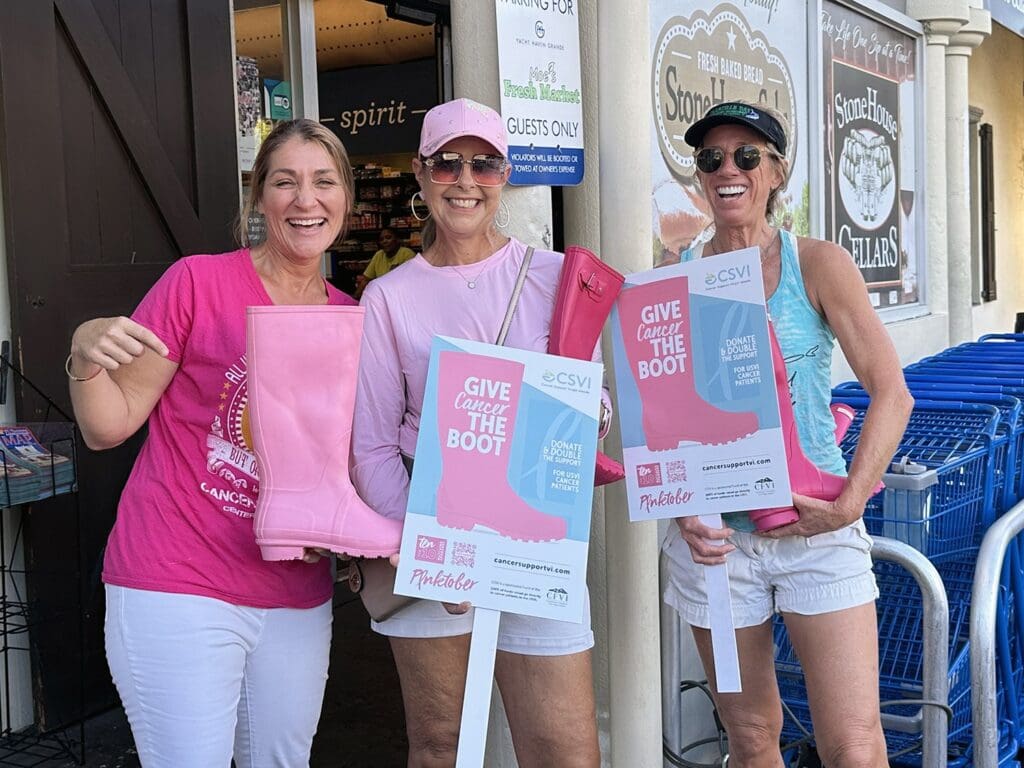
This October marks CSVI’s 11th Pinktober. (Photo courtesy CSVI)
Cancer Support Virgin Islands (CSVI) has launched its 11th annual Pinktober, a month-long celebration raising awareness and critical funds for cancer patients across the U.S. Virgin Islands. As the territory continues to face rising cancer diagnoses, Pinktober has grown into a powerful symbol of hope, community, and resilience.
This year’s campaign comes with an exciting boost—a $500,000 grant from the V.I. government, coupled with a challenge to the community to raise an additional $500,000. In an inspiring show of support, businesses and community members have been stepping up to meet this goal, including Gov. Albert Bryan Jr., who has also pledged an additional $250,000.
The outpouring of generosity has already made a significant impact. In 2024 alone, CSVI has distributed over 260 grants, totaling more than $710,000 to cancer patients in the territory. Before the year ends, the organization expects to surpass $1 million in grants, helping more than 350 patients receive the care and support they need.
Introducing the Pledge to Partner Campaign
Several local businesses have already stepped up as part of CSVI’s Pledge to Partner campaign. (Photo courtesy CSVI)
As part of its ongoing efforts to expand support, CSVI is launching the “Pledge to Partner” campaign, part of a bigger “Rise to the Raise” challenge, this fall. This initiative encourages community members, businesses, and caregivers to join forces in the fight against cancer through peer-to-peer fundraising. Participants can set personal fundraising goals and track their progress on a personalized leaderboard, all while contributing to CSVI’s ambitious target of $1.25 million for 2024.
Several prominent local businesses have already signed on to support the campaign, including Lucky Jewelers, Magens Bay Bar & Beach Boutique, Island Grind VI, CC1 Virgin Islands, Taphus Beer House, St. Thomas Carribean Surf Co., St. Thomas Yacht Club, The Market STT, Moe’s Fresh Market, Bank of St. Croix, Amalie Car Rental, First Bank, Anoush 242 Gallery, Heavy Materials, Leatherback Brewery, Bellows International, West Indies Company, Mutiny Island Vodka, Rock Rakers, Frenchman’s Cove Marriott and Virgin Islands Oncology & Hematology, among others. These partnerships are critical in ensuring that no Virgin Islander faces cancer alone and that the community continues to rally behind those in need.
CSVI’s “Rise to the Raise” campaign sets out to achieve three key goals:
Community Engagement: Encouraging widespread participation through the leaderboard challenge, inspiring people to unite for a common cause.
Lead Donor Development: Nurturing yearly donors to become lead donors, empowering them to inspire others in the community.
Activating New Donors: Reaching untapped communities and encouraging more people to join the fight through respected pledgers.
Celebrating a Decade of Impact
Pinktober has become synonymous with breast cancer awareness in the Virgin Islands, and this year marks its 11th annual celebration. The festivities kicked off on Friday with the “Get Pink’D” event at Taphus Brew House and will be followed by a host of community-driven activities throughout the month. The goal of these events is not only to raise funds but also to highlight the importance of early detection, prevention, and support for those battling breast cancer.
“With over 400 cancer cases diagnosed annually in the territory, CSVI’s work is more important than ever. Since 2005, the organization has distributed more than $4 million in grants, assisting over 3,300 patients. Through efforts like Pinktober, CSVI continues to build a support network for Virgin Islanders navigating their cancer journey, ensuring they have access to both financial assistance and emotional support,” said CSVI Director Barb Michaud.
For those wanting to help out on the ground, CSVI is seeking volunteers for its “Give Cancer the Boot” drives on St. Thomas and St. Croix, where participants will raise funds with iconic pink boots. To volunteer, contact Anna Holley at anna.holley@cancersupportvi.com.
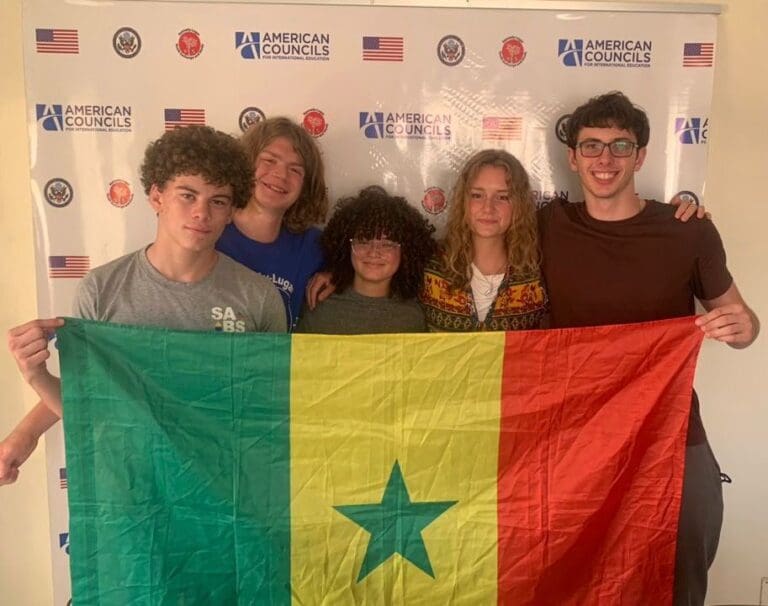
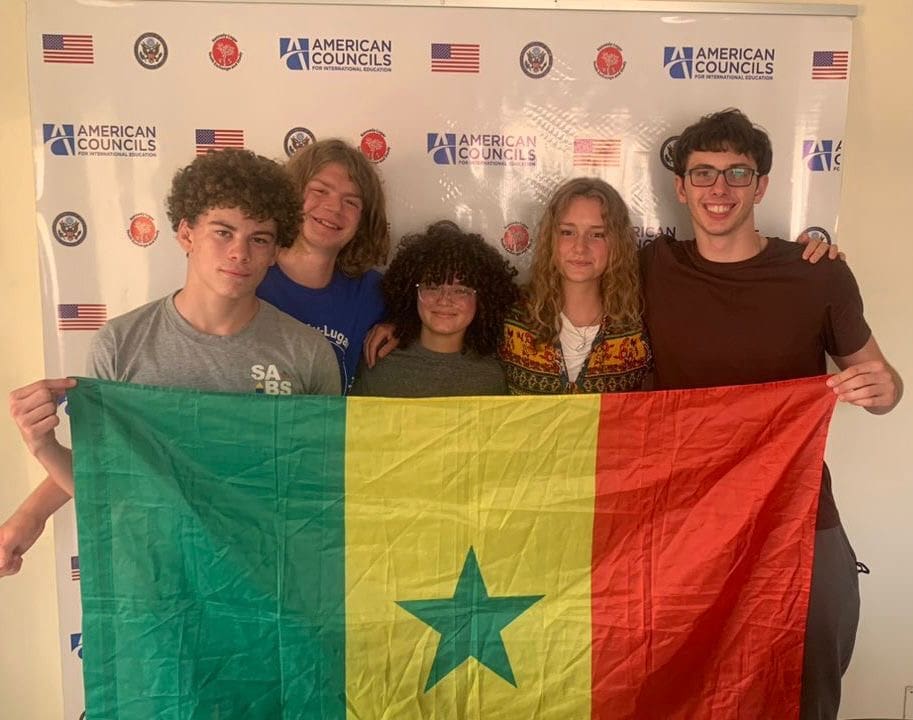
Roshan Kalantarian, center, was awarded the Kennedy-Lugar Youth Exchange and Study (YES) Abroad scholarship for the 2024-2025 school year. (Photo courtesy Roshan Kalantarian)
Roshan Kalantarian, a 17-year-old St. John graduate from Gifft Hill School, was awarded the Kennedy-Lugar Youth Exchange and Study (YES) Abroad scholarship for the 2024-2025 school year. With this award, Kalantarian will begin the 11th grade in Senegal on Monday.
“I was excited to start college at a top liberal arts school with enough aid to attend college my first year, but I was a little disappointed about the study abroad opportunities at the college I chose,” said Kalantarian. So, even though they have graduated high school on St. John, they will attend grade 11 based on their age in Senegal’s school system.
Currently, Kalantarian is enjoying the experience so far and has already spent a month in Senegal with their host family. “It feels kind of special knowing that there’s not that many students doing this program in the United States. It is a very prestigious program in these countries. It feels like being an ambassador truly of the United States knowing that there’s not that many students doing the program here in Senegal,” Kalantarian said.
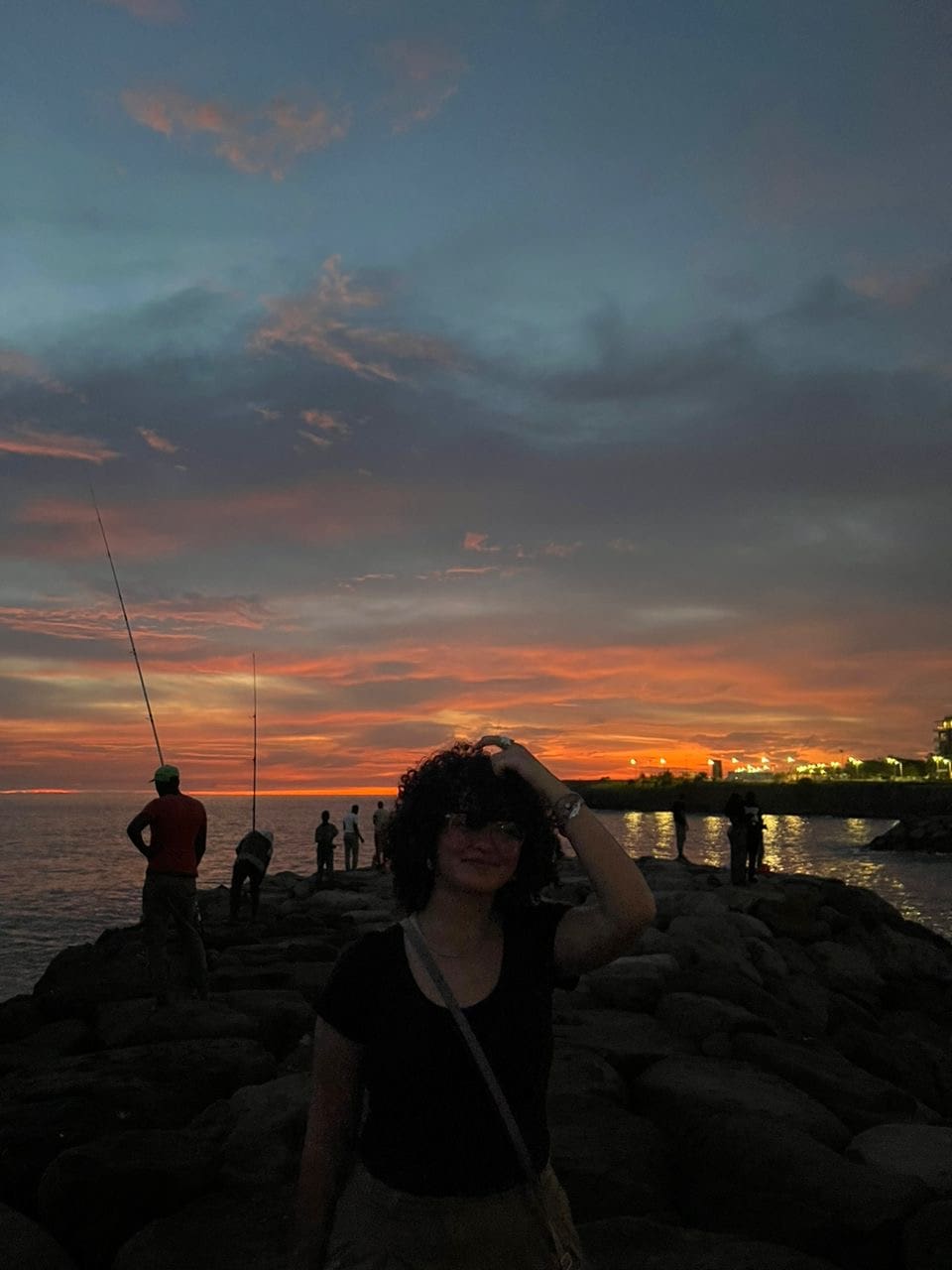
Kalantarian has enjoyed a month in Senegal and has already created memories. (Photo courtesy Roshan Kalantarian)
Kalantarian is one of 65 students who was competitively selected from across the United States to participate in the program. Through participation in the YES Abroad program, Kalantarian is at the forefront of citizen diplomacy, serving as a “youth ambassador” in Senegal.
Initially, Kalantarian learned about the relations between the United States and China in a global context and how their relationship impacts the entire world. Through that program, Kalantarian learned how to interact with Chinese students and learned how to do cross-cultural communication. That contributed to Kalantarian’s selection for the program.
Additionally, Kalantarian said that the program was looking for someone who obtained resilience, and as a Virgin Islander, that was something they saw.
“It feels special and also nice to be able to communicate with other cohorts in other countries,” referring to others participating in the program. “My cohorts are close so it is interesting to see other cohorts have different dynamics because they might live in multiple different countries that they are hosted in,” Kalantarian said.
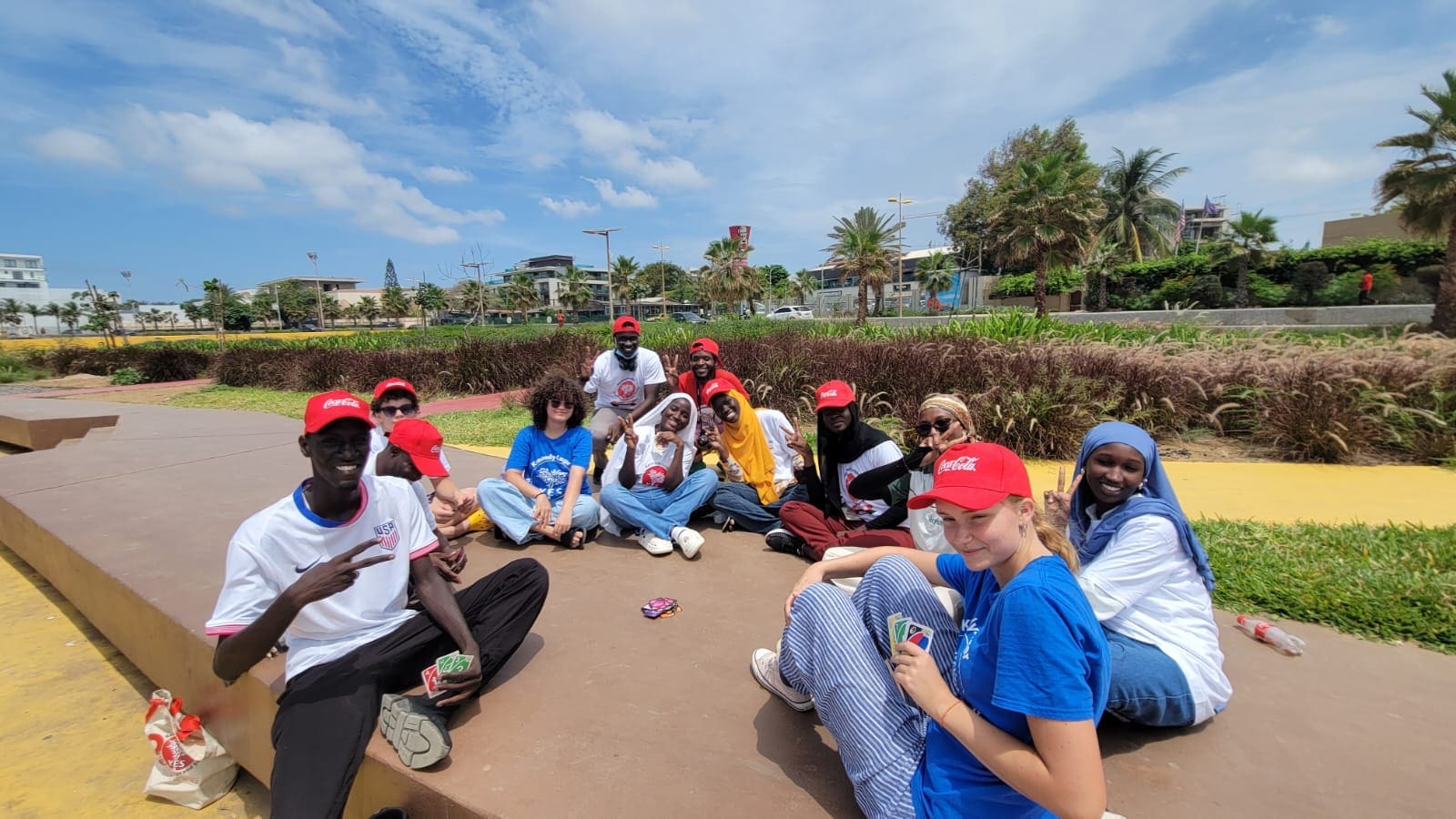
Kalantarian enjoys time with cohorts and host family. (Photo courtesy Roshan Kalantarian)
In Senegal, Kalantarian will enhance cross-cultural understanding and deepen trust by building lasting relationships with their host family and peers. Kalantarian will also engage in volunteer service and leadership training to help their host community. For now, Kalantarian’s experience has already broadened their horizons, meeting lots of nice people and visiting different bakeries and ice-cream shops, among other fun activities. “They are cool people”, said Kalantarian, who has already made friends with YES Alumni.
“I think it is important to learn about other cultures and the world we are living in because in the Virgin Islands, I feel like we are kind of closed off to the other side of the world. We don’t have the same conversations about Asia and Africa that I can have now in Senegal. I think it’s very important to broaden your horizons and learn about the world through different perspectives,” said Kalantarian.
You can follow Kalantarian and her cohort’s Instagram pages by following @roshan.abroad and @yesabroadsenegal.
The Kennedy-Lugar Youth Exchange and Study Abroad program was first authorized by the U.S. Congress in the aftermath of Sept. 11, 2001, as an effort to increase dialogue and mutual understanding between people of the United States and people of countries with significant Muslim populations. For the 2024-2025 academic year, YES Abroad provided the opportunity for Americans to study for one academic year in 11 diverse countries: Bosnia and Herzegovina, Bulgaria, India, Indonesia, Jordan, Malaysia, Morocco, North Macedonia, Senegal, Thailand, and Türkiye, according to a press release.
Chalinda George, MKenzii Gittens, Steven Henry, Bennett Knopp, Devaughn Richards and Marina Gasperi, all students from The Center for Educational Growth on St. Croix, contributed to this story.
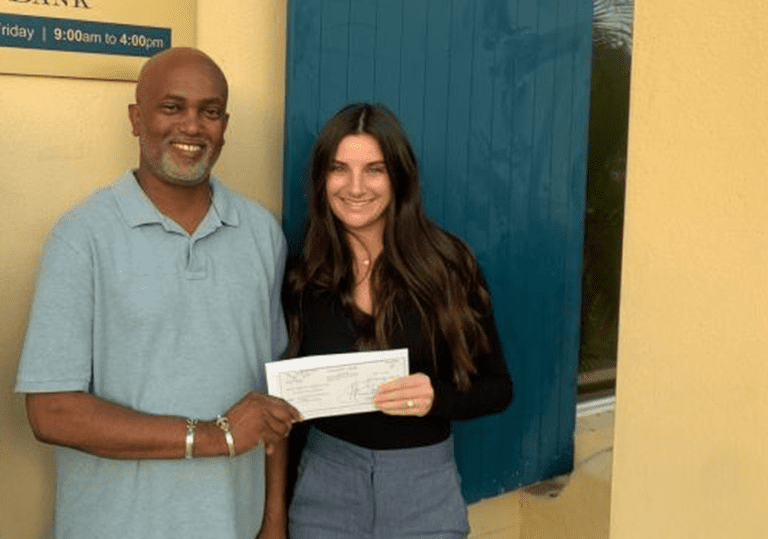
In a continued effort to support local enterprises, Merchants Commercial Bank (MCB), in partnership with the Federal Home Loan Bank of New York (FHLBNY), has awarded eight small businesses and non-profits in the U.S. Virgin Islands with Small Business Recovery Grants (SBRG). The grants, ranging from $5,000 to $10,000, are designed to offer critical relief to organizations grappling with the financial challenges brought on by inflation, rising energy costs, and supply chain constraints.
Unlike many other recovery initiatives that follow large-scale emergencies, the SBRG program targets businesses that may be facing economic hardships or are in the early stages of development. This periodic disaster relief program is one of the key ways smaller banks like Merchants can remain agile in securing funds and resources for the local market. This year’s recipients include VI Christian Ministries, The Leader’s Branch, Speedy Redemption Vegan Raw Food and Sandwich Deli, Seven Four, Island Green Building Association, CRC Payroll Management, Buddha Sushi House, and Alliance Point Charter.
For these businesses and non-profits, the grants provide a lifeline—offering financial support to help mitigate the effects of economic pressures and aid in advancing new business initiatives, according to Merchants representatives. Last year, MCB was able to provide relief to five local businesses; this year, the bank has broadened its reach, helping more organizations navigate an unpredictable economic landscape.
Valdamier Collens, president of Merchants Commercial Bank, emphasized the importance of these grants for both the businesses and the community at large. “As a financial institution founded in the U.S. Virgin Islands, we understand that small businesses and non-profits are essential components of a thriving community,” Collens said. “By providing grant funding to this sector, we contribute directly to the growth and sustainability of these organizations. MCB’s commitment goes beyond banking—it’s about fostering partnerships that strengthen our community and support long-term economic growth.”
With the help of FHLBNY, MCB continues to demonstrate its dedication to local businesses by actively seeking and applying for grant opportunities. The SBRG program enables the bank to be nimble in its response to the needs of the territory, ensuring that small businesses have the resources necessary to grow and succeed, according to Collens.
This year’s grant recipients represent a diverse range of sectors, each playing a crucial role in the territory’s economic ecosystem. From promoting sustainable building practices to expanding vegan cuisine options and supporting payroll management services, the awarded businesses reflect the resilience and innovation that define the local market.
As businesses across the territory face growing economic challenges, initiatives like the Small Business Recovery Grant help ensure that local enterprises remain strong, contributing to the broader goal of a thriving and resilient Virgin Islands community, Merchants officials said.
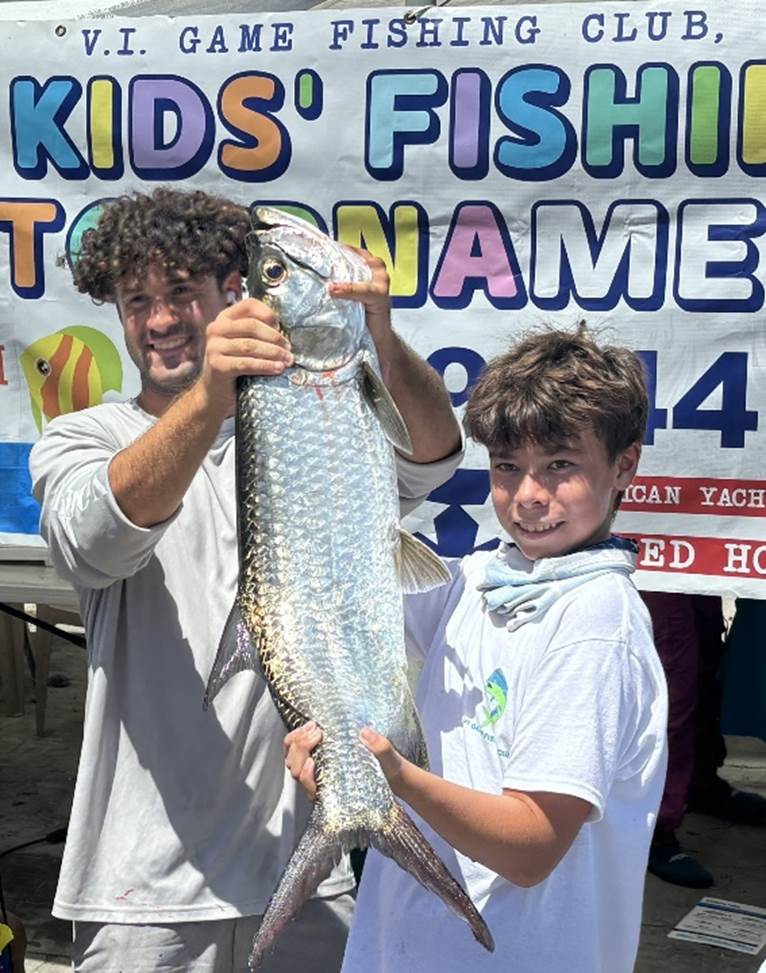
Earl Questel with his whopper-winning Tarpon. (Photo by Rian Bareuther/VIGFC)
On Saturday, 165 anglers, 14 years old and younger, competed in the Virgin Islands Game Fishing Club’s Annual Kids’ Fishing Tournament in Red Hook on St. Thomas.
Mere minutes before the noon line’s out time in the tournament, 13-year-old Earl Questel came running to the weigh station set up at IGY’s American Yacht Harbor Marina with what was said to be a “whopper.” Professionals from the Department of Planning & Natural Resources Fish & Wildlife Division weighed the Tarpon at 3690 grams (8.1 pounds), according to the press release.
“It was there swimming in a school by the dock,” said Questel, who earned first place in the tournament for the biggest fish by weight. “It came to my bait, and I caught it.” The tournament was free to junior anglers and promoted the sport and life skills of recreational fishing and catch-and-release conservation, the press release stated.
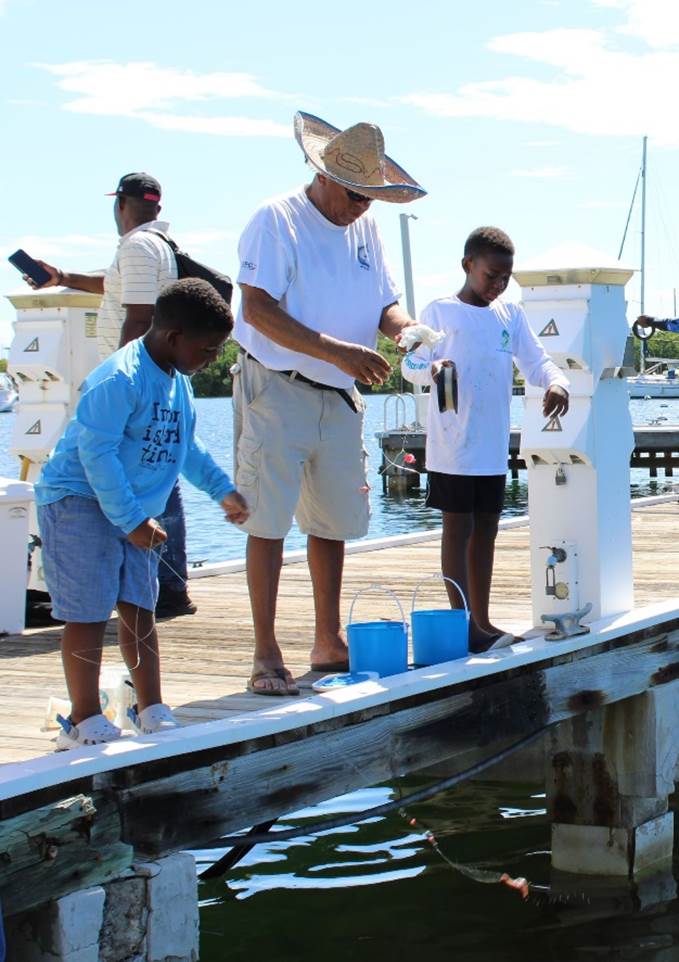
Tots to teens, accompanied by parents and friends, were equipped with Virgin Islands Game Fishing Club-provided handlines, bait, and buckets as they spread out along the marina docks and tried their luck. Club members walked the docks and helped junior anglers and adults alike with everything from fishing techniques to untangling lines. It didn’t take long for the fish-catching action to happen, the release stated.
“I’ve caught a lot of fish,” said 7-year-old Kain LaPlace, one of the entrants to catch a fish shortly after lines-in at 9 a.m. “I like being outside.” LaPlace earned an Honorable Mention prize for his 465-gram Cubera Snapper, it said.
Six-year-old Kai James was equally excited, saying, “I want to catch an eel.”
K’nyaii Rochester did just that by reeling in a 1425-gram Green Moray Eel, earning the Most Unique Fish prize, the release stated.
Christian Bryan,10, brought his catch of a Mangrove Snapper to the weigh station. “I like fishing. It’s yummy.” Bryan made several more trips to the scales, ultimately earning three prizes. These were second place in the Biggest Fish for his 660-gram snapper, Most Fish by Total Weight at 2180 grams, and Most Fish by Count at 19, it said.
Ten-year-old Lynnea Steuerwald tied with Bryan on Most Fish by Count and earned herself a prize, it said.
Ma’liayah Bryan,9, enjoyed the tournament, saying she wanted to participate because “I like to catch fish.”
Bryan and her mother, Masairah Francis, were among the Girl Scouts parent volunteers of Troop 55407 who took part, the release stated.
“Many people think that Girl Scouts only do girly things. We also do more adventurous things like camping, hiking, and fishing,” Francis said.
Grunt, snapper, tarpon, and tomtates numbered among the day’s catch. Junior anglers practiced conservation by keeping their fish in a bucket of seawater until weighed and then released their catch back into the sea, according to the release.
The tournament’s overwhelming success was evident on the young faces as they ate pizza and drank cold drinks following the noon call for lines out. Prize giving followed shortly after, it said.
Captain Red Bailey (center) with 9-year-old grandson Kai Bailey (right) and 6-year-old Cayman Richardson. (Photo by Rian Bareuther/VIGFC)
“The Virgin Islands Game Fishing Club provides handlines and buckets, while Neptune Fishing Supplies donates fishing rods as prizes so kids and families can continue fishing year-round. It’s what we as a Club are all about. That is, passing these skills and a love of fishing to the next generation,” said Kelvin Bailey Jr., president of the VIGFC Board of Directors.
The Virgin Islands Game Fishing Club’s Kid’s Fishing Tournament was sponsored by IGY’s American Yacht Harbor and Island Time Pub, with prize donations from Neptune Fishing Supplies, Lattes in Paradise, Ocean Surfari, Shen Dragon, Red Hook Dive Center, Coki Dive Center, the St. Thomas Swimming Association, Neptune Fishing Supplies, Nomads Bar & Grille and Splash Zone, the release stated.
The Virgin Islands Game Fishing Club’s next event will be the Wahoo Windup on Saturday, Nov. 9.
For more information, call (340) 775-9144 or Email: usvigfc@gmail.com. Check out photos from the event on Facebook.
The Virgin Islands Waste Management Authority advises the community that the LBJ Pump Station on St. Croix is temporarily offline due to mechanical problems, which caused manholes near the Christiansted Harbor to overflow.
The VIWMA’s staff, along with the V.I. Fire Service and the Health Department, is working diligently to bring the station back online and mitigate cleanup efforts as soon as possible.
Motorists and pedestrians are advised to avoid any standing water in the area.
Virtue of the Week focuses on building peaceful and caring communities through understanding and fostering the practice of virtues. The Source supports the Virtues Project and will publish one virtue developed by the project each week.
Creativity
Creativity is the power of imagination. We are open to inspiration, which ignites our originality. We are resourceful and intuitive. We solve problems in new and surprising ways. We know how to play. We take time for dreaming and we discover our own special talents. Creativity connects us to beauty of sound, design, color, movement, ideas and words. It allows us to bring something new into the world. Creativity brings our gifts to fruition.
Quote: “Make an empty space in any corner of your mind, and creativity will instantly fill it.” -Dee Hock
The Practice of Creativity
I treasure my imagination.
I am innovative in solving problems.
I take time for inspiration.
I remember to play.
I develop my gifts through learning and discipline.
I dare to be original.
Questions for Discussion
Do we allow space to solve problems in new and exciting ways in our community?
Do we create conditions that make it easier for community members to bring something new into the world?
As a community, how can we play together? When do we take time for inspiration?
In our community, how can we take time to honor each other’s gifts?
Sign up to receive the Virtue of the Week by email!
Virtue of the Week is provided by the Community Foundation of the Virgin Islands (CFVI) in partnership with the VI Source and Virtues Matter.
About the Community Foundation of the Virgin Islands
Since 1990, CFVI has been a catalyst for positive change in the territory through initiatives committed to youth, learning, family support and the environment. With a professional staff and a volunteer Board of Directors composed of community leaders, CFVI is a trusted advocate and supporter of programs that ensure opportunity and sustainability for current and future generations. CFVI is a registered non-profit organization entirely supported by individual donors, grants, trusts, corporate donations and estate planning. For more information, visit cfvi.net.
About Virtues Matter Virtues Matter was started by a passionate wife-husband team of social entrepreneurs seeking to positively uplift as many lives as possible. We aim to inspire and empower, to build capacity, strengthen relationships, and help everyone lead lives of passion and purpose.
Virtues Matter believes in a world where people are committed to kindness and respect, strive to be their best, and live with hope, courage and in unity. We built the Virtues Cards mobile app, an interactive personal and team development tool, to help people identify and develop key virtue skills. We also offer dynamic workshops, online training, and customized programs to help people cultivate these positive qualities of character. To learn more, visit virtuesmatter.com.
Sonja Sulcer, one of the co-founders of SEAT Caribbean. Which is based on St. Thomas, USVI, proudly announces the launch of the Build Your Faith App™. The platform is designed to help individuals and families manage stress and anxiety while going through health challenges.
Inspired by her journey of overcoming a critical illness diagnosis with the support of her faith, family and friends, Sonja Sulcer has created an app that offers healing prayers, life-giving affirmations and an engaging gratitude activity.
In recognition of October’s being Breast Cancer and Liver Cancer Awareness Month, Sonja is making the Build Your Faith App™ free of charge to everyone in the U.S. Virgin Islands. Use code SEAT2024 to gain access.
About SEAT (Supporting empowering advising training)
SEAT Caribbean is a coworking space located on St. Thomas, USVI, dedicated to supporting, empowering, advising and training U.S. Virgin Islands entrepreneurs. SEAT Caribbean offers modern workspaces, private offices, dedicated desks and conference/meeting rooms to members and the public.
Check out our weekly weather forecast with Jesse Daley, covering Sunday, Oct. 6, through Saturday, Oct. 12. Our YouTube playlist is updated every week, AND check out Jesse’s daily weather updates here.
The St. Croix Animal Welfare Center sent out a cry for community help Friday after receiving no response when they inquired about a new contract and after many late payments from the government to partially cover work for which the V.I. Government is responsible.
The appeal was emailed and included names, addresses, and phone numbers for St. Croix senators, announcing the closure of the Pets from Paradise, limited services, and asking supporters to write government members to ask for financial support.
Becca Hughson, director of public relations and marketing for the animal shelter, told the Source Saturday that the non-profit organization started inquiring about a new contract at least a month before it was due, but received no reply. The previous contract expired Monday and since payments are usually weeks late, they didn’t want to leave anything to chance.
SCAWC has been under contract with the V.I. Government’s Department of Agriculture for many years. It performs a contract that is ultimately the responsibility of the V.I. Government according to the V.I. Code.
Currently, the $175,000 government allocation pays for 250 animals a year. However, the actual annual intake is between 2,500 and 3,000 dogs and cats, according to shelter statistics. Under the GVI contract, SCAWC is supposed to be an open-door shelter and welcome every animal delivered to them – even if they are sick or aggressive. Another $50,000 helps fund the spay/neuter program.
According to SCAWC Executive Director LaToya Petty, the organization is “in the hole $500k every year trying to fulfill the contract” taking on the stray animal population on St. Croix. She has been trying to communicate with the VIDOL for months, she said, to begin negotiations on the new contract, without success. Recently, she received an “aggressive email” stating the shelter will get the same funding as last year but said nothing about discussing the document.
Petty said she had to borrow money to pay staff this month and will try to raise $200,000 at the end of the year to catch up. They will depend on donations and fundraising to make ends meet.
Until something changes financially, the executive director said SCAWC will continue to do what it can but only will accept animals on a case-by-case basis, and spay/neuter surgeries will only be offered during specific privately funded events.
The SCAWC’s goal is to give all animals the best outcome possible, stated Petty, but “we don’t guarantee it with buckets of puppies being dropped off.” It’s impossible when we’re overcrowded, she added.
“We have been getting the grant for a lot of years, but haven’t gotten a raise. It’s not appropriate or possible to fund the entire thing,” Jackie Goodyear-Johnson, co-president of the SCAWC board, told the Source. “We don’t feel safe depending on it without a signed contract or money in the bank.”