



In Part 1 of this series I wrote about the geological formation of the forest within the newly established Maroon Sanctuary Territorial Park on St. Croix. I briefly spoke about how the Virgin Islands were once part of the greater landmass of Puerto Rico during the submarine development as an island some 125 million years ago. In Part 2 of this exploration of forest development within the park, I will briefly touch on the indigenous people’s influence on the terrestrial environment in Puerto Rico and the Virgin Islands, specifically the island of St. Croix.

The effect of the indigenous people’s (Amerindians’) occupation of Puerto Rico, beginning perhaps around 4000 B.C., was probably limited to small clearings of land before the advent of European settlement after the 15th century. The same situation occurred for the island of St. Croix with the indigenous people’s occupation of the island. The introduction of animals such as cattle, and the large-scale agricultural development, changed the ecological niche of the forest ecosystems of both islands.
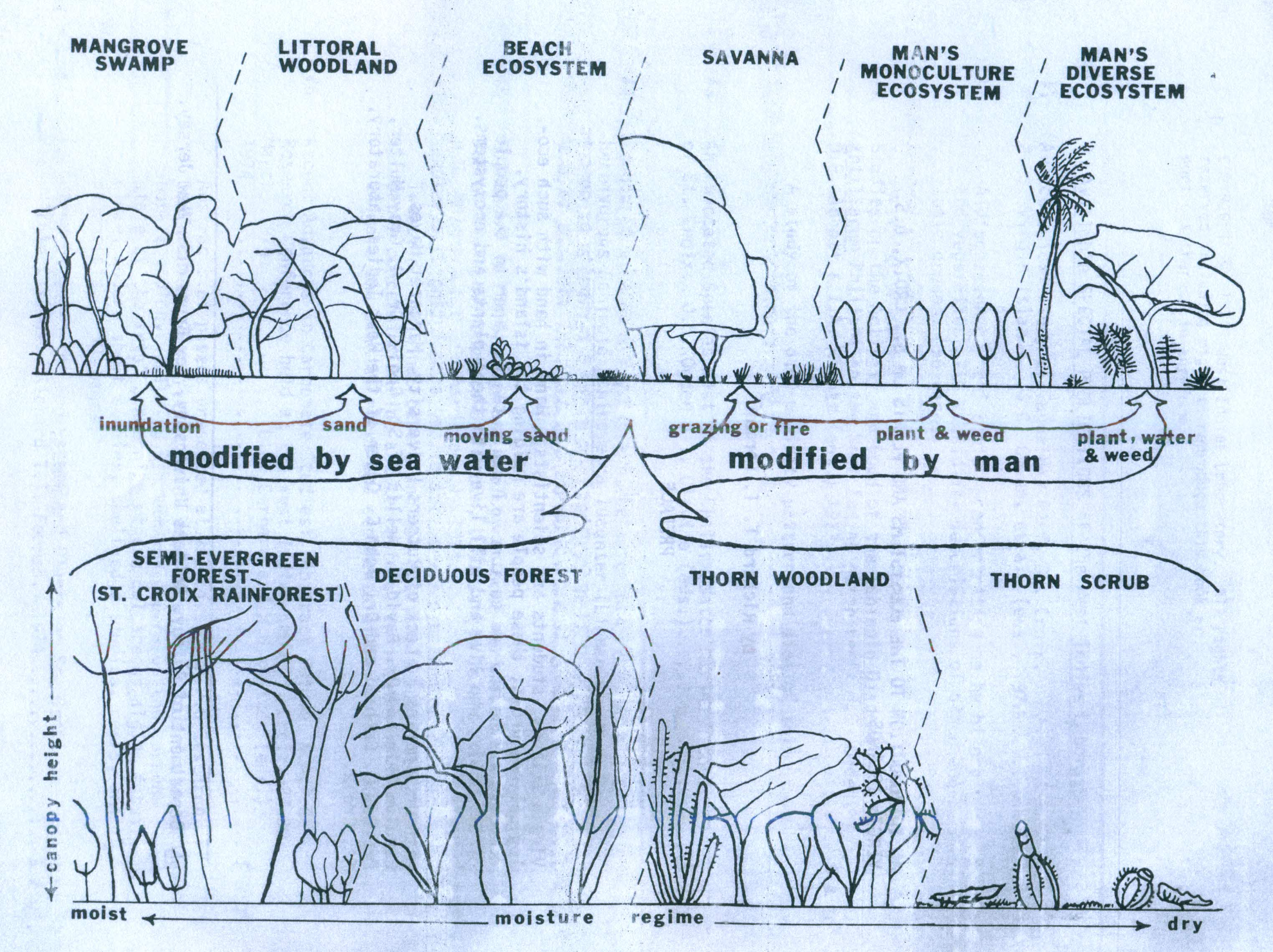
Puerto Rico was mostly a tall mesophytic forest, varying from tropical rain forest in the wettest areas to the cactus-scrub landscape of the driest southwestern coastal vegetation life zone of the island. St. Croix doesn’t have a true tropical rain forest, but much wetter forest with patches of micro-tropical rain forest ecosystems in the west, northwest, and northeast central part of the island to the deep valleys of Blue Mountain.
By the end of the 1900s, the primeval forest of Puerto Rico disappeared almost completely. St. Croix’s forests had fallen into the same situation, thanks to the colonizers. However, within the Maroon Park the forests were protected from being cut down by the Maroons’ harassment over several decades, where planters couldn’t develop the northwest and northeast section of the island into sugar plantations until the 1750s and 1760s. Estate Bodkins, now part of the Maroon Sanctuary Park, didn’t develop until the 1800s. The plaque over the entry of the Bodkins sugar mill is marked 1808.

In Estate Wills Bay, the heart of the Maroon Sanctuary Park, that area was developed in the late 1760s as a sugar plantation. The entry of the sugar mill in Wills Bay Estate is marked 1769. The Bodkins and the Wills Bay areas are difficult terrain, with steep slopes facing toward the Caribbean Sea. In the northwest, patches of virgin forest still exist due to the steep slopes and valleys that runaway slaves used as a refuge. The forests in these areas are totally different, where native plants like bromeliads cover the floor like a carpet.
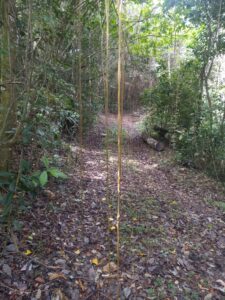
Thus, the forests in the Maroon Park have different micro-climate ecosystems, depending on the topography, rainfall, and wind impact on the landscape of the area. Isolated ravines (streams) in the higher northwestern and northeastern portion of the island usually contain semi-evergreen forest. The soil in these areas holds more moisture than most of the island, and a distinct leaf litter layer is generally present. Wind desiccation is low in these protected, steep-sided ravines.
Within the Maroon Park, most woody plants are evergreen, but many canopy trees are deciduous. About half of the trunks of these trees have smooth gray bark, and large tree buttresses are uncommon, except in the deep valley basin, the moist tropical forest of the park. Historically, trees with buttress root structures, such as Kapok or Silt Cotton (Ceiba pentandra), were probably more common but almost eliminated during the deforestation of the 1700s into the early 1900s.
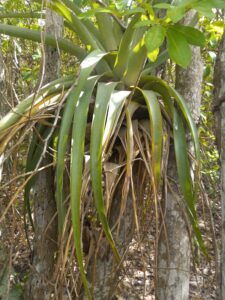
Also, most trees within the park don’t have flowering plants growing as epiphytes on their branches. In the virgin forest (northwest) of the Maroon Park’s rugged ridge there are more flowering plants on trees, which indicates that at one time there were more epiphytes hanging on tree branches in the forest canopies. The uncommon bromeliads that hold water grow mainly on Ceiba, although they can be found on other large native trees such as Gre-Gre (Bucida buceras) in the forest of the Maroon Park.
In the park northwest and northeast of Mt. Eagle, extending to Blue Mountain Forest, ferns, orchids, and aroids (Araceae) are not so common. However, in isolated spots, epiphytes such as orchids and ferns may be found in considerable abundance. Apparently, the populations have drastically decreased by a long history of man’s land use and by collectors. A few years ago, orchids and other rare plants were removed from Mt. Eagle because of wild goats eating the plants.
I was told that the orchids and other species of rare plants would be returned in the wild once the goats are no longer a threat to them. There are species of Piperaceae growing in openings within the park. The northwest park has a dense tropical dry/moist evergreen and deciduous forest, especially in the areas of Annaly Bay, Wills Bay, Wells Bay, Sweet Bottom Bay, Maroon rugged ridge, and Bodkin’s ridge, with very deep-sided steep slopes facing the Caribbean Sea. This is a beautiful forest, often seen with clouds or fog during overcast weather that brings in heavy or light rain showers.
The northeast Maroon Park where Mt. Eagle summit is located, especially the eastern side of the mountain facing the north and west side (particularly Estate North Star), has a dense, moist tropical forest with towering trees toward the blue sky. These forests also are covered by thick cloud or fog at times during heavy or light rainfall showers. These forests are known for their stemmed, grape-like vine, Cissus sicyoides (Vitacease), with twining tendrils and hanging aerial roots exceedingly abundant in the canopy trees.
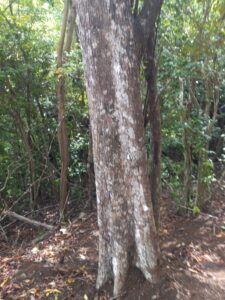
The North Star Forest below Mt. Eagle, including in the ravines (streams) of both northwest and northeast central forests of the park, are known for an abundance of Cissus sicyoides hanging aerial roots. Believe me, the forests give the appearance of a “jungle.” Nonetheless, on the leaf surfaces of some trees green algae are common due to the constant moist environment. Crustose lichens are present in the forest along with bryophytes. Both foliose lichens and crustose are common on the bark of the trees. Leafy liverworts, crustose lichens, and moss or foliose lichen grow on rock outcrops and boulders in the streambed.
Comparing the northwest and northeast central forests of the park with semi-evergreen forests elsewhere in the American tropics, these forests have higher relative dominance by 3 to 7 species, lower species diversity due mainly to deforestation historically, and a higher percentage of exotic non-native species. The park forests have a remarkable density of hanging aerial roots and leafy vines and are narrow strip forests remaining from the earlier period of more extensive coverage in the mountains of Maroon Country.
In Part 3 of this series, I will talk briefly about the understory of plants within the park forests and species of trees most common in the Maroon Sanctuary Park.
Read Part 1 of the series here.
— Olasee Davis is a bush professor who lectures and writes about the culture, history, ecology and environment of the Virgin Islands when he is not leading hiking tours of the wild places and spaces of St. Croix and beyond.
Editor’s Note: Opinion articles do not represent the views of the Virgin Islands Source newsroom and are the sole expressed opinion of the writer. Submissions can be made to visource@gmail.com.