


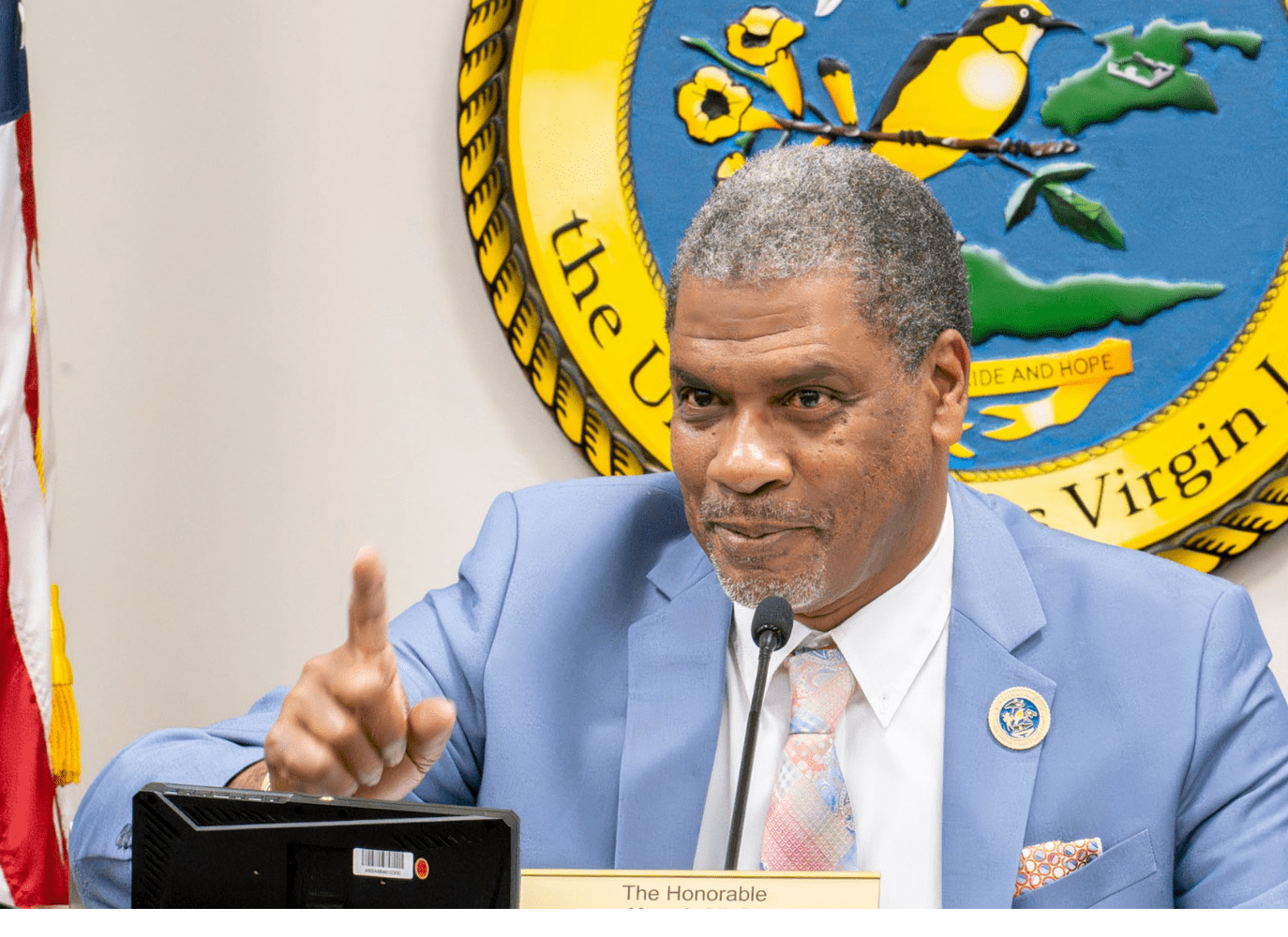
The Senate Education and Workforce Development Committee on Wednesday discussed a sweeping St. Croix school redistricting plan that would shift hundreds of students, open a new PreK – 8 campus and close John H. Woodson Junior High.
The committee heard testimony from the Virgin Islands Education Department on the proposal to redraw school attendance zones across St. Croix. Officials said the changes would affect hundreds of students and reshape how they are assigned to schools across the island.
Education Commissioner Dionne Wells-Hedrington told lawmakers the redistricting effort is aimed at correcting decades of imbalance between where students live and where they attend school, reducing transportation costs and addressing aging infrastructure. But the proposal also drew concerns from senators about transparency, equity and whether the territory is prepared for such a large-scale transition.
“The redrawing of the school district boundaries reflects the shifts in population and demographics and reallocation of resources. Students shall attend school based on residential boundary lines that feed into the various schools,” said Wells-Hedrington.

Under the plan, which would take effect in the 2026–27 school year, the new Arthur Richards PreK – 8 campus at Estate Paradise would add significant capacity for crowded western St. Croix schools, including Eulalie R. Rivera PreK – 8. The modern facility is designed for roughly 720 students across 29 classrooms, with additional “flex” spaces that can be converted as needed.
By shifting students from nearby neighborhoods into Arthur Richards and redrawing surrounding school boundaries, education officials say they can even out enrollment that has become lopsided over three decades of school closures and housing changes.
“Simply put, students are not attending the school closest to their residential address, and busloads of students are passing each other daily,” Well-Hedrington told senators, arguing that aligning campuses with residential clusters would shorten commutes and cut transportation spending.
Currently, the Education Department contracts for about 950 miles of bus routes each day for general and special education students at $16.01 per mile. Wells-Hedrington said having buses “traversing our highways” to ferry students past their nearest schools has become one of the department’s most expensive line items, and that redistricting is intended to reclaim some of that money for classrooms and building upkeep.
“The current system is no longer aligned with where our students live, how our schools are utilized, or what it costs to operate efficiently … If no action is taken, the territory will continue to face overcrowded classrooms … and escalating transportation costs that reduces instructional time and strain already limited resources,” said Well-Hedrington.
However, the Virgin Islands Board of Education indicated it is not yet prepared to sign off on the redistricting map. Board Chair Kyza Callwood told lawmakers the board “was not involved in the creation or adaptation of the redistricting plan” crafted by the Education Department and sees its role as ensuring any changes do not undermine access to quality schools.
Callwood said the board’s support is contingent on the department proving the plan will be implemented fairly and transparently. He called for a comprehensive equity analysis to show which communities and student groups would be moved and making sure “no group of students is disproportionately affected,” and urged officials to demonstrate that all schools gaining students will have adequate teachers, support staff and facilities.
“The board requires assurance that all schools are adequately prepared for enrollment shifts,” he testified, “including proper staffing, instructional materials, technology and facility readiness to support student success.”
Communication with families was another major concern. Callwood pressed for a centralized redistricting support call center to serve as “a primary point of contact for parents, guardians and community members,” staffed with people who can answer questions about school assignments, transportation and program availability in multiple languages.
He also recommended creating a redistricting advisory committee that includes the commissioner’s office, superintendents, special education, parent-teacher associations, the Board of Education, the business community and the Senate.
Lawmakers did not oppose the redistricting outright but pressed Wells-Hedrington on whether the system is prepared for such a significant change. Several questioned the 2026–27 timeline, requested detailed boundary maps and transportation data, and raised concerns about impacts on special-education students, parents and students who could lose trusted teachers if reassigned.
Others focused on what the changes will feel like for families. They worried parents could learn of new school assignments only after buying uniforms and said many households will miss website notices or radio spots unless letters go home with students.
“I really have some concern with this entire redistricting … we have to make sure that families are notified in a timely manner and they’re prepared, because if not, we’re going to have serious problems.” Sen. Franklin Johnson said.
Before any lines are finalized, senators urged the Education Department to prove that receiving campuses are ready for a larger student body, including showing that classrooms are free of mold, core positions are filled, and programs such as ESL and special education can be maintained at least at current levels.
Sen. Kenneth Gittins and other senators added that decisions must be data-driven. “I want to make sure that the department is making policy decisions based on confirmed migration data and not on projected assumptions tied to housing redevelopment, because this could change at any time,” he said.
One of the most contentious pieces of the redistricting plan is the decision to shut down John H. Woodson as a junior high. That move was complicated by testimony from Craig Benjamin, executive director of the Bureau of School Construction and Maintenance, who told senators a recent walk‑through found John H. Woodson “fully operational” after more than $5 million in mold remediation and roof repairs this school year, with major systems functioning and only minor maintenance needs. Lawmakers used that contrast to question whether it makes sense to close a campus that has just received significant investment.
Wells‑Hedrington said she remains optimistic that the redistricting “represents a necessary and strategic step toward creating a more efficient, equitable and sustainable public education system in the Virgin Islands,” calling it an effort “grounded in data, informed by changing population patterns, and guided by our responsibility to provide students with access and quality to quality education within their communities.”