


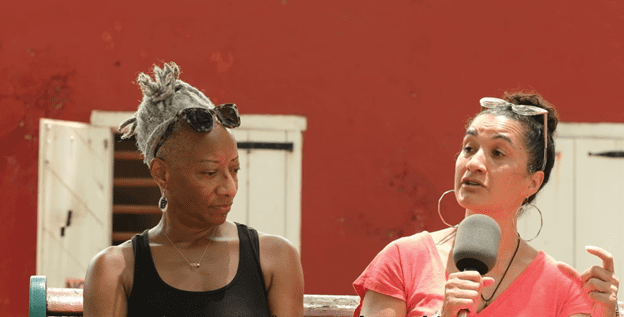
Archive, and Memory in the U.S. Virgin Islands. (Screenshot from YouTube video)
Sometimes the most consequential work does not happen on a stage or inside an institution, but in the quiet spaces between meals, in shared pauses, in conversations that stretch late into the evening. That was the energy that carried Embodied Histories weekend, a gathering of artists, scholars, and cultural workers whose collaboration felt less like an event and more like a reckoning.
“We need to strike while the iron is hot,” said Monica Marin, chief curator of the Division of Libraries, Archives and Museums, reflecting on the urgency that shaped the weekend. For Marin, the work is not episodic. It is long-form, relational, and deeply rooted in a belief that Virgin Islands artists are not simply creators, but living archives. “Our artists are archives,” she said. “They are reclaiming the narrative. They are excavating the historical record. They are the truth tellers.”
In this interview, Monica Marin, Paloma McGregor, Cynthia Oliver, and Chalana Brown reflect on Embodied Histories, reclaiming Virgin Islands narratives, and the power of collective cultural work.
That conviction runs through Marin’s decades-long practice, which bridges contemporary art, movement, and decolonial scholarship. Her interest in tangible and intangible heritage converged years ago through collaborations with two art historians, Thor Mednick and Bart Pushaw, whose research on decolonial practice and the repatriation of Indigenous and African diasporic artifacts mirrored her own questions about absence and access.
“We don’t have our tangible artifacts,” Marin said plainly. “We had petroglyphs in Salt River — Atabey and the bat god — excavated by Nazi archaeologists. They’re sitting in the basement of the National Museum. Our students need to know who the people of AyAy were and be able to see what they made.”
The absence is not abstract. Marin spoke of early African percussion instruments documented on St. Croix plantations, of basketry, woodworking, dolls, and material culture that shaped everyday life but now live in off-island collections. “Imagine being able to borrow those things,” she said, “and reimagine them through contemporary artists.”
Embodied Histories took that idea seriously, structuring the weekend around both tangible and intangible heritage. Woodworker Kurt Marsh spoke about vanishing craft traditions and the urgency of keeping them alive. Priscilla Hinds-Rivera Knight shared basket-weaving knowledge alongside work on a forthcoming catalog. Pushaw presented images of Virgin Islands life sourced from auction houses, including a striking post-emancipation painting of Black Virgin Islanders dancing. Movement artists, scholars, and performers explored how the body itself becomes a vessel for memory and reclamation.
“Dance is a space of revolution,” Marin said. “People aren’t always familiar with the body as a medium, but when you’re watching someone perform, you start to feel in ways other art forms can’t reach. It hasn’t been properly archived, even though Bamboula and Cariso were used to communicate.”
That sense of embodied knowledge resonated deeply with participants. Paloma McGregor described movement as “a way of activating our full intellectual capacity,” calling the body “an ancestral archive coming forward.” For her, returning home to the U.S. Virgin Islands to work alongside Crucian cultural producers was fortifying. “You might be able to go faster alone, but you can’t go deeper alone,” she said. The weekend, she added, felt like a call-and-response between the territory and the mainland, weaving shared struggles alongside shared visions.
Cynthia Oliver, a Crucian dancer and scholar whose work examines pageantry, feminism, and performance as resistance, spoke about curiosity as an act of preservation. “I’ve always been intellectually curious about how things come to be — the backstory, the history,” she said. “It’s about revealing Black genius.” Even the smallest gestures, she noted, are rooted in cultural memory. “The air hits my skin and goes into my lungs,” she said gently. “Ah deh yah! It changes the attunement.”
Throughout the weekend, the line between artist and archivist dissolved. “The institution is sort of like us,” said Stephanie Chalana Brown, emphasizing that the preservation of cultural knowledge does not have to wait for formal validation. “People of the diaspora have always done this work.” Still, the hope remains that these living archives will one day be housed locally. “Hopefully the archives will be in our libraries here,” Brown said.
For Marin, the work ahead is already unfolding. Plans are underway for continued gatherings, including work on St. John next summer and a longer-term vision for a major exhibition in the near future. The collaborations, she stressed, are lifelong. “There were moments that touched me to the soul. It affirmed why we do this work — to honor their legacies and pass the torch to the next generation.”