


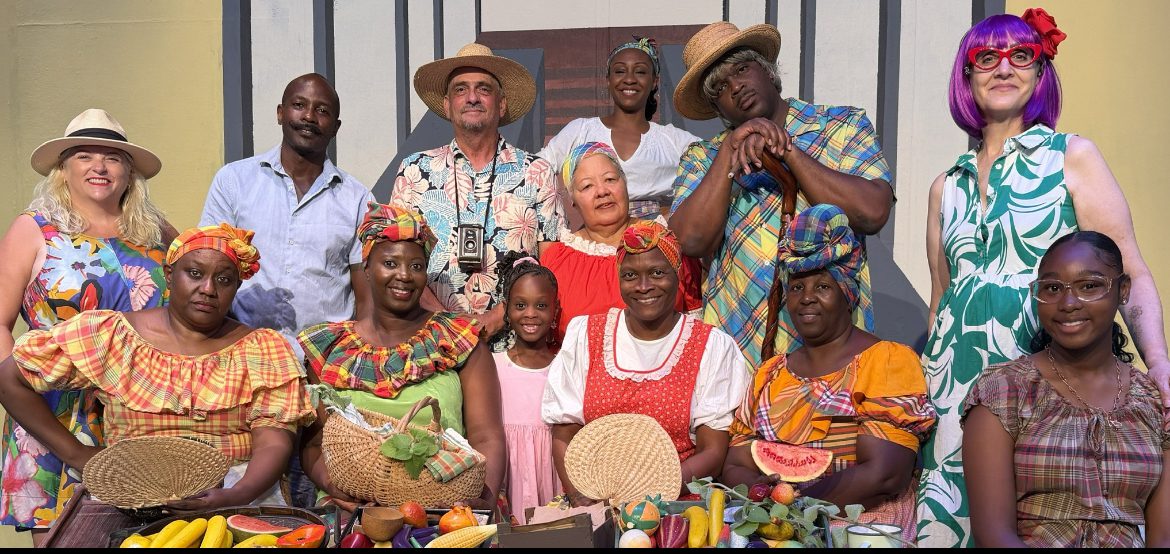
“Sarah & Addie”, the beloved collection of short comedic plays by late Crucian playwright Anton C. Teytaud, drew a lively and enthusiastic crowd to Caribbean Community Theatre on Sunday, where audiences responded with near-constant laughter to its sharp humor, colorful dialect, and affectionate portrayal of mid-20th-century Crucian life.
Under the direction of Eileen Bishop Des Jardin, the production brings to life eleven vignettes centered on Sarah and Addie, two market women whose running commentary on island happenings serves as both comedy and social observation. Performed in Crucian dialect by Andrea Elsweeta Christian, Glenderlyn David, Sheelene Gumbs and Cleon D. Lynch, the characters embody the wit, wisdom and gossip that once made market vendors some of the most informed and influential voices in the community.
Written in Crucian vernacular, the play celebrates the market women who, long before social media and talk radio, served as trusted sources of news, humor and local insight. As the production notes, while taxi drivers may be among the best-informed people in New York and barbers may fill that role elsewhere, on St. Croix, anyone seeking the latest news went to the market.
Teytaud’s Sarah and Addie are irrepressible gossips who eagerly weigh in on everything from tourists and traffic to wayward husbands and neighborhood scandals. Their observations, delivered through the rich rhythms and colorful idioms of Crucian speech, form the backbone of a production that is as much a celebration of language as it is a comedy.
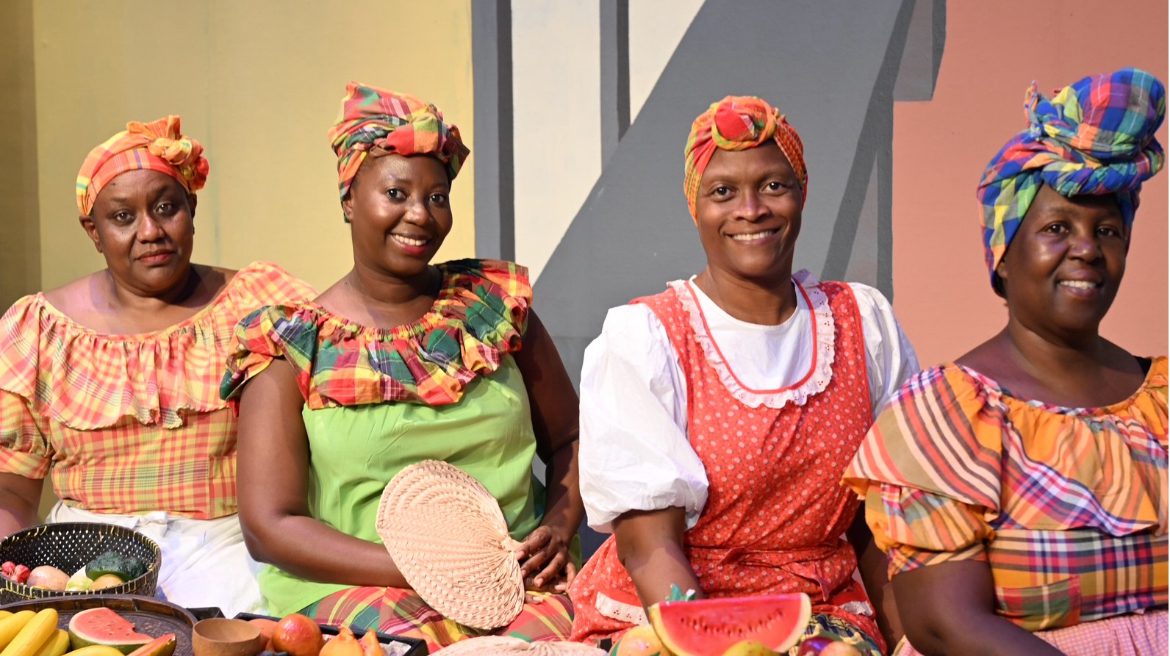
One of the production’s greatest strengths is its embrace of the poetry and musicality of Crucian dialect. The vivid turns of phrase and distinctive expressions that characterize the local vernacular are on full display throughout the performance. While a glossary in the program helps guide those less familiar with the language, many of the play’s biggest laughs come from nuanced references and colloquialisms instantly recognizable to local audiences.
The production’s minimalist set, consisting solely of Sarah and Addie’s neighboring market stalls, provides an effective backdrop for the pair’s expansive commentary on island life. From this small corner of the marketplace, the women offer observations that touch on tourism, culture, community relationships and the changing character of St. Croix.
One particularly memorable vignette, “Addie & Sarah Meet the Tourists,” pokes fun at visitors who view island life through a narrow lens of tropical stereotypes. When a camera-toting tourist attempts to photograph the women as though documenting a disappearing culture, Sarah and Addie quickly turn the tables, insisting on photographing him instead, complete with his floppy hat, baggy shorts and sunburn-prone complexion.
Through scenes such as “Purple Hair, Fish Poisoning and Other Matters,” “The Dangers of Crabbing, Traffic Lights and Wayward Husbands,” and “Of Gambers & Chicken Thieves,” Sarah and Addie transforms everyday conversations into a humorous and insightful portrait of Crucian culture, proving that some of the island’s most enduring wisdom can still be found in the marketplace.