


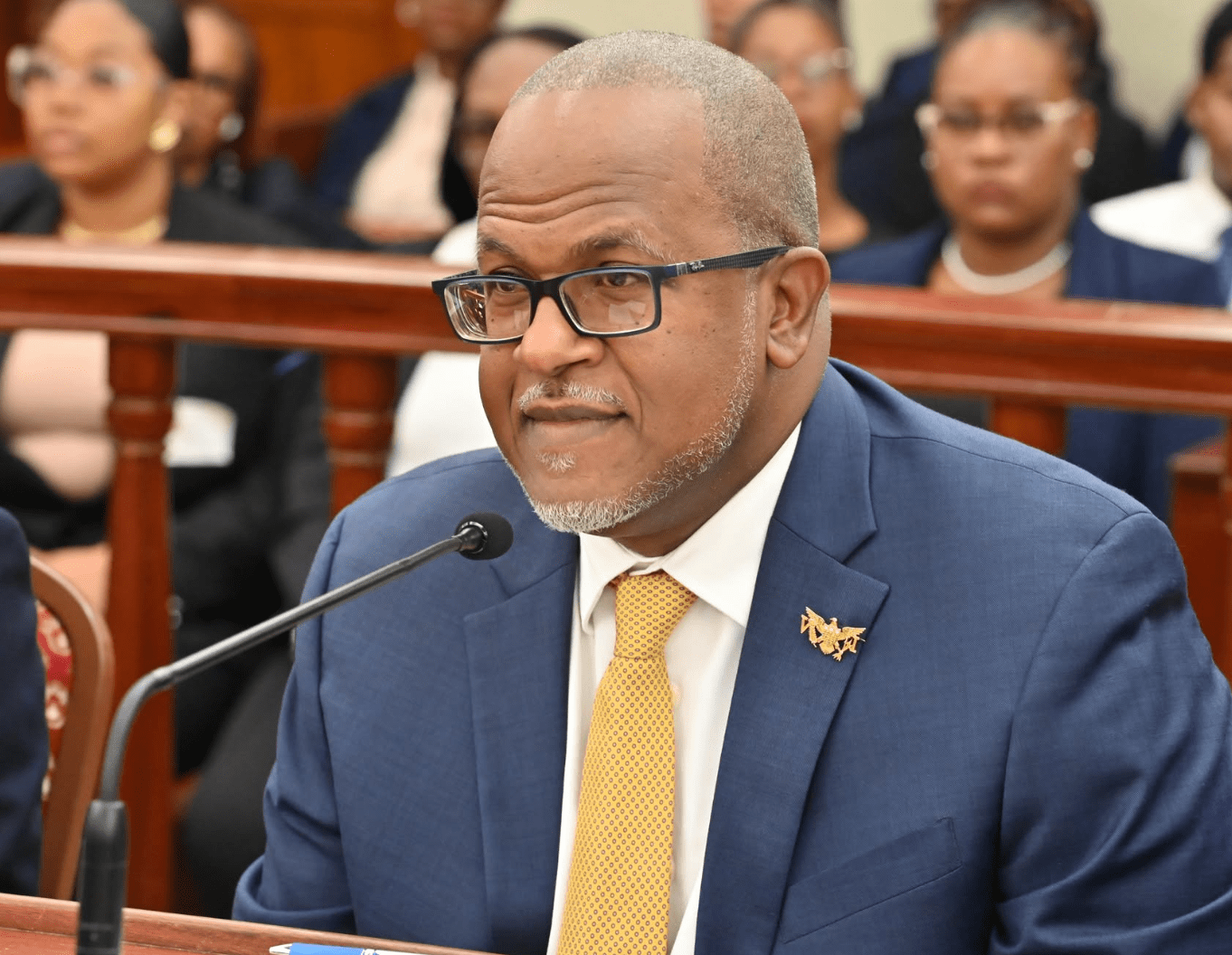
The Senate Budget, Appropriations and Finance Committee heard testimony Tuesday from Office of Management and Budget Director Julio Rhymer Sr. on financial management issues.
Rhymer told lawmakers the government has paid about $140 million in prior-year obligations that were not entered into the financial system when they were incurred and instead appeared later, sometimes after new appropriations had been approved. He said repeated audit findings show that agencies have failed to reconcile accounts and record invoices on time, leaving the administration and the Legislature without a complete picture of the government’s liabilities.
Rhymer said the government’s response to ongoing financial control issues is to centralize oversight of agency finances. He said all chief financial officers and business office directors now report to the commissioner of Finance, working with OMB, under an executive order issued earlier in the term.
As part of the restructuring, Rhymer said OMB has established a Financial Responsibility Unit and a separate compliance unit to focus on agencies with repeated audit findings, delayed federal grant drawdowns or weak budget controls. The units can be assigned to work within an agency’s finance office to review spending, assist with reporting and develop corrective action plans, and may recommend changes in financial leadership if problems persist.
He identified the Health Department and Agriculture Department as agencies requiring significant intervention under the model. He also pointed to the Education Department, which remains under federal third-party fiduciary oversight and continues to face audit and grant management issues.
Ending the third-party arrangement could save the territory about $2.6 million annually in fiduciary costs, according to Rhymer, who said the government has asked the U.S. Department of Education to transfer oversight to OMB’s Financial Responsibility Unit. He said federal officials have required additional steps before approving the transition, including strengthening Education’s fixed asset policy and completing a biannual inventory of its assets. Rhymer said the department is “on the cusp” of meeting those requirements but there is no confirmed timeline for when the arrangement will end.
The hearing also examined the use of federal pandemic aid and the impact of its expiration. Rhymer said the Virgin Islands received about $547 million under the American Rescue Plan Act to support health care, infrastructure, workforce development, and community revitalization. He said roughly $14.7 million remained as of the hearing, down from about $16 million in late March, with all funds required to be spent by Dec. 31.
According to figures cited during the hearing, about $195.6 million in ARPA funds have been used for payroll and vendor payments. Senators said the federal aid has helped cover operating costs that would otherwise fall on the general fund. Sen. Kurt Vialet said the current spending framework is “a false budget floated with federal funds” and warned that “reality is beginning to hit us” as that support runs out.
Hospitals are another major source of financial pressure on the government, with lawmakers questioning how they are managing revenue they are already owed. Rhymer, who chairs the hospitals’ finance committee, said staff at Schneider Regional Medical Center and Gov. Juan F. Luis Hospital do not consistently collect patient co-pays at the time of service. He said he has observed patients leaving without paying and that bills are sometimes issued months later, reducing the likelihood of full recovery.
To address outstanding obligations, the Legislature previously authorized a $3.5 million line of credit for each hospital, allowing the government to pay certain overdue bills directly upon receipt of documentation. Rhymer said Juan F. Luis Hospital has begun submitting bills under the arrangement and receiving payments, while Schneider Regional Medical Center has not yet accessed the line of credit.
Rhymer said the government is pursuing longer-term structural changes, including a $400,000 U.S. Department of the Interior grant to hire a consultant to develop a consolidated strategy for both hospitals. The plan includes a single executive leadership structure and a consolidated financial strategy for the two facilities.
The committee also discussed new oversight measures for nonprofit organizations that receive government funding. Rhymer said the territory funds roughly 200 nonprofits through the miscellaneous section of the budget at a total cost of about $7 million a year.
He said OMB has established a Not-for-Profit Unit to review whether those organizations are in good standing with local and federal tax and corporate agencies, withhold payments from groups that are not compliant, and, in cases where problems persist for more than a year, he said OMB would “request the legislature to no longer fund” that organization.
Sen. Marvin Blyden said many nonprofits “play a critical role” and “fill the gaps in many areas” and urged OMB to work with them rather than “just cutting them off” when compliance problems arise.
Rhymer also acknowledged that the government’s transparency website is offline. He said the previous version contained data accuracy issues and that OMB and the Department of Finance are working with IT staff to rebuild the data system. He said the goal is to relaunch the site by Oct. 1, the start of the next fiscal year.
Rhymer said one of the government’s most persistent audit findings is that agencies fail to reconcile accounts and record expenses in a timely manner, leaving some invoices out of the financial system altogether. Several senators said those weaknesses could open the door to improper or even fraudulent spending and make it harder to track how public funds are used, while Rhymer maintained that better “accountability” and stricter adherence to existing financial procedures will be needed to prevent similar problems in future budgets.