


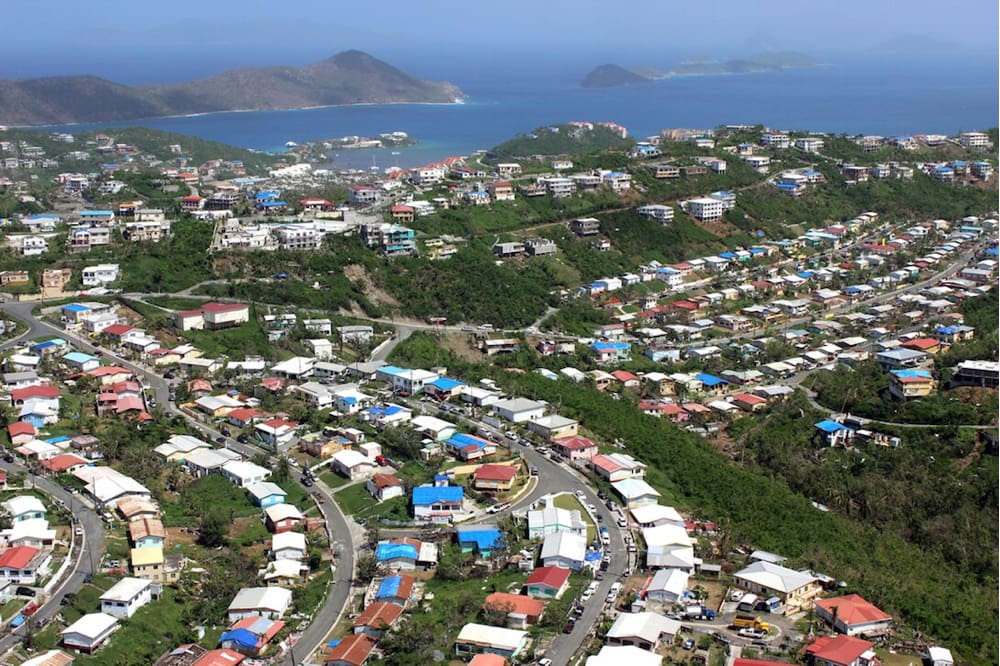
Puerto Rico native Abiel Osorio Cotto is getting used to the Pennsylvania winters five years after he moved there, albeit unwillingly, because what he thought would be a lucrative job repairing roofs on St. Thomas in the wake of hurricanes Irma and Maria instead left him stranded and penniless.
Osorio Cotto is a plaintiff along with eight others in a long-running lawsuit against the companies that had contracts under the STEP recovery program — also known as the Emergency Home Repair Program Virgin Islands — that was funded by the Federal Emergency Management Agency and managed locally by the Virgin Islands Housing Finance Authority.
Defendants in the case are Gerald Toliver, doing business as Blue Water Staffing Company; Thomas Sutton; TJ Sutton Enterprises, LLC; Citadel Recovery Services, LLC; AECOM Caribe, LLP; Bellavista Properties, Inc., doing business as Scott Hotel Bellavista; Leonard Ramsey, doing business as Ramsey Hotel; and Celestino White Sr., doing business as Celestino White Management and Consulting Firm. All have denied wrongdoing.
According to the complaint — which last month was moved to the Complex Litigation Division of V.I. Superior Court and is headed to mediation on Tuesday — the Housing Finance Authority contracted with AECOM Caribe for the STEP program, which in turn contracted with Citadel to provide construction services, which contracted with the Sutton defendants for the work, which contracted with Bluewater for manpower.

The plaintiffs, one of whom has since died and is now represented by his two children, were hired by the Sutton defendants, Citadel and Toliver on Jan. 14, 2019, on promise of earning $2,200 weekly, according to the complaint.
Instead, they claim they were never paid — at one point working 37 days straight repairing roofs on St. Thomas in the scorching sun without food, bathroom facilities and sometimes water — and were abruptly fired and forcibly evicted from accommodations arranged by their employers when they complained and demanded compensation.
The men, represented by Peter Lynch of Flag Law V.I., first filed suit in V.I. Superior Court in November 2020, alleging they were victims of human trafficking and forced labor. The case was removed to District Court in February 2021, where it was ordered into arbitration that remains pending before the American Arbitration Association. Lynch subsequently filed a pared-down complaint in Superior Court in March 2022, alleging three counts of labor human trafficking in violation of Virgin Islands Code Title 14, which was the subject of last month’s hearing to determine if it is a complex case.
Just a Contract Dispute?
At the hearing before Judge Alphonso G. Andrews Jr., head of the complex litigation division, AECOM Caribe’s attorney described the case as a simple contract issue that belongs in arbitration, even though the men have said they never saw or signed a contract, despite repeatedly asking for one before and after they arrived on St. Thomas to work.
“I don’t agree that there is a presumptive complexity here over the fact that there are a lot of words and multiple parties,” said Michelle Meade of Meade and Teague, LLC on St. Thomas. “It is simply a case of nine people who worked for, at most, 40 days and didn’t get paid. The fact that it’s tangentially arising after a hurricane doesn’t make it complex.”
Lynch disagreed, both about whether the case is complex — it is, he said — and also on the appropriateness of arbitration.
“[T]he defendants/respondents’ entire theory of arbitration hinges on the existence of a contract. This is the contract which the plaintiffs begged to see, begged to sign, were never shown, never had an opportunity to sign,” said Lynch. “They came to St. Thomas based on promises of pay which never happened. So that’s why these are human trafficking statutory claims, not contract claims. So, arbitration is not appropriate for these types of claims.”
As for concerns that the plaintiffs are not interested in a global resolution of all the claims, “I would inform the court that we have nine plaintiffs now. We started in 2020 with eight. One of our plaintiffs has deceased, and there is another one who is not in very good health. So, to suggest that we are not anything but all in is not correct. We are very interested in resolving this matter as soon as possible,” Lynch said.
He also noted that arbitration has been painfully slow in the District Court case, with the venue and forum the subject of arguments up until August, and that each of the respondents — AECOM, Citadel and TJ Sutton defendants — filed a single motion to dismiss. “That’s as far as arbitration has got,” he told Andrews.
Bipartisan legislation has been introduced in Congress to address federal laws governing arbitration — critics say they force disputes behind closed doors and deprive plaintiffs of their day in court — most recently by U.S. Senators Josh Hawley (R-Mo.) and Richard Blumenthal (D-Conn.).
Under current law, the legislators said, traffickers shield themselves from accountability through coercive loopholes in employment contracts that effectively force victims to relinquish their legal remedies available under the Trafficking Victims Protection Act.
“Human trafficking survivors deserve justice, not forced arbitration,” Hawley said in a post on his website. “This legislation puts power in the hands of survivors and gives them the power to hold human traffickers accountable.”
“Forcing victims of modern-day slavery into a rigged arbitration system deprives them of one of the most powerful tools they have to hold their traffickers accountable: access to justice,” Blumenthal said.
‘It’s Been a Rollercoaster’
Osorio Cotto and fellow plaintiff Jeremy Santos Ramirez discussed in recent interviews how, five years later, they remain hopeful they will be compensated for the episode they say turned their lives upside down, both financially and emotionally.
“In my wildest dreams I never dreamed I would live in Lebanon, Pennsylvania,” Osorio Cotto told the Source. “It was a matter of cause and effect. It’s been a rollercoaster.”
Santos Ramirez said the men who were married with families and thought they’d be sending money home every week instead had to call on their spouses to send them cash during their time on St. Thomas, which meant bills piled up at home. The financial stress, coupled with their own recovery from the 2017 hurricanes that also devastated Puerto Rico, caused some of those relationships to break, he said.
He made it back home to his wife and son, living without water or electricity, but had to leave all his equipment behind — harnesses, tools — because he did not have the money to ship it to Puerto Rico, where he has his own construction business. After seeking counseling, he said he’s back on his feet today. He has friends who experienced similar problems working on St. Croix, but they have already had their cases litigated.
“We’re the only ones waiting for five years. It’s crazy,” said Santos Ramirez, whose first language is Spanish, like the others. “Sir, you’ve got the money to pay us. Why not just pay us? If they pay us, there would be no lawsuit. I don’t know what they have in their mind. They didn’t do anything well. That’s why we’re here,” he said.
Osorio Cotto — “literally almost broke” after working at a St. Thomas gas station to earn enough money to send himself and his father, Benjamin Osorio, also a plaintiff in the suit, home to Puerto Rico — landed in Pennsylvania after hearing about a job at a chicken processing factory that also provided housing, and transportation to and from work.
“It wasn’t the best job,” but it was a stepping stone, he says now. “It was horrible at the beginning. I would never have dreamed I would be working in an environment like that.” The 12-hour shifts standing on an assembly line in freezing temperatures were “a nightmare,” he said.
Also hard was leaving his family behind and moving to a state where he knew nobody, said Osorio Cotto. He stuck with the factory job for six months to honor his contract, and now drives a forklift at a lumber factory, for better pay. He’s eyeing bigger dreams but keeping them under wraps until they are firmed up so he can surprise his father, but they might involve a military career.
In the meantime, he’s still processing the events of five years ago, and focusing on cultivating his intentional gratitude, which is so strong that in a different life he could be a motivational speaker.
“This is not going to be my whole life. It is just a moment. That is the way I look at things whenever I feel like I’m stuck over here, in a place I don’t really want to be. This is not going to be forever. Just enjoy the journey,” he said.
“The whole thing of leaving your family behind. Those weren’t my plans. You don’t have those plans in life, just to leave, like, ‘I’ve got to go!’ You think you’re going to go one way and then it goes another way. That’s life, I guess,” said Osorio Cotto.
“The whole journey has been surreal,” he said. “It was an experience. My philosophy is optimism above pessimism. You can’t focus on the problem. You focus on the solution.”
Should another natural disaster strike, requiring the help of outside workers, Santos Ramirez said he wouldn’t go without a signed contract.
“I’ll go, but I’ll go if I get a contract. I trusted this guy. I already worked for him through another company,” he said of the person who hired him for the St. Thomas job. “That’s why I went there with my guys. I saw that he got another face. We called it a movie. It was like a movie,” he said.
Both he and Osorio Cotto expressed hope as the complaint heads to mediation. Hopeful that the case is resolved soon and they can move on with their lives, perhaps financially restored, and that the next time disaster strikes, what happened to them doesn’t happen to anybody else.
“I don’t want nobody else to experience what we have gone through,” said Osorio Cotto.
Judge Andrews has stayed the case pending the outcome of the mediation and ordered both sides to file a joint motion on the status of those negotiations by Feb. 29.