


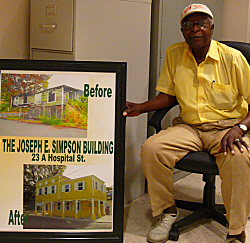
 With resources perpetually strained and the economy struggling, community group Our Town Frederiksted believes stronger enforcement of community standards and codes along with innovative tax breaks and financial incentives are the best route to revitalizing Frederiksted and increasing property values for everyone.
It may be an overused phrase, but Frederiksted truly is a study in contrasts. Many of the town’s residents take great pride in the town’s history and architecture and work tirelessly to improve it. Others spray-paint graffiti on historic buildings and drop beer bottles and trash wherever they happen to be standing.
Millions of dollars have been spent on revitalizing the waterfront, rebuilding historic structures like the Old Danish School, building new housing on Queen Street and cleaning up the town. Yet many of its properties are overgrown ruins, periodically cleaned up by groups like OTF, only to quickly become overgrown and trash strewn once again.
The town boasts beautiful churches and cemeteries, a wealth of historic buildings, old houses and businesses with intricately detailed colonial era stonework and a wealth of architectural gems. But major landmarks like the old Frederiksted Municipal Hospital on Strand Street languish for years, even decades, slowly become vermin-infested eyesores, historic homes fall slowly into ruin and completely dilapidated eyesores speckle the streets.

"Over the past 20 years, Frederiksted has more or less been abandoned by the government, regardless of administration," Alphonso Franklin, a native of the town and OTF member, said this week. "It is not that the governors or administrations do not care about Frederiksted or St. John — it is what I would call benign neglect," he said.
Franklin commended Lt. Gov. Gregory Francis for beginning to work toward a comprehensive revitalization program. In recent months, Francis has toured the town with OTF, looking at problem properties and talking with property owners and lending institutions about ways to get moving forward.
"It is not something new; it has been done before," Franklin said. "But I am hopeful this initiative by the lieutenant governor will take root."
Scarce resources have always been a major obstacle. Though there have been limited programs to restore, renovate and revitalize the historic towns of Frederiksted, Christiansted, Savan and Charlotte Amalie, the sustainability of these programs has often been hampered when funds are pulled toward more pressing needs, leaving revitalization in a piecemeal state, he said. But lack of funds is not the sole problem.
"A lack of … enforcement of standards of upkeep and maintenance have contributed highly to the present situation," Franklin said. Property owners who are not in compliance with standards should be cited and required to correct conditions which are unacceptable in the historic district, he said.
Lack of enforcement allows owners to abandon their properties while paying minimal taxes to keep the properties in their possession, he said. First should come warnings, then citations, then fines, and then if the properties are not improved, the government should consider taking them into receivership, allowing the owners to retake possession after the repairs are paid for, Franklin recommends. Taking property through eminent domain should be a last resort and reserved for larger tracts of blighted property rather than family homes, he said.
Along with the stick of enforcement should come a carrot of low interest improvement loans, perhaps through the requirements of the federal Community Reinvestment Act. If loans are cheap enough, perhaps four percent or less, and there are real consequences for neglecting property, property owners would have more of an incentive to get moving.
Making these properties habitable and attractive can be a "win-win" situation for property owners and the government, he said. "Owners can rent their buildings and the government can collect more tax dollars for improved buildings," he said.
OTF was created in the aftermath of Hurricane Hugo as a way to organize efforts at revitalizing the badly damaged town. It is entering its third decade of efforts to revitalize Frederiksted.
Franklin, a Frederiksted native, moved to New York after high school, returning in 1991. Franklin has worked with OTF since his return as well as serving on the Governing Board of the Water and Power Authority, on the Gov. Juan F. Luis Hospital Board and with local public television.