


 Like Scheherazade weaving tales of magic for her captor, so too did members of the India Association dazzle its captive audience Friday night with stories of valor, pride, and even a little bedroom comedy in celebration of India’s 64th Independence Day.
And according to Indian Consul General Prabhu Dayal, it was those stories that were able to show an Indian community strong and united, forever connected to one another, but also to the territory and the causes it has helped support for decades. Dayal, who took up the post of Consul General of India in New York two years ago, illustrated his point with a little fable about the five fingers on a hand – competing against one another, they’re nothing, but together as a fist, they’re one, he said.
Locally, the India Association has continued to maintain its cultural independence while strengthening the lives of the people around them, Dayal added. Looking around the room, the “pride” of its membership was captured in the ambiance of the room as Indian music filled the air, the exotic food and the beautiful silken saris that encased the women in swathes of turquoise, purple and glittering black.
“You can take the Indian out of India, but you can’t take India out of the Indian,” Dayal said in his keynote speech, as he looked around the room at the various cultural touches.

Kanta Vasandmalani, host of the weekly Indian program on Radio 1000, swept from table to table throughout the evening in a hand embroidered black sari, sequins glittering across the eight yards of fabric. She said the “sexy” silhouette of the sari – with its close fit and drape — has been revered the world over for thousands of years, while the color of the cloth highlighted the shadows of the evening.
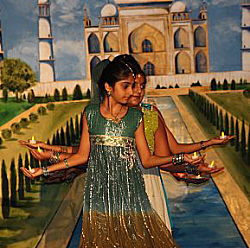
Little hints of gold also illuminated the stage during the cultural presentation, which showed off the beauty of Indian dance and music. The jeweled bindis adorning the foreheads of each of the young dancers caught the light as they twirled, while the toy candles in their hands helped create the desired ethereal effect as the girls moved into a line and fanned their arms in imitation of the gods.
Each dancer was given a picture depicting an important aspect of Indian culture – the last of which was the country’s new international currency symbol for the rupee, which is hoped to become as widely recognized as the dollar sign or Euro. According to Rohit Kiani, master of ceremonies for the evening and an officer at Merchant’s Commercial Bank, the designation of such a symbol is “a big deal,” one that “few countries are invited to do.”
Other symbols included the lotus, India’s official flower, and the peacock, an image frequently used in Indian art.
But equally as important as maintaining its heritage, the association has also managed to become an integral part of the community, displaying its “valor” through its support of the community. Association president Mulo Alwani told the story of how his membership banded together over the years to raise enough money to provide public school students with some essential learning tools, to help Haitian residents after the recent devastating earthquake and to improve the quality of care at the Charlotte Kimelman Cancer Institute.
Friday night continued the tradition, as the association presented another $25,000 check to CKCI – part of its pledge to raise $100,000 for institution.
In his speech Friday, Dayal said that he was “impressed” by what Indian community has been able to achieve within the territory. And pledging that this week’s visit was not his last to the U.S. Virgin Islands, the diplomat wrapped up by saying that he hopes to play a vital role as the association continues to weave its story locally, both by providing a strong connection to India, along with a bond to the United States as the country continues to build its economy and democratic future.
Dayal met with various V.I. leaders while in the territory this week, including Gov. John deJongh Jr. and Senate President Louis P. Hill. Both leaders have said their visits went well, as talks centered on issues such as education, economic development opportunities and issues that are affecting the local Indian community.