


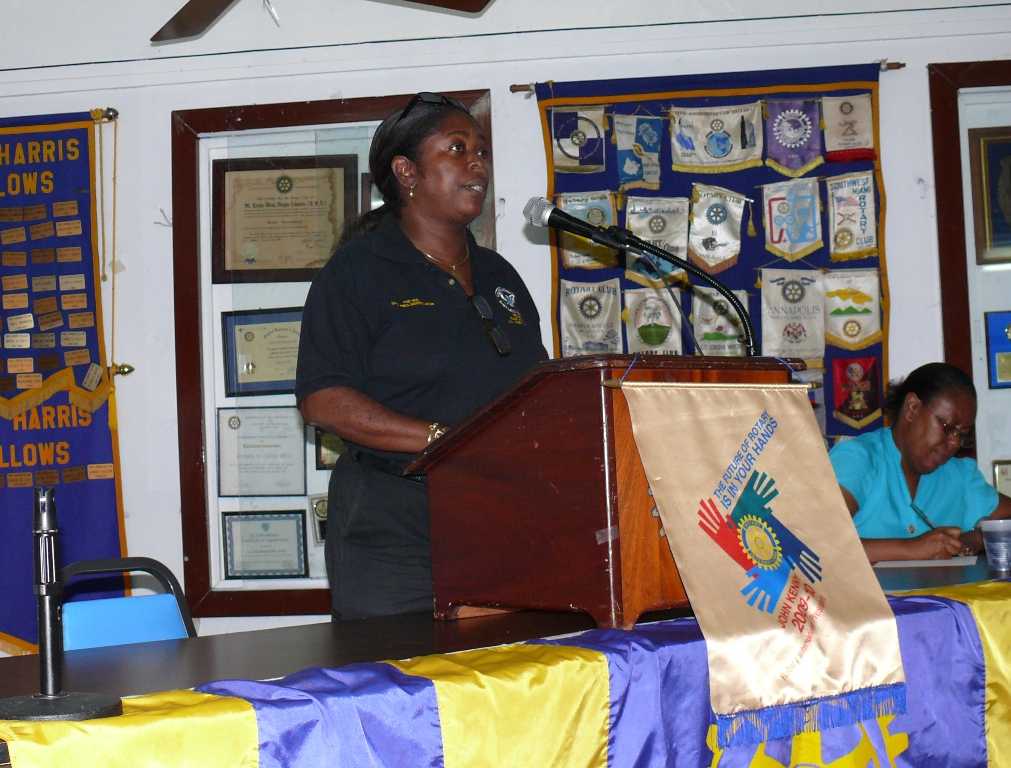
 Although the U.S. Virgin Islands, like Haiti, is subject to earthquakes and tsunamis, Frederiksted and the west end of St. Croix are especially vulnerable and need to do more to prepare, Deborah Christopher told Rotary West Tuesday evening.
"This is in no way a criticism of VITEMA [V.I. Territorial Emergency Management Agency]," said Christopher, a volunteer trained in emergency earthquake response through the U.S. Department of Homeland Security. "VITEMA has plans in place for what they will do. But the public needs to be aware of the danger and have well-rehearsed plans ready, too."
While all eyes are on the recent catastrophe in Haiti, it is also important to see the lesson that applies at home, she said.
"You see a neighbor’s house on fire, wet yours," she said, recalling a parable her mother used to say. "Our neighbor’s house has burned down, and ours still isn’t wet," she said.
Most Caribbean islands are near fault lines and subject to regular minor earthquakes, she said. Frederiksted itself was hit by a 7.5 magnitude temblor in 1867, followed by a major tsunami, she reminded the crowd of 40 or so.
"The wave ran up five streets into town," she said. "Thankfully there were only 23 deaths because, at that time, most inhabitants lived inland on plantations. But there were massive economic losses."
While everywhere is vulnerable, Frederiksted and the west end of St. Croix are especially vulnerable to tsunami because they lack any protective barrier reef and much of the landscape stays relatively close to sea level for some distance inland, she said.
Since Hurricane Hugo, people commonly have hurricane plans for their families, and building codes have been improved. But with a hurricane, one has several days of warning. There is essentially no warning for an earthquake and only a few minutes at best for a tsunami, she said.
To prepare, families should have a good idea of how to respond. "What should you do the moment an earthquake hits?" she asked the group, getting several answers.
"It’s just like you were taught in school; drop, cover and hold," she said. That means get under cover of a desk or a doorjamb, drop to the floor and cover your head until the shaking stops, she explained. When it is over, you may want to go outside, but during the actual quake it may be too difficult and dangerous to get outside, she said.
Make a plan of escape for a tsunami, she said. Driving might seem to make sense, but everyone else may be doing the same, leaving everyone stuck in a traffic jam. So figure out the best route to higher ground and make sure everyone in your family knows where to meet, she advised.
While the government has plans in place, Christopher believes the public needs more education and more explicit training and instruction for an emergency.
"Is there a tsunami warning system in place? Not yet, not that I’m aware of," she said.
While there may be an ocean-based detection system, there are no sirens to immediately broadcast the warning on St. Croix. Even if there were, the public has little in the way of a rehearsed, organized emergency reaction.
Christopher urged Rotarians to "be the catalyst" to get Frederiksted civic organizations to perhaps form a "consensus group" to work out quick evacuation routes and plans for various locations and to push the government to invest in warning systems and more public preparation.
"Disasters are full of tragic choices and are unavoidable, but catastrophes are the result of failure—failure to plan," she said.