


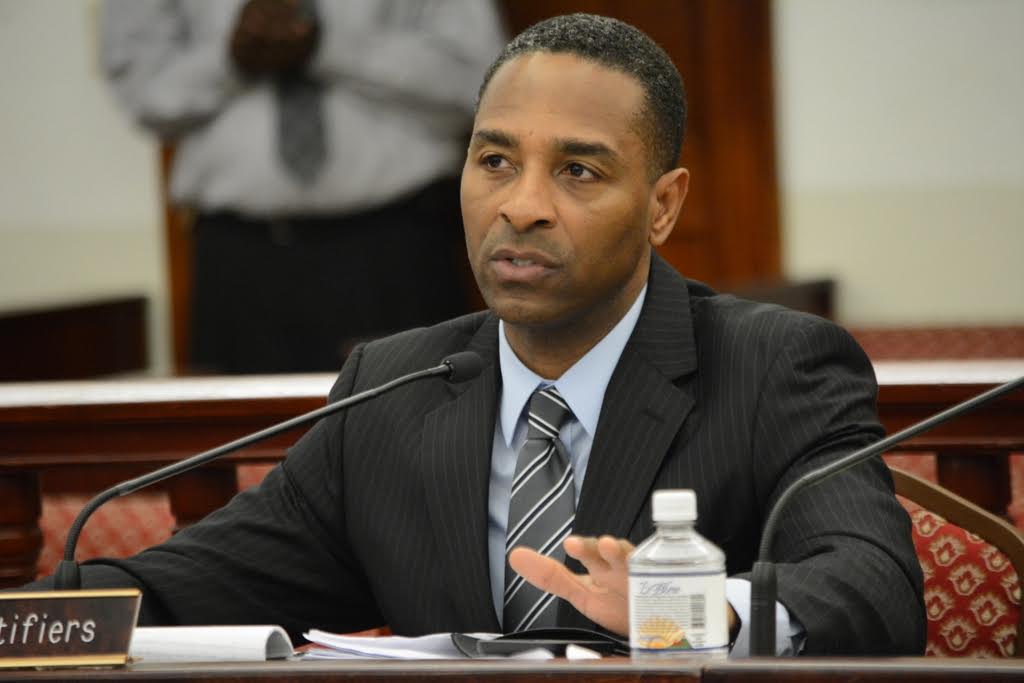
The Committee on Rules and Judiciary dealt Friday with bills concerning the Board of Elections, funding for school repairs, returning to work government employees who are not paying into the Government Employee Retirement System, and the creation of a government ethics commission.
The bill on government ethics was the only bill not to move forward to the full Senate.
Leading the opposition to the bill was Virgin Islands Attorney General Claude Walker, who said his department had “grave concerns” about the results the commission would produce as well as its ability to function properly.
He also questioned if the government could presently afford to fund such a commission.

The commission would be tasked with “investigating, enforcing and appealing” ethics and conflict-of-interest violations. The bill, No. 32-003, was introduced by Sen. Janet Millin Young.
On the mainland, 42 states now have some sort of ethics commission.
Walker spoke at length in his testimony about studies and analysis of the effectiveness of ethics commissions in other jurisdictions.
He cited research saying “there is surprisingly little evidence that institutions [i.e., ethics commissions] designed to enhance these goals [of reducing public corruption or conflict] actually work in practice. Instead, anticorruption policies tend to be based more on the intuition of public administrators or self-appointed watchdogs from the press than from any systematic evaluation.”
This research was done by a doctoral student in political science and professor Jeffrey Milyo at the University of Missouri.
“In short, given the poor performance of many other states’ ethics commissions, together with the probable lack of funds allocated for this proposed commission, the department has grave concerns about the passage of this legislation and recommends that it be held in committee for further review and investigation,” Walker said.
Sen. Positive Nelson took exception to Walker’s contention that “the press” could be relied on to be the public watchdog.
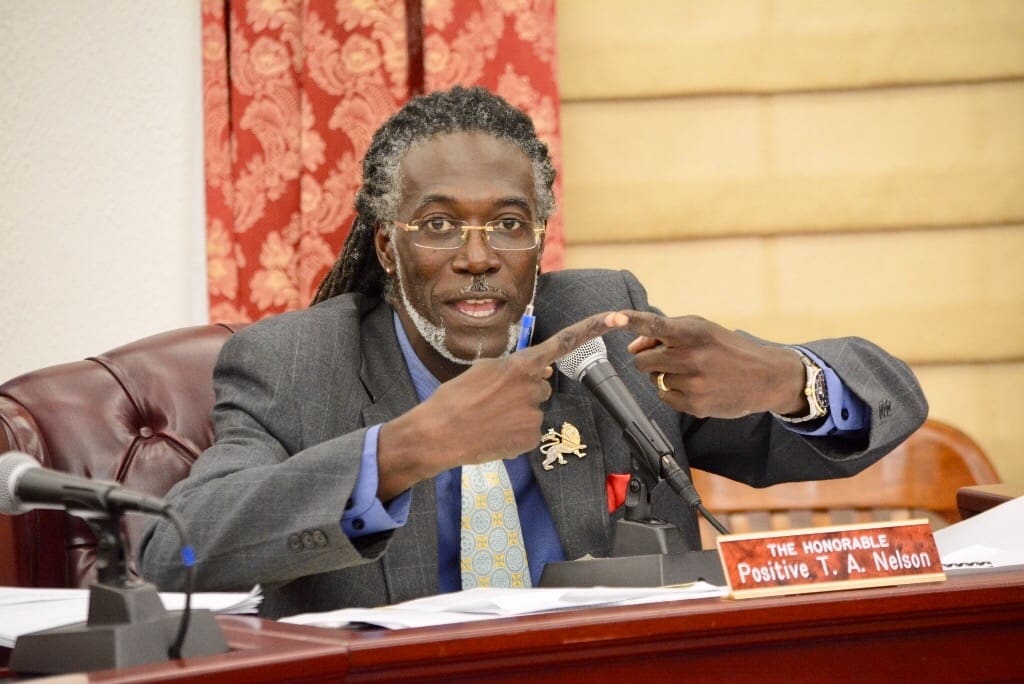
Nelson said that some of the media just practiced “yellow journalism” attacking the government for everything it did; and other media “rushed to be first, not caring whether the information it had was accurate or not.”
Walker concluded “Overall, the department believes the prospect for the creation of a successful and fully-functioning commission are, at best, unpromising. Rather, the department would suggest maintaining reliability on the press serving as a watchdog and the department’s anti-corruption units, equipped with sufficient investigation and prosecution resources, to each continue to significantly contribute to enforcing ethics standards.”
Two other bills that sparked discussion during the day-long hearing concerned the Board of Election.
Bill No. 32-0054 would grant the supervisor of Election the authority to set places, days and times for early voting. It was proposed by Sen. Dwayne DeGraff.
Caroline F. Fawkes, supervisor of elections, testified that passage of the bill would increase efficiency and reduce costs for the board of elections.
“Historically, during a non-gubernatorial election, the voter’s turnout is less than 35 percent,” she said. “Therefore, conducting early voting for 14 days would not be productive and will be costly. In addition, due to the technology on hand, the elections staff requires more than three days to close out the early voting process and prepare for the at-the-polls voting.”
She projected that between 30 to 40 percent of voters will utilize early voting in the 2018 election cycle and an increase in every election cycle.
“By approving this amendment authorizing the supervisor to establish the place, date and days, will prove more effective and efficient in the long term,” she said.
Fawkes also addressed Bill No 32-0097, which would “bar cancellation of voter registration in every instance other than death.”
She agreed with several sections of the bill because the board must manually delete voters from the rolls and the chore is labor intensive. Voters are presently deleted from the rolls if they don’t vote in two straight elections.
Fawkes reminded the senators that there remained before them other critical election reform issues, including whether photographs of candidates will appear on ballots and how party primaries are conducted and financed.
“We have learned from the past, election laws passed closed to the deadline, do not provide sufficient time to educate the public nor the staff on the required change,” she said. “We would prefer not to repeat this same situation in 2018.”
Bill No. 32-0089 would reprogram some department education funds to help with deferred maintenance at St. Croix schools, including lightning rods and ground wiring. The bill received some negative comments from Sen. Positive T Nelson, who said he was not comfortable with the figures in the bill. He said they appeared “arbitrary” because the amounts allotted to each was the same, while the schools would have varying needs. However, he voted along with the other senators to move the bill forward.
Bill No. 32-0102 would repeal provisions that allow persons who are receiving a retirement annuity from the Government Employees’ Retirement System (GERS) to return to work for the government of the Virgin Islands without making contributions to the GERS.
The bill would exempt teachers and police officers who return to work from having to contribute to GERS. The territory is having a hard time filling positions for teachers and for police officers.
However, Nelson indicated that it stymied the opportunities for young people when older people “hold on to these jobs until they die.” Nelson, a former teacher, also said that it was good for the students when more young, fresh teachers were brought into the system.
The Committee on Rules and Judiciary is chaired by Novelle Francis. Attending the meeting were Jean Forde; Sammuel Sanes; Janette Millin Young, Nelson, DeGraff and Janelle Sarauw