

Home Blog Page 302

36th Legislature of the Virgin Islands Calendar Sept. 4 – Sept. 12

0

36th Legislature of the Virgin Islands Calendar Sept. 4 – Sept. 12

THURSDAY, SEPTEMBER 04, 2025 

Committee on Homeland Security, Justice and Public Safety

10:00 A.M.

Frits E. Lawaetz Legislative Conference Room

The 36th Legislature’s Committee on Homeland Security, Justice and Public Safety will meet on Thursday, 

September 4, 2025, at 10:00 A.M. in the Frits E. Lawaetz Conference Room on St. Croix, U.S. Virgin Islands. 

BLOCK I 10:00 A.M. – 11:00 A.M. 

Bill No. 36-0144 – An act amending title 14 Virgin Islands Code, chapter 113 to define and prohibit assault

rifles, ban suppressors and silencers, and requiring safety training for licensed rifles and shotgun holders; prohibiting large-capacity magazines and preventing the illegal sales of firearms, firearm accessories and ammunition 

Invited Testifiers:

Honorable Mario Brooks, Commissioner, Virgin Islands Police Department 

Honorable Gordon Rhea, Esq., Attorney General of the Virgin Islands, Virgin Islands Department of Justice 

Mr. Antonio Emanuel, Director, Office of Gun Violence Prevention, Office of the Governor

BLOCK II 11:15 A.M. – 12:30 P.M. 

Bill No. 36-0105 – An act amending title 7 Virgin Islands Code, chapter 13, subchapter III by prohibiting the possession, sale, or manufacture of tetrahydrocannabinolic acid, delta-6 THC, delta-8 THC and delta- 10 THC products in the Virgin Islands and for other related purposes

Invited Testifiers:

Honorable Mario Brooks, Commissioner, Virgin Islands Police Department 

Honorable Gordon Rhea, Esq., Attorney General of the Virgin Islands, Virgin Islands Department of Justice 

Honorable Justa Encarnacion, Commissioner, Virgin Islands Department of Health

Honorable Louis E. Petersen, PhD, Commissioner, Virgin Islands Department of Agriculture

Honorable H. Nathalie Hodge, Commissioner, Virgin Islands Department of Licensing and Consumer Affairs

Ms. Joanne Moorehead, Executive Director, Virgin Islands Office of Cannabis Regulation

Ms. Riise Richards, Chair, Virgin Islands Industrial Hemp Commission, Deputy Commissioner, VI 

Department of Agriculture

Mr. Duane Howell, Executive Director, ARCH Institute

LUNCH BREAK 12:30 P.M. – 1:00 P.M. 

BLOCK III 1:00 P.M. – 3:00 P.M. 

Bill No. 36-0123 – An act amending title 20 Virgin Islands Code, part II, chapter 43, subchapter I, section 493 making it unlawful for a person who has 0.04 percent or more, by weight, of alcohol in his blood to operate a commercial motor vehicle, and making it unlawful for a person under the age of 21 years who has any detectable amount of alcohol in his blood, to operate a motor vehicle

Invited Testifiers:

Honorable Mario M. Brooks, Commissioner, Virgin Islands Police Department

Honorable Gordon Rhea, Esq., Virgin Islands Attorney General, Virgin Islands Department of Justice

Ms. Julie Smith Todman, Esq., Chief Public Defender, Virgin Islands Office of the Public Defender

MONDAY, SEPTEMBER 08, 2025

Committee on Rules and Judiciary

10:00 A.M.

Frits E. Lawaetz Legislative Conference Room

The 36th Legislature of the Virgin Islands Committee on Rules and Judiciary has scheduled a hearing for 10:00 

A.M. on Monday, September 08, 2025, in the Frits E. Lawaetz Legislative Conference Room on St. Croix. The purpose of the meeting is to receive testimony and consider the following legislative measures: 

BLOCK I 10:00 A.M. – 11:30 A.M.

Mr. Roy Moorehead, Governor’s Nominee, Board of Parole 

Mr. Damian M. Cartwright, Governor’s Nominee, Virgin Islands Board of Land Use Appeals

BLOCK II 11:30 A.M. – 1:00 P.M.

Mr. Xavier A. Acevedo, Governor’s Nominee, Virgin Islands Water and Power Authority Governing Board 

Dr. Safiya George, Governor’s Nominee, Virgin Islands Government Hospitals and Health Facilities Corporation Board of Directors

LUNCH 1:00 P.M. – 2:00 P.M.

BLOCK III 2:00 P.M. – 3:30 P.M. 

Bill No. 36-0101 An act to provide for continuity of operations in the Superior Court of the Virgin Islands in  the event of prolonged judicial vacancies. 

Invited Testifiers:

Ms. Regina deChabert Petersen, Administrator of the Courts, Judicial Branch of the Virgin Islands 

Mr. J. Russel B. Pate, Esq., President, Virgin Islands Bar Association 

Honorable Gordon C. Rhea, Esq., Attorney General, Department of Justice 

Ms. Julie S. Todman, Esq., Chief Territorial Public Defender, V.I. Office of the Territorial Public Defender

BLOCK IV 3:30 P.M. – 5:00 P.M.

Bill No. 36-0112 An act amending title 4 Virgin Islands Code, chapter 31, section 516 increasing the filing fee for general civil complaints in the Superior Court of the Virgin Islands and title 5 Virgin Islands Code, chapter 41, section 426 allowing for the collection of nine percent prejudgment interest when an offer of judgment is filed with the court. 

Invited Testifiers:

Ms. Regina deChabert Petersen, Administrator of the Courts, Judicial Branch of the Virgin Islands 

Mr. J. Russel B. Pate, Esq., President, Virgin Islands Bar Association 

WEDNESDAY, SEPTEMBER 10, 2025 

Committee on Housing, Transportation and Telecommunications

10:00 A.M.

Earle B. Ottley Legislative Hall

The Committee on Housing, Transportation & Telecommunications has scheduled a meeting for Wednesday, 

September 10, 2025, in the Earle B. Ottley Legislative Hall on St. Thomas.

VIHA Operations, Challenges, and Opportunities 

The Committee will receive testimony on the Virgin Islands Housing Authority’s operations, challenges, and 

opportunities. Areas of focus include agency updates on operations and maintenance issues, the Housing Choice 

Voucher Program, and progress in community rehabilitation. Testimony will also address the Williams Delight 

sale and related funding assistance, as well as the impact of federal-level policy changes on VIHA’s funding and 

overall operations. 

Invited Testifier:

Dwayne Alexander, Executive Director, Virgin Islands Housing Authority 

BLOCK II 12:30 PM

Homeownership and Housing Development Programs

The Committee will also hear testimony on the status of homeownership and housing development programs. 

This includes updates on funding and progress of current initiatives, the availability and utilization of funds 

for affordable housing, and the effects of federal policy changes on funding streams, operations, and programs. 

Invited Testifiers:

Eugene Jones, Executive Director, Virgin Islands Housing Finance Authority 

Adrienne Williams-Octalien, Executive Director, Office of Disaster Recovery 

Wayne L. Biggs, Chief Executive Officer, VI Economic Development Authority

THURSDAY, SEPTEMBER 11, 2025

Committee on Rules and Judiciary 

10:00 A.M.

Earle B. Ottley Legislative Hall

FRIDAY,

SEPTEMBER 12, 202

Committee on Disaster Recovery, Infrastructure and Planning

10:00 A.M.

Frits E. Lawaetz Legislative Conference Room

Estranged Husband Charged in Galleon House Homicide

What began as a call about an unresponsive woman at a downtown guesthouse quickly turned into a homicide investigation that ended with the arrest of her estranged husband.

Police said 42-year-old Maireni Heredia Tiburcio was found shot in the upper body late Friday morning at the Galleon House. Officers arrived after a 911 call at 11:48 a.m. and discovered Tiburcio unresponsive. Emergency medical technicians pronounced her dead at 12:26 p.m.

Investigators later identified the suspected gunman as 54-year-old Tizoni A. Mahoney, Tiburcio’s estranged husband. He was arrested and charged with first-degree murder, according a Virgin Islands Police Department release sent Monday night. Mahoney is awaiting his advice of rights hearing.

The shooting adds to mounting concerns about domestic violence in the territory, a pattern that advocates say often escalates when relationships break apart. Authorities have not released details on what led to the confrontation inside the guesthouse.

Police are urging anyone with additional information to call the CIB Major Crimes Division at 340-714-9823, 340-714-9828, or 340-714-9829, contact the VIPD at 340-774-2211, or reach out via WhatsApp at 340-642-8449. Anonymous tips can also be submitted through Crime Stoppers at 1-800-222-8477.

Photo Focus: Labor Day in Coral Bay

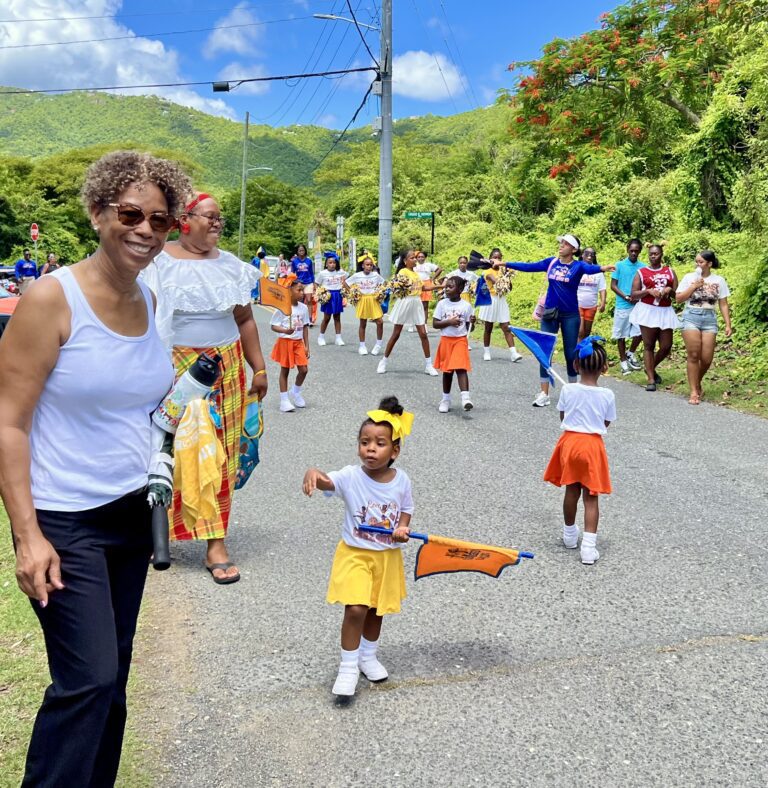
“It’s always hello and goodbye.” That’s how one bystander characterized the annual parade on Labor Day in Coral Bay, St. John. Step away from the parade route to buy a cool drink, and you might miss the whole thing.

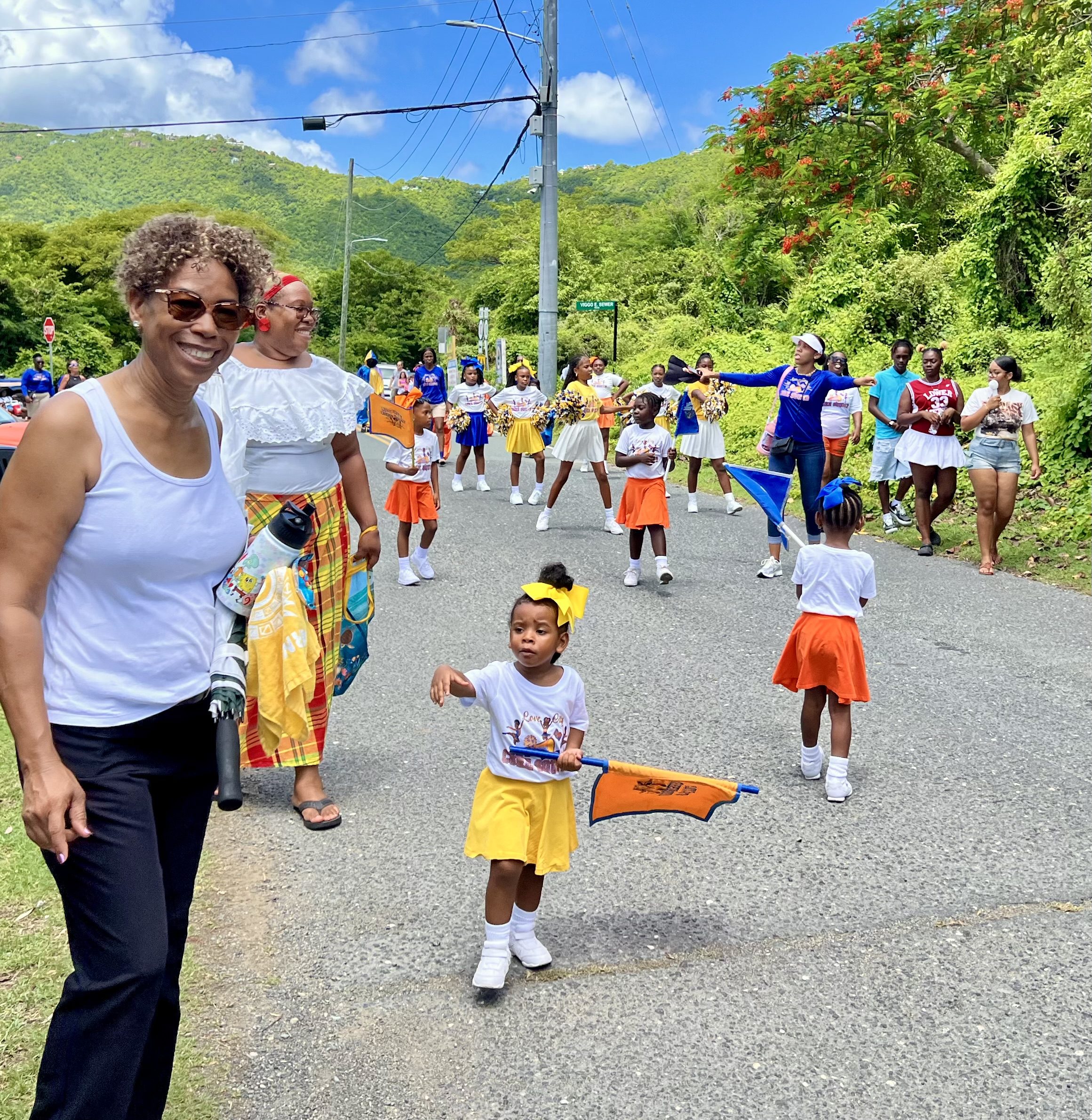
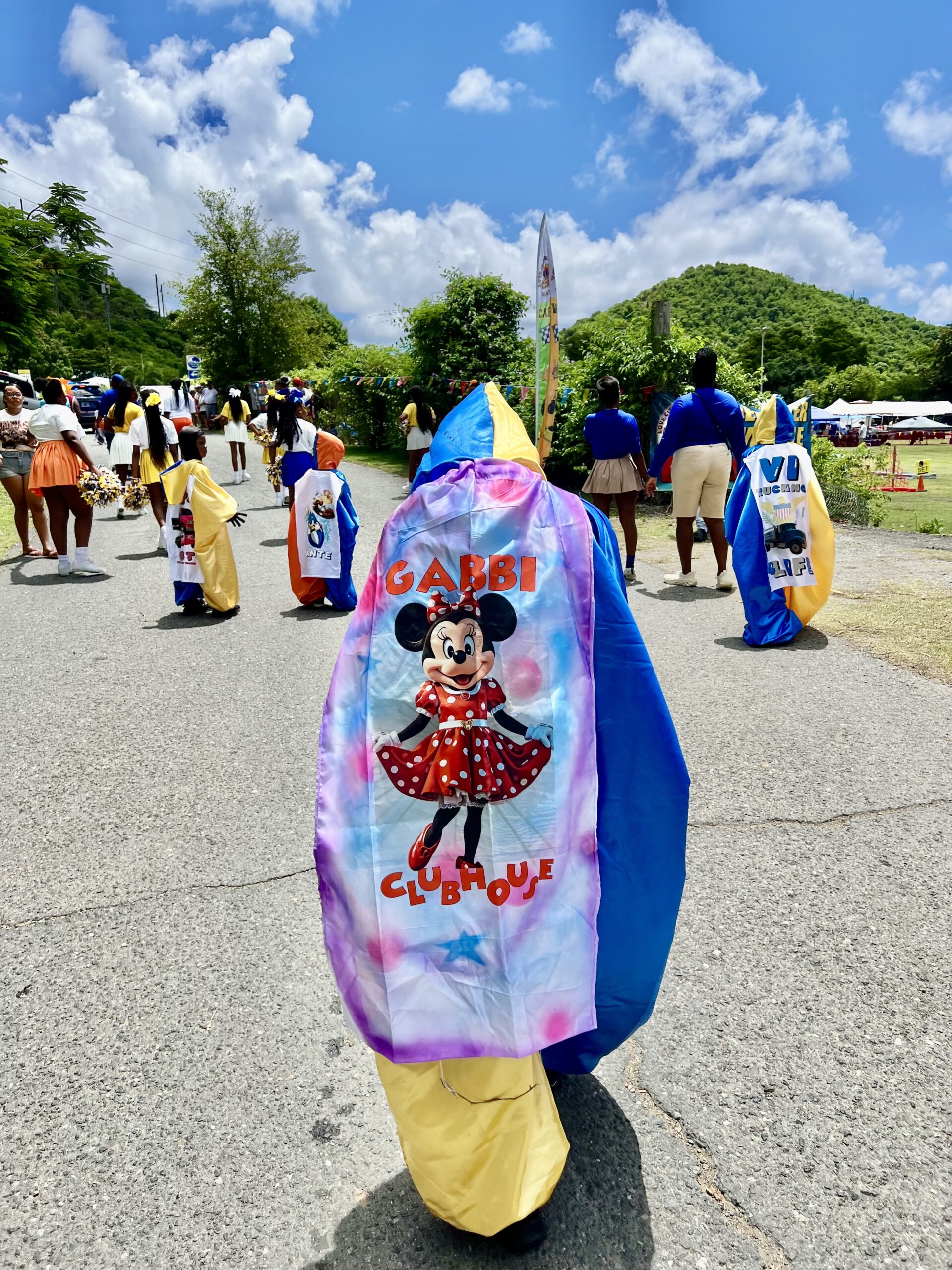
Although this year’s was short, the Love City Core Squad’s presence made it particularly sweet. Led by Ceamba Amory, the troupe featured twirlers, pom-pom girls, and clowns ranging in age from two to 15.

(Source photo by Amy H. Roberts)

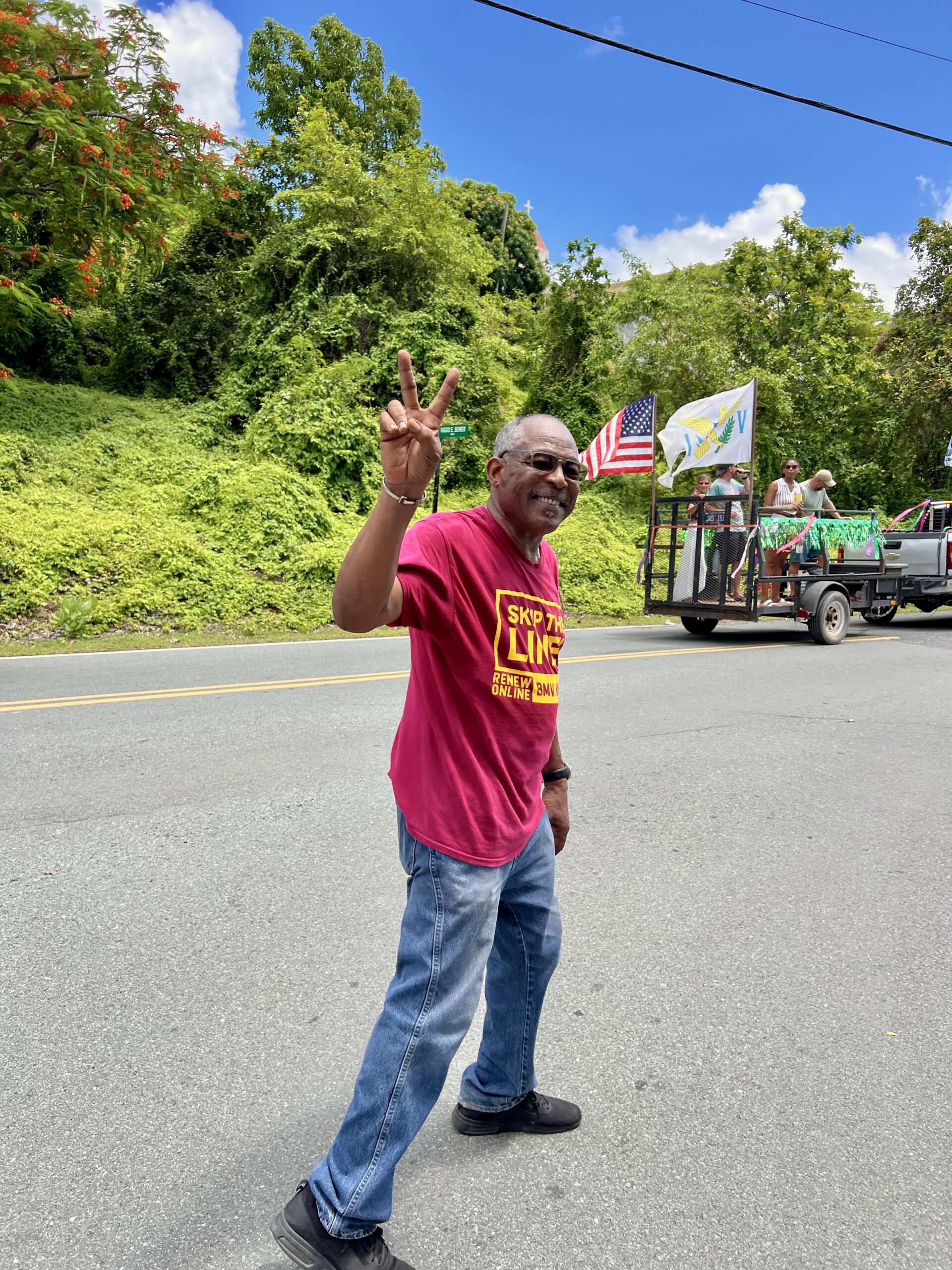
They were followed by St. John Carpenters bringing the V.I. flag, who were followed by St. John Department Police Chief Clayton Brown.

(Source photo by Amy H. Roberts)


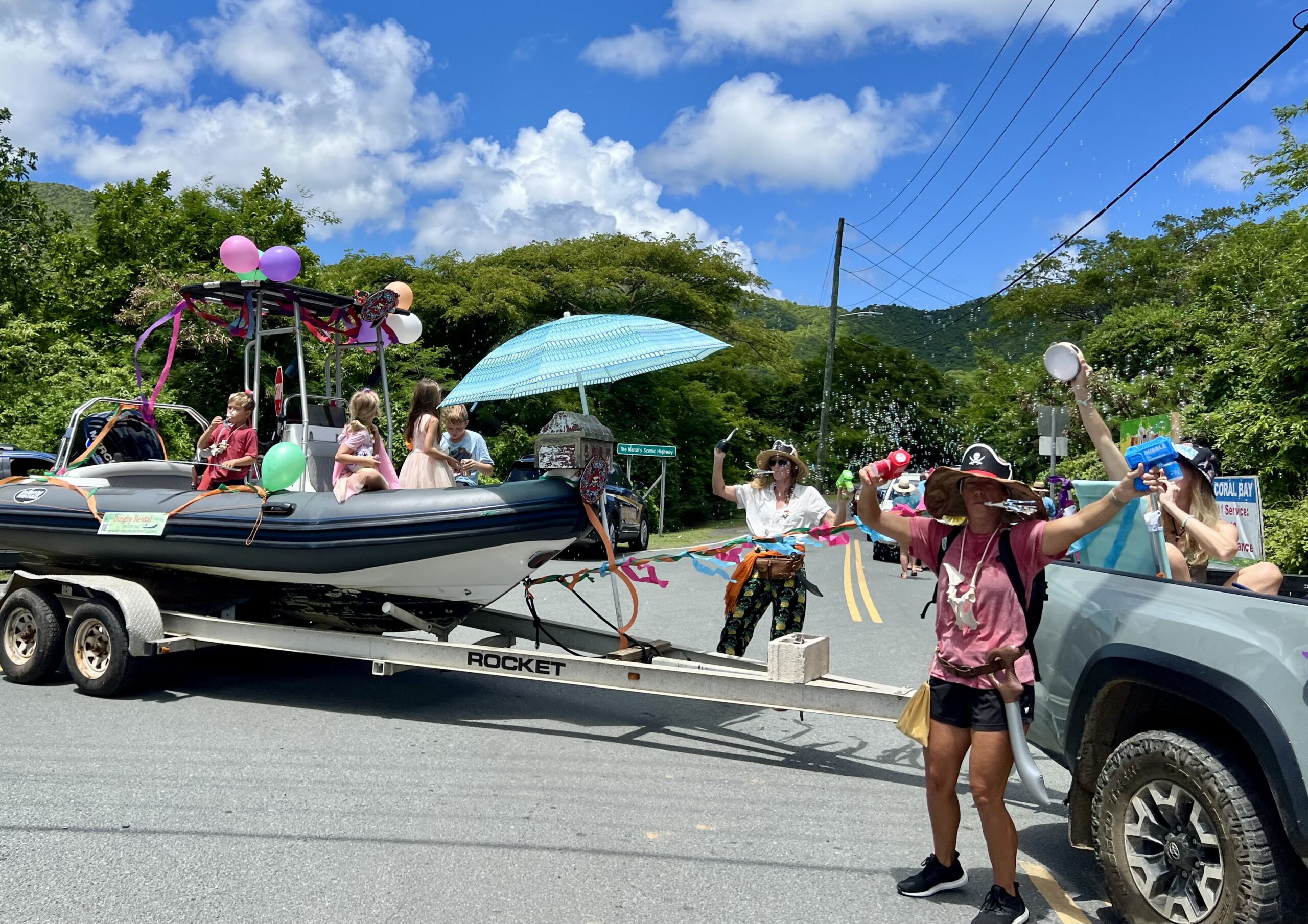
Dockside Dinghy towed their “Pirates and Princesses” in a float that could literally float – a dinghy loaded with cute kids. The adults towing the dinghy provided the bubble machines, noisemakers and a bit of rowdiness.

(Source photo by Amy H. Roberts)

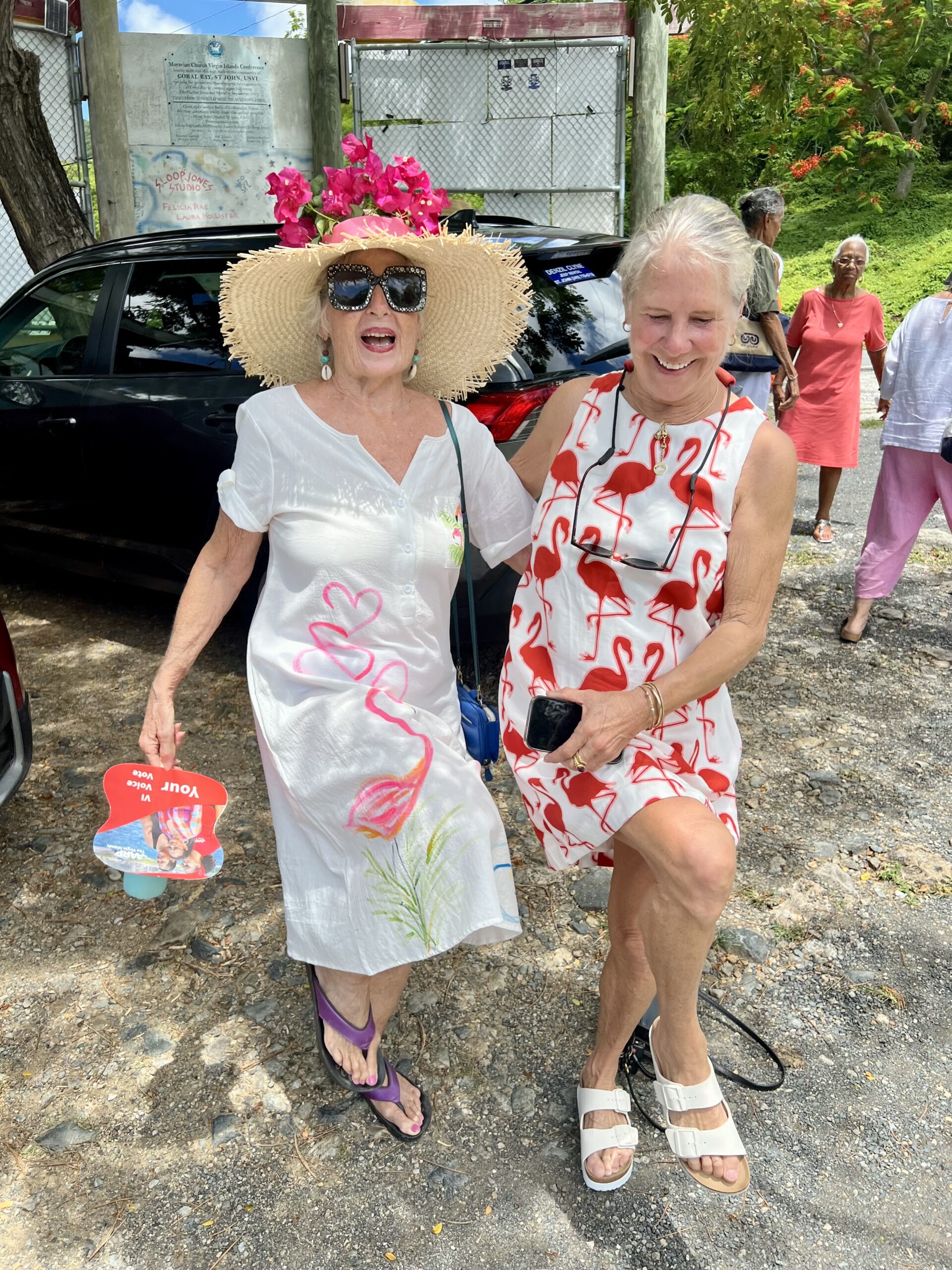
Parade viewers brought their own brand of fun, including Gail George and Kris Robinson, who posed like the flamingos on their dresses.

(Source photo by Amy H. Roberts)

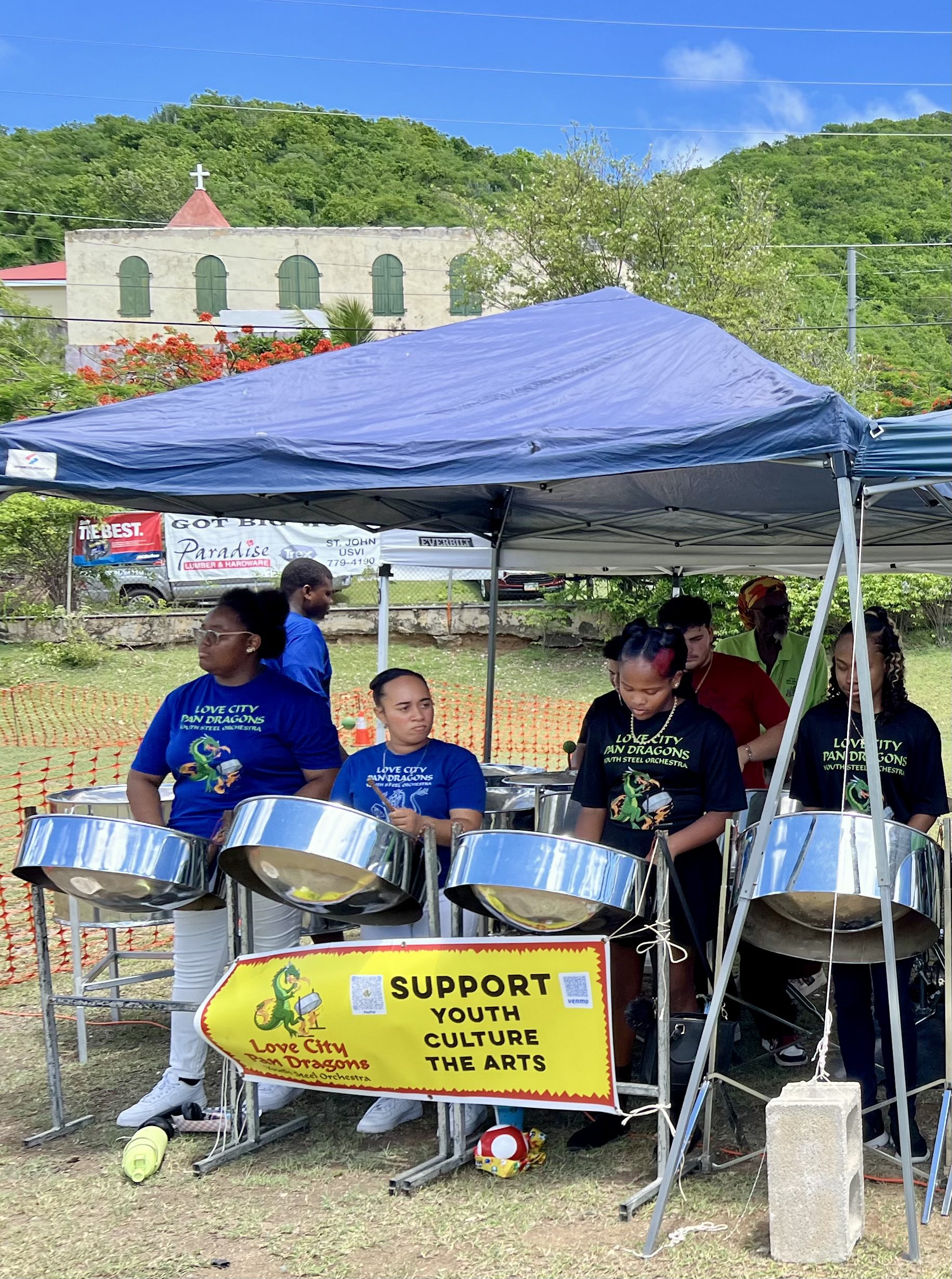
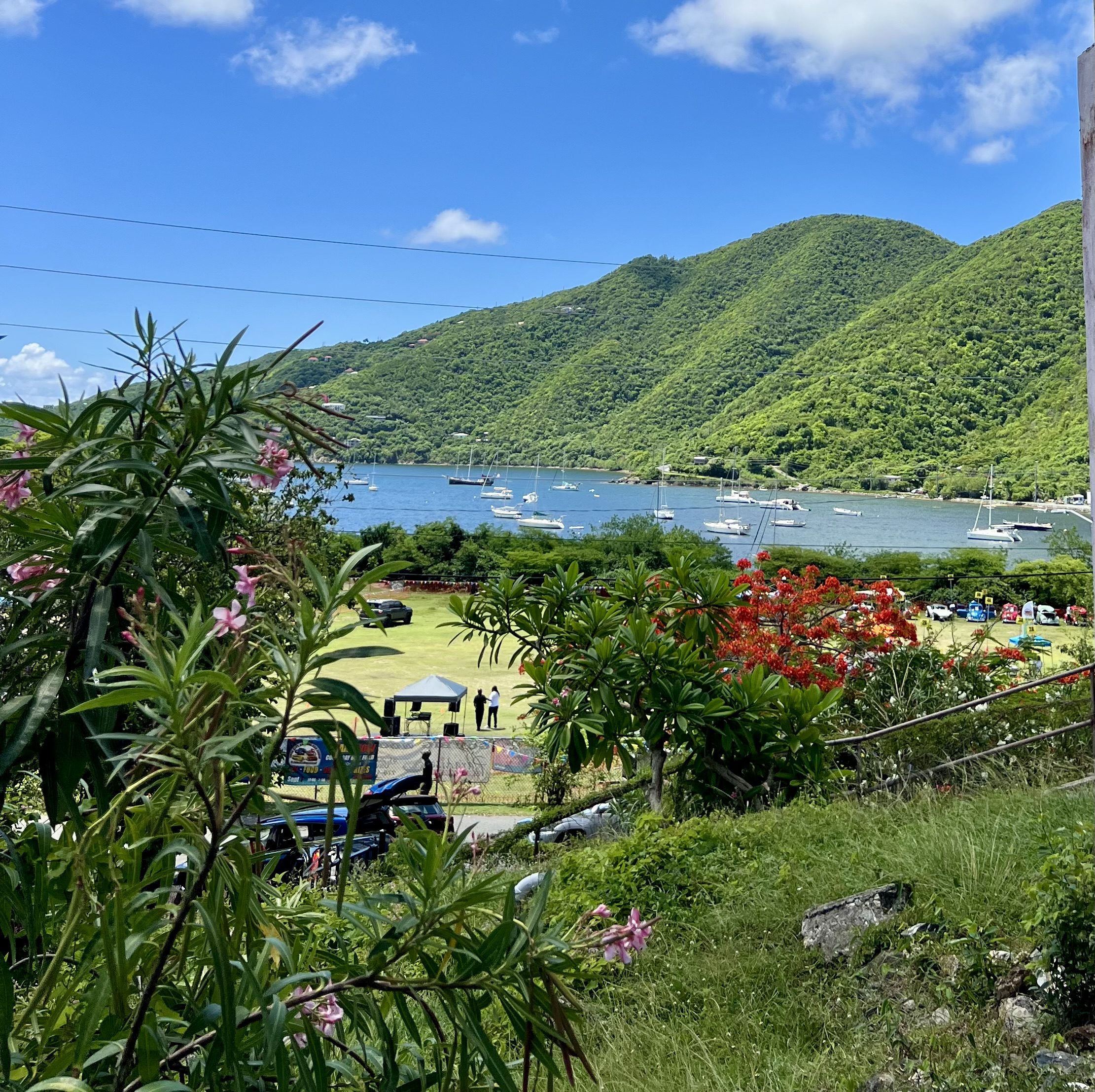
The Love City Pan Dragons provided live steel pan music from the ball field, where Love City Car Show served as the center of entertainment for the rest of the day.

(Source photo by Amy H. Roberts)

Alston “Big Al” Smith, who started the car show as a fundraiser 10 years ago with Jay Swartley, said he was hoping for a hundred entries by the afternoon.

By noon, more than a dozen colorful VWs lined the back edge of the ball field as more continued to arrive.

(Source photo by Amy H. Roberts)

Children and adults wandered around the field admiring some extraordinary vehicles, including the vibrant “Tangerine,” which was parked under its own matching tent.

(Source photo by Amy H. Roberts)

Henry Hinkle brought his 1986 CJ-7 Jeep, distinctly decorated with skeletons and a stuffed parrot. “It’s kind of an island thing,” he said. Hinkley rebuilt the jeep himself on St. John and still uses it on the road.

(Source photo by Amy H. Roberts)

Malcolm Greene showed off his Red’z Party Bus. During the day, he gives island tours on St. Thomas, but at night, he provides a party-on-wheels with a super sound system, disco balls and a mirrored ceiling.

(Source photo by Amy H. Roberts)

The Love City Car Show donated funds this year to Carla Sewer’s summer reading program and to St. John’s LRVI FC Castaways Soccer Club. “We provide scholarships so that all kids on St. John can play,” said Swartley. The event “is all about community, music, food, quelbe and cars.”

(Source photo by Amy H. Roberts)

This year, Smith and Swartley were assisted by Ric Ortiz, who said, “I’ve got two little ones growing up here, and I want them to have things to do.”

(Source photo by Amy H. Roberts)

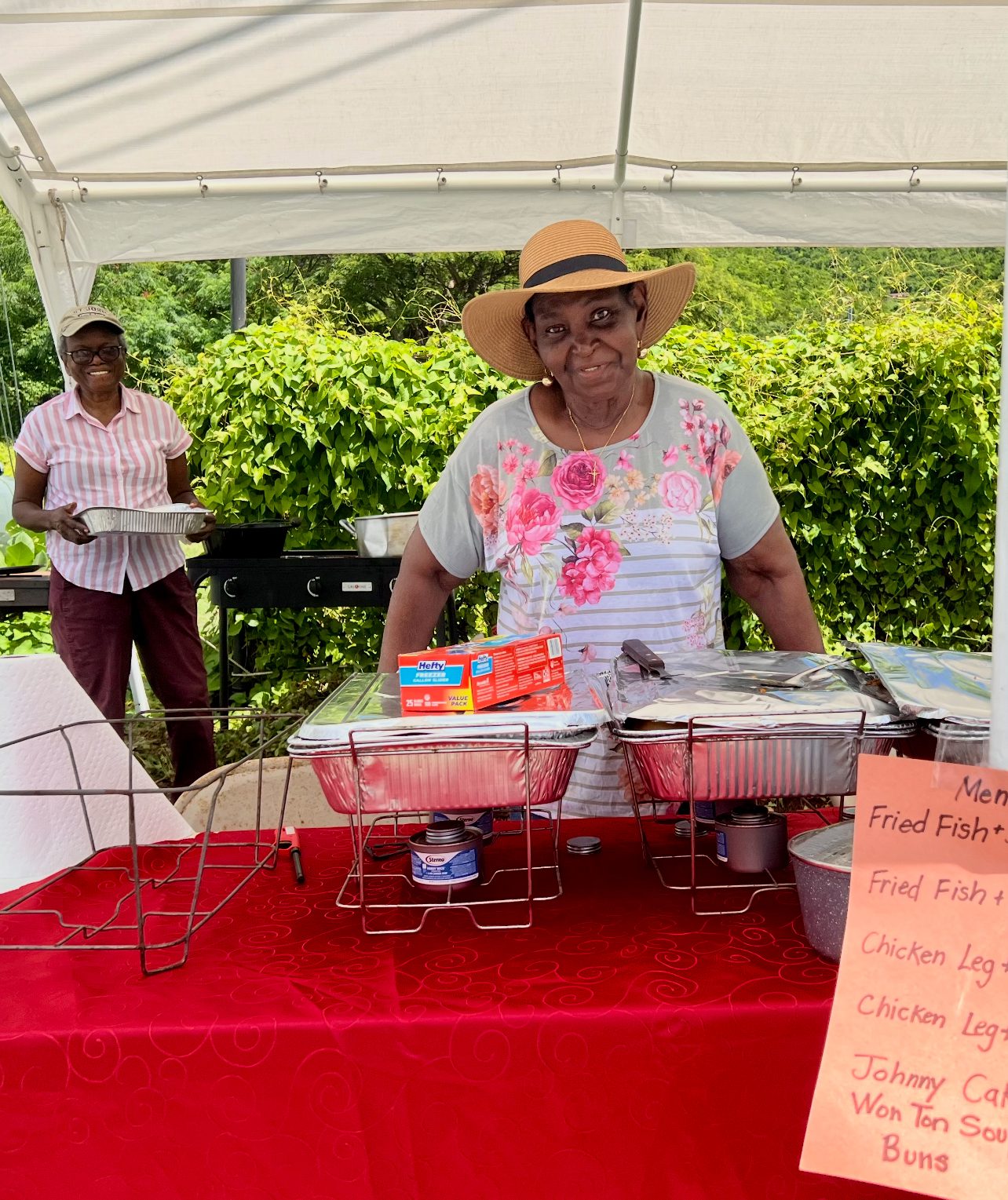
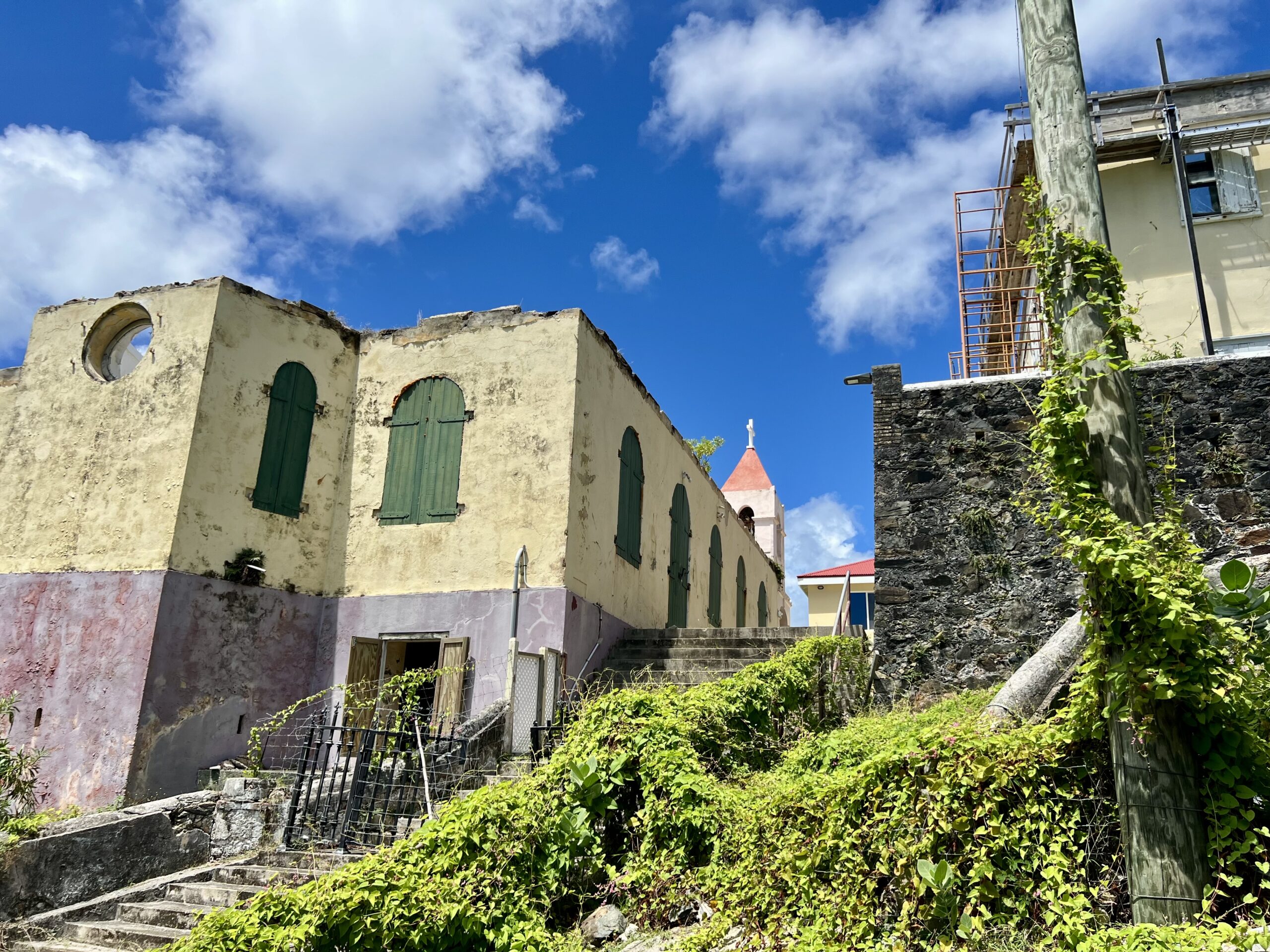
The car show wasn’t the only fundraiser going on in Coral Bay. Members of the Emmaus Moravian Church were holding a food sale to raise $60,000 to complete the rebuild of “the little manse,” tucked between the historic church (on the left) and the “big manse” (on the right) now under construction.

(Source photo by Amy H. Roberts)

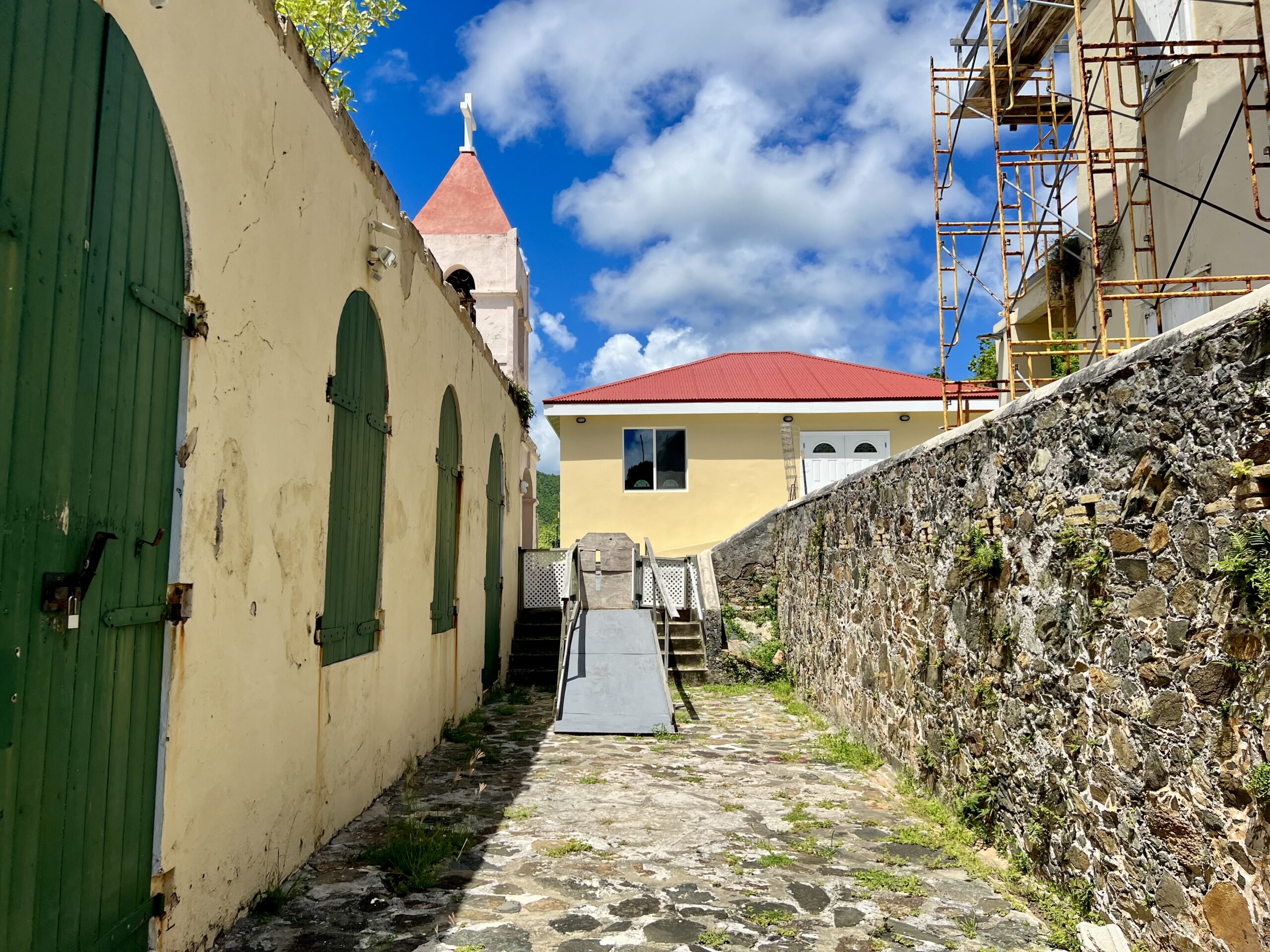
The historic Emmaus Church and the “big manse” lost their roofs in Hurricane Irma. Church officials are now getting ready to advertise for Requests for Proposals to repair the church roof. For the past seven years, parishioners have been holding services in a tent. The “little manse” will serve as their temporary church while construction is underway.

(Source photo by Amy H. Roberts)

Spirit Files for Bankruptcy Again Amid Restructuring

1
Spirit Airlines petitioned for bankruptcy protection last week amid a “comprehensive restructuring” focused on redesigning the budget air carrier’s network and fleet reductions. (Photo courtesy Spirit Airlines)

Budget air carrier Spirit Airlines filed for Chapter 11 relief last week as part of a “comprehensive restructuring,” according to a statement posted on the airline’s website. The move comes less than a year after the airline’s last bankruptcy filing.

“Spirit is redesigning its network to focus its flying on key markets to provide more destinations, frequencies, and enhanced connectivity in certain of its focus cities, while simultaneously reducing its presence in certain other cities,” Chief Financial Officer and Executive Vice President Fred Cromer said in a declaration filed in U.S. Bankruptcy Court Sunday. “In line with the redesigned network, Spirit intends to rightsize its fleet to match capacity with profitable demand. Doing so will significantly shrink Spirit’s overall fleet, which in turn will materially lower Spirit’s debt and lease obligations, leading to hundreds of millions of dollars in annual operating savings.”

The airline currently has routes connecting St. Thomas to Orlando and Fort Lauderdale, the latter of which also has flights to and from St. Croix. During the restructuring, Spirit said flights will operate normally and flyers can use tickets, credits and loyalty points.

Spirit previously filed for bankruptcy in November 2024 amid “large upcoming debt maturities and external macroeconomic pressures,” Cromer wrote, and the airline ultimately reached a deal with bondholders to equitize approximately $800 million in debt and inject $350 million in cash through an equity rights offering.

“Unfortunately, the industrywide headwinds that preceded the Prior Chapter 11 Cases did not abate; rather, they intensified,” he wrote. “In the post-COVID industry environment, the domestic airline industry, and particularly its low-cost/value sector, has suffered from a combination of material excess capacity and slack passenger demand, particularly from the more price-sensitive leisure travelers who are the core customers of low-cost/value carriers.”

In a quarterly report to the U.S. Securities and Exchange Commission filed this month, Spirit said its plans to improve liquidity could include selling aircraft, real estate and excess airport gate capacity.

“However, there can be no assurance that we will be able to improve our liquidity position, achieve our business plans or return to profitability,” according to the filing from Spirit Aviation Holdings. “Further, we can give no assurances that we will be able to secure additional sources of funds to support our operations or refinance our existing indebtedness, or, even if such additional funds are available to us, that such additional financing will be on terms that are acceptable to us or sufficient to meet our needs.”

The airline cautioned that its business, financial condition and operations “will be materially and adversely affected” if it’s unable to raise capital or refinance its debt.

In a statement last week, Spirit Chief Executive Dave Davis said that since the airline’s last Chapter 11 petition, “it has become clear that there is much more work to be done and many more tools are available to best position Spirit for the future.”

“After thoroughly evaluating our options and considering recent events and the market pressures facing our industry, our board of directors decided that a court-supervised process is the best path forward to make the changes needed to ensure long-term success.”

Landsharks Host Fourth ‘Francis Bay Fives’ With New Beach Dash for Kids

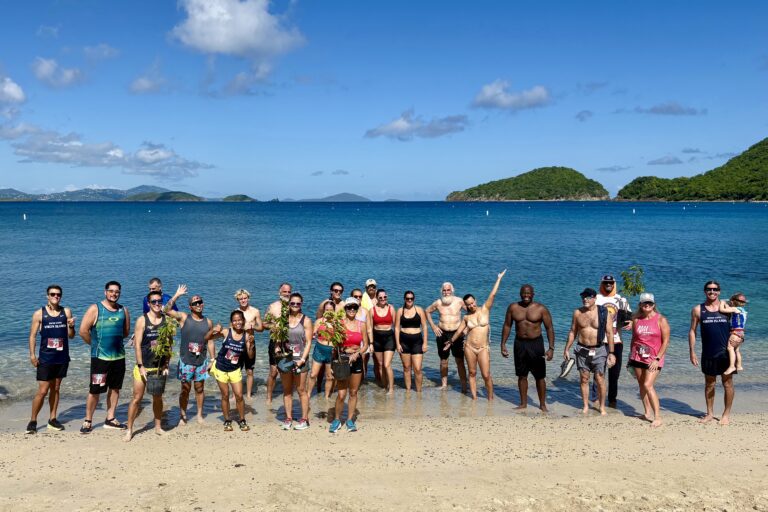
Participants pose on Francis Bay Beach after completing 5K and 5-Mile fun runs hosted by St. John Landsharks. (Source photo by Amara Stokes Gilbert)

On Sunday, the St. John Landsharks hosted 5K and 5-Mile fun runs and a new 500-yard Beach Dash at Francis Bay. The courses featured a variety of terrain, including trails, road, and a finish on the beach.

Thirty-four athletes participated in the event, including five children in the new 500-yard Beach Dash, which was offered to children aged eight and under. There were 14 runners in the 5-mile race and 15 in the 5K.

In the 5-mile event, the top male finishers were Connor MacKelvey of St. Thomas (34:38), Mark Hayes-Ayala of St. Thomas (40:24) and Lee Richter of St. John (41:46). The top female finishers for the 5-mile course were Brenda Simpson of St. Augustine, Florida (46:36), Jena Bradley of St. John (52:51) and Samantha McNamara of St. John (1:00:55).

First place winners Connor MacKelvey (5-Mile), Brenda Simpson (5-Mile), Krystina Miller (5K) and Sam Normington (5K) were awarded soursop trees from Freeman’s Farm in Coral Bay. (Source photo by Amara Stokes Gilbert)

In the 5K, the winners in the men’s division were Sam Normington (24:36), Kallen Payne (25:03) and Matt Crafts (31:16), all from St. John. The top women finishers for the 5K were Krystina Miller of South Weymouth, MA (32:01), Mary Jay Cajes of St. Thomas (33:04) and Noel Wright of St. John (44:55). The first-place male and female finishers received a soursop tree from Freeman’s Farm in Coral Bay.

Full results can be found here.

MacKelvey, who also competed in the Victory Half Marathon the day before, was a last-minute addition to the race field. “I wasn’t too sure if I was going to compete today or not and jumped on to register yesterday afternoon,” he said. Two of his friends from St. Thomas also participated in both events.

“We were all very impressed with the community-based atmosphere and to see the famous Peter Alter also running this morning,” MacKelvey noted.

The 5-mile winner praised the race’s distinctive finish: “Running on the Francis Bay Boardwalk and then finishing on the beach certainly made it a memorable experience, especially jumping right in the water after the race to cool down.” What stood out most to MacKelvey was his prize: “I think my favorite part was earning a Soursop Tree to take home. Having a practical prize that I can care for and nurture for years to come will always remind me of this race.”

MacKelvey, who coaches cross-country and track and field at Antilles School, expressed enthusiasm for returning and expanding participation. “I certainly plan on coming back next year to support the St. John Landsharks and would love to promote this race on St. Thomas more to build the running communities between St. Thomas and St. John – especially with my athletes at Antilles!”

Lee Richter, who finished third in the 5-mile and has participated in all four Francis Bay Fives, echoed the community spirit that makes these events special. “Matt and Mary put on a fantastic race,” said Richter, who also competed in the Love City Aquathlon in 2017. “I guess you could say I just like race events on St. John and I really enjoy the ones they’ve put on over the years.”

For Richter, the races serve as motivation throughout the year. “I enjoy being active and the races give me something to work towards,” he explained. “I’ve never really cared a whole lot about getting on the podium, so to speak, but I just enjoy the atmosphere and the community that the races tend to conjure up. Everyone’s really supportive along the way and just in good spirits!”

Brenda Simpson of St. Augustine, Florida, was the first woman across the 5-mile finish line with a time of 46:36. (Source photo by Amara Stokes Gilbert)

He echoes MacKelvey’s appreciation for the race’s unique finish. “Real big fan of the Francis Fives for the finish though … you definitely get your sweat on during the last stretch on the road with the sun beating down. With the finish line right on the beach, there’s no better feeling than flopping right in the water afterwards!”

Richter also enjoyed watching race organizer Matt Crafts include his kids in the race day fun. “Also enjoyable moment today was watching Matt running his kids on the stroller along the boardwalk portion – the dude can drive! The kids seemed to enjoy the ride too.”

The race organizers and attendees extended special thanks to the volunteers, St. John Rescue, V.I. National Park Service, and VIPD for their support.

The next St. John Landsharks event is the Turkey Trot 5K and Kids’ Fun Run at Annaberg on Thanksgiving Day, Nov. 27.

St. John Landsharks is an informal local athletic club, focusing on swimming, biking, running, stand-up paddleboarding, and anything else they feel like doing.

Contact stjohnlandsharks@gmail.com for information.


Dialysis Clinic Prepares St. Croix Patients for Emergencies

0
The Dialysis Clinic in Sunny Isle provides the latest in equipment, comfort and privacy. (Photo by Jodi Rodriguez)

The Virgin Islands Healthcare Foundation, operated by Dialysis Clinic, Inc., is working with agencies across St. Croix to create islandwide disaster contingency plans to protect patients who rely on dialysis treatment.

“Dialysis is critical for those who have lost kidney function,” said Jodi Rodriguez, RN, nurse manager at the Sunny Isle facility. “The whole territory is trying to do this work together as a team. We are all on those joint meetings with the Department of Health and the network sharing how many machines we have, how many stations we have, the availability of staff and machinery. The whole territory is trying to work together as a team.”

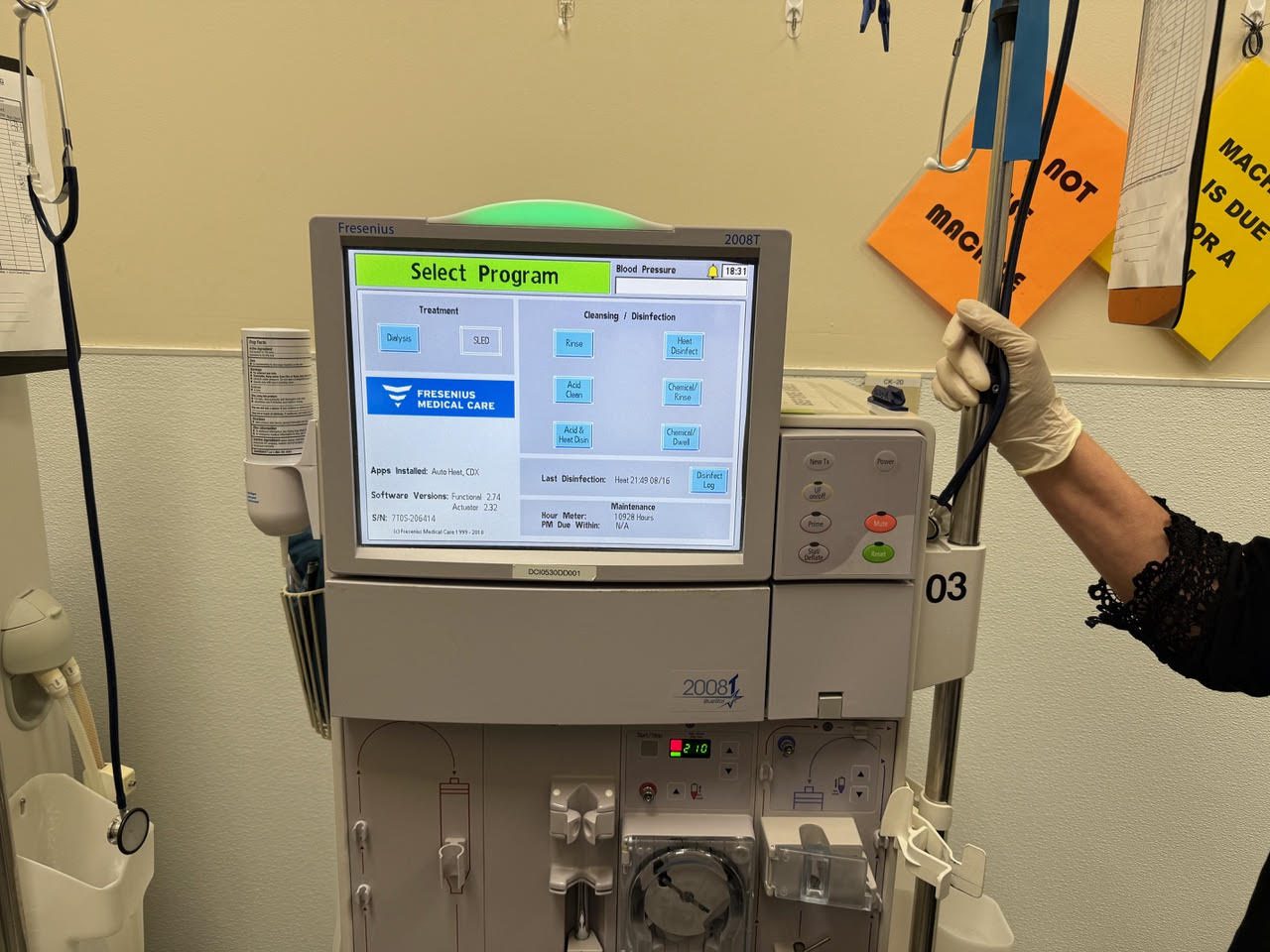
Peter Cole, Bio Med Technician, and Jodi Rodriguez, RN, nurse manager, check a Fresenius 2008T dialysis machine. (Source photo by Linda Morland)

The Virgin Islands Healthcare Foundation, a nonprofit established in 2018, opened its St. Croix dialysis clinic in January at Sunny Isle, next to the Social Security office. The facility currently treats 31 patients and can accommodate up to 78. Most patients receive dialysis three times a week, with treatment available six days a week on Monday, Wednesday, Friday or Tuesday, Thursday, Saturday schedules. Treatment frequency may be adjusted based on fluid levels, toxins, or potassium concerns.

The Fresenius 2008T dialysis machine provides critical data to the skilled teams who care for dialysis patients at the Dialysis Clinic in Sunny Isle. (Source photo by Linda Morland)

To prepare for emergencies, the clinic keeps updated contact, emergency, and personal information for all patients. Each patient also receives an emergency packet that includes national contact numbers for Dialysis Clinic, Inc., in case the local facility is unable to open. The clinic’s goal is to keep all patients on St. Croix. It operates on feeder 5A, which also powers the hospital, and has a backup diesel generator in place. Sharing the road with the hospital also improves the likelihood of quick access after a storm.

“When the governor puts a state of emergency, we are being guided by the government. At that point, we will only be able to say, this is what we have available, this is what’s running. And they’re going to leave us to determine that,” Rodriguez said. The team is also seeking hurricane passes for staff, patients, and drivers who transport patients.

Kevin Marusa, one of the first patients at the clinic, said he understands what is at stake. “I went through full stage renal disease when I was 27 years old. It hasn’t all been dialysis. I was transplanted twice as well.” Now 52, Marusa said he intends to remain on St. Croix even during a major storm. “In the event of a major disaster, I will still come in, I’ll still be here every day at 06:30. My life depends on being here.”

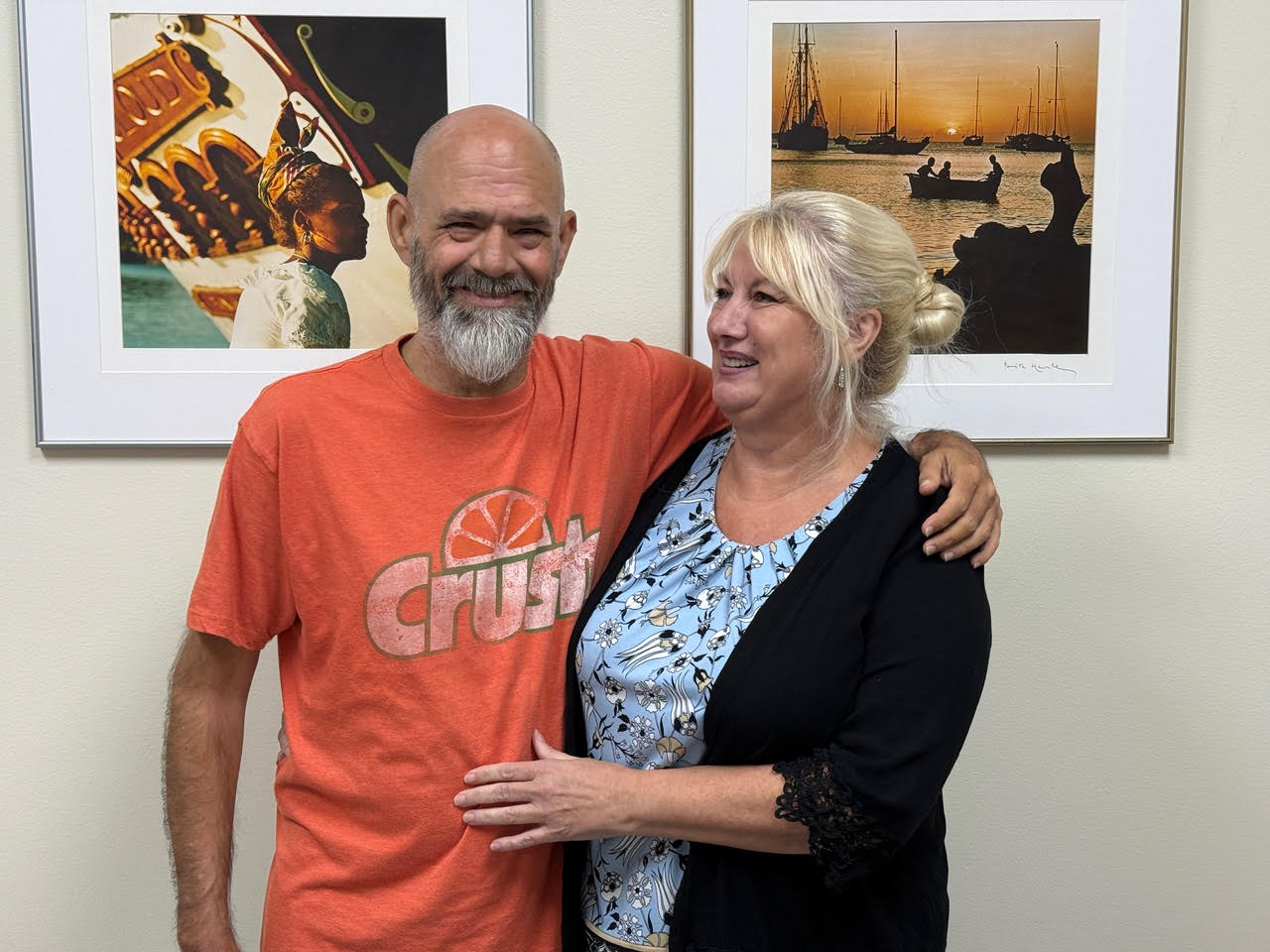
Kevin Marusa, dialysis patient and Jodi Rodriguez, RN, nurse manager of DCI, enjoy a moment together after his treatment concludes for the day. (Source photo by Linda Morland)

The facility is stocked with three months of supplies, storm shutters, a cistern, a backup generator, and the ability to bring in water tanks. “This is a good strong building. All of our storm shutters are good,” Rodriguez said. She plans to return the day after any storm to check operations and, if necessary, retrieve patients herself.

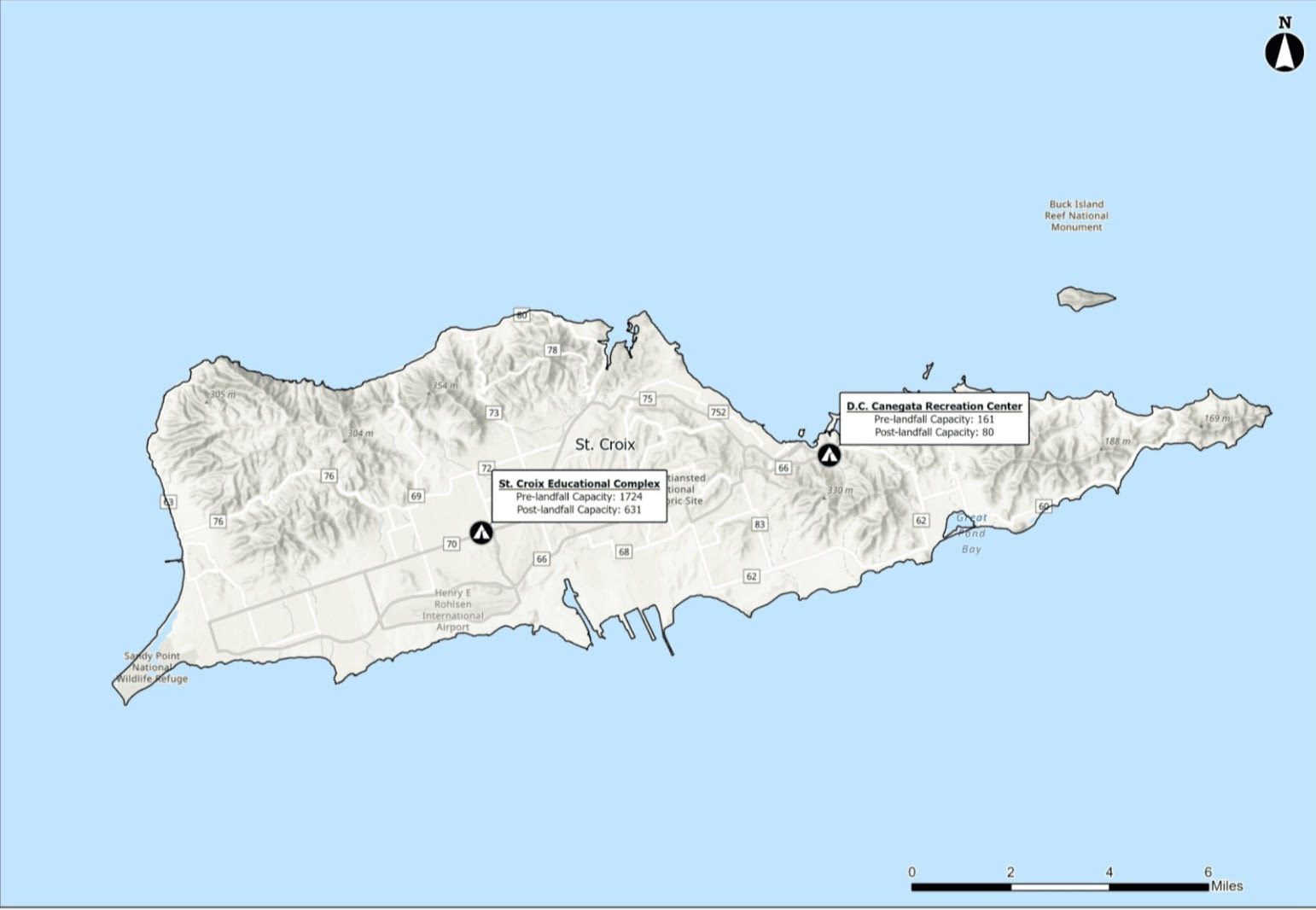
Emergency shelter capacity for 2025 has also been identified. Ryan Nugent of the V.I. Human Services Department said shelters on St. Croix include the St. Croix Educational Complex, with a pre-landfall capacity of 1,724 and post-landfall capacity of 631, and the D.C. Canegata Recreation Center, with a pre-landfall capacity of 161 and post-landfall capacity of 80. The Educational Complex is also pet-friendly.

A map of St. Croix emergency disaster shelters. (Photo courtesy VIDHS/FEMA/Capstone)

Elderly, dependent adults, and persons with disabilities aged 60 and older can register with the Disaster Registry. Forms are available at the Human Services Department, the Bureau of Motor Vehicles, and the Virgin Islands Elections System.

Dialysis Clinic, Inc., operates as a not-for-profit corporation focused on kidney care innovation, addressing care gaps, supporting local communities, and investing in research to advance treatment and improve the lives of people with kidney disease.

Archaeologists Employ New Mapping Technology to Find St. Croix’s Long Hidden Maroon Settlements

0
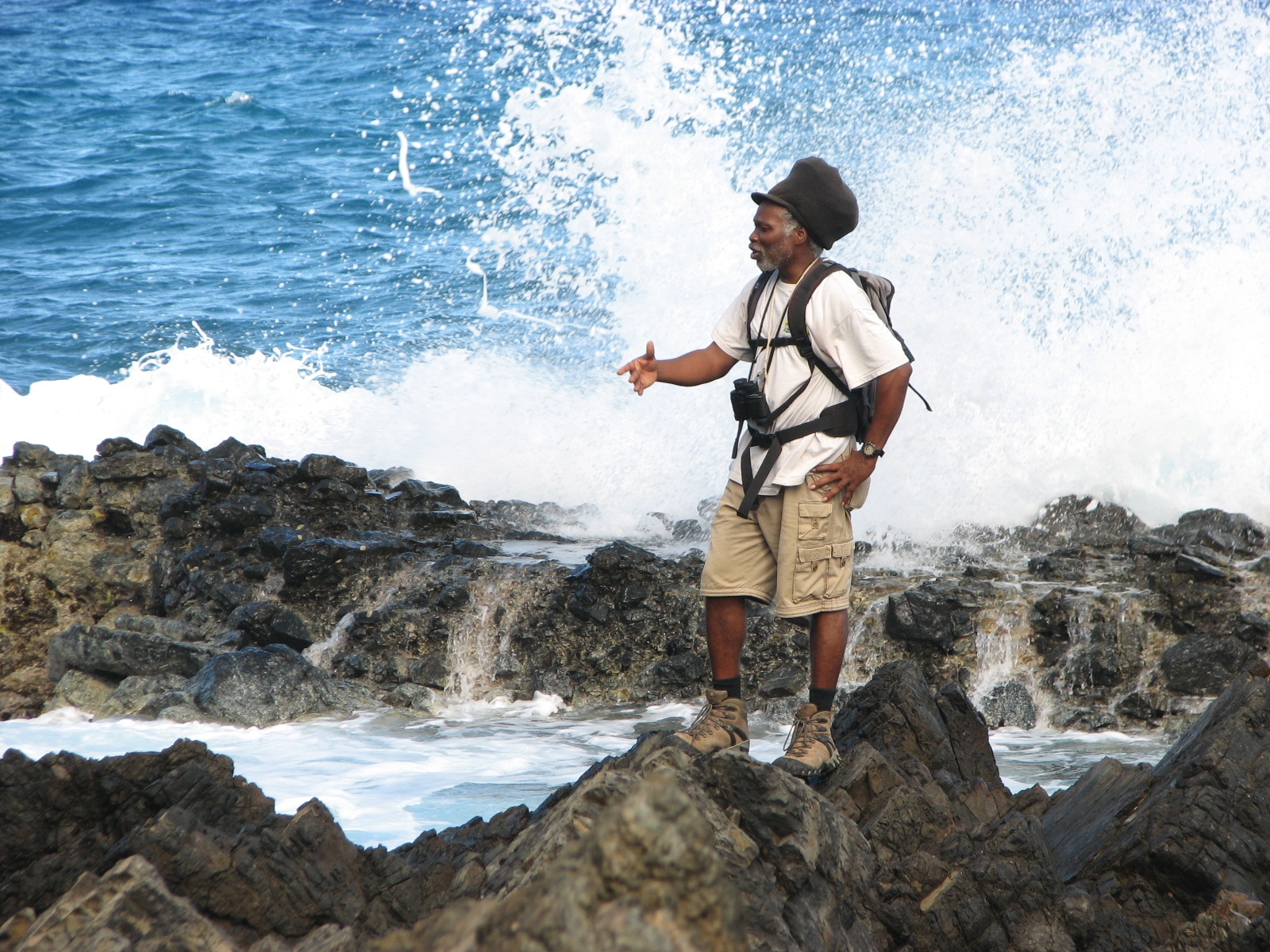
With my backpack, hat on, and hiking boots on feet teaching the cultural and environmental massage to protect Maroon Country. (Photo courtesy of Olasee Davis)
Olasee Davis, teaching about the cultural and environmental importance of Maroon Country on St. Croix during a hike in 2022. The vast area has now been designated part of the Territorial Park system. (Photo courtesy Olasee Davis)

“For a long time now, a large number of [escaped slaves] have established themselves on lofty Maroon Hill in the mountains toward the west end of the island [of St. Croix]. … They are there protected by the impenetrable bush and by their own wariness.”

Justin Dunnavant
Justin Dunnavant

Those are the words of Christian Oldendorp, a Danish missionary who visited the Caribbean island of St. Croix in 1767. His account is one of the few Danish historical records of Maronberg, a community of escaped slaves, known as Maroons, in the northwest mountain ranges of the island.

In 1733, the Danish West India-Guinea Company purchased St. Croix from France and quickly expanded the island’s sugar and cotton production. This also meant expanding the slave population to harvest lucrative plantations. But the Danes were never able to fully control the island — or the enslaved. By the end of the 1700s, nearly 1,400 people – more than 10% of the enslaved population — successfully escaped captivity. But where did they escape to? Only recently have researchers started to shed more light on this centuries-old mystery.

As an archaeologist specializing in slavery and resistance, I’ve excavated plantations in the Americas and used geographic information systems to model Maroon escape routes by sea. Recently, I turned my attention to Maroon settlements on land, working with a team of archaeologists to locate Maronberg.

Honoring a legacy

I first learned about Maronberg on a nature tour of St. Croix given by local activist and University of the Virgin Islands professor Olasee Davis in 2016. At that time, I was on the island to excavate a sugar plantation, a project that gave my colleagues and me a unique perspective on the enslaved experience in the Danish-controlled Caribbean.

In August 2025, Davis’ decades-long campaign to create an official heritage sanctuary to protect Maronberg finally came to fruition. The local government purchased 2,386 acres of land to serve as the U.S. Virgin Islands Maroon Territorial Park.

But one problem remains: We have yet to find the physical remains of the settlement. Locating and preserving Maronberg’s historical artifacts and buildings could provide new insight into residents’ way of life and give greater meaning to the sanctuary.

Fortunately, advanced computer modeling and high-resolution maps are helping us get closer to pinpointing the settlement.

Maroon Hole difficult cliff below Maroon Ridge where runaway slaves hid. (Photo by Olasee Davis)
Maroon Hole, a difficult cliff below Maroon Ridge, where runaway slaves hid. (Photo by Olasee Davis)

Finding what was meant to remain hidden

Many Maroon settlements in the Americas have proved difficult to locate. This makes sense when you consider that their inhabitants were trying to hide from colonial settlers. If the Danes had found Maronberg, they would have either killed its inhabitants or forced them back into slavery.

Runaways tended to settle in areas that were intentionally difficult to access, like remote swampy or mountainous terrain. Houses and other shelters often consisted of  semipermanent structures so that Maroons could relocate as needed to avoid detection.

The boundaries of Maronberg and the size of the settlement along the northwestern mountain range remain unknown. Colonial militias attempted periodic raids, but historical records report that they were met with rugged terrain, booby traps and counterattacks.

The missionary Oldendorp wrote: “[The Maroons] keep every approach safe by attempting carefully to conceal small, pointed stakes of poisoned wood so that the unwary pursuer might wound his foot on them and therefore be prevented from continuing the chase as a result of the unbearable pain.”

All those precautions paid off: The Danes were never able to penetrate the Maroons’ encampment.

Using new tech to see 300 years into the past

Recent attempts by researchers to locate Maronberg began in 2007, with more extensive geographic information systems mapping conducted in 2008. These digital, computer-based geographic programs allow researchers to store a range of geological data and model spatial patterns across vast terrains.

Pairing a historical map with a low-resolution elevation map from the U.S. Geological Survey, archaeologist Bo Ejstrud created a predictive model to assess the probable location of the Maroon settlement. He considered elevation, slope and colonial infrastructure to identify the most remote areas of St. Croix with the least visibility from colonial lines of sight.

Back in the 1700s, urban centers accounted for only a small percentage of the overall landmass of the 83-square-mile (215-square-kilometer) island. Much of the land was either plantations or uninhabited forests and mountains. Ejstrud’s model reaffirmed the likelihood of a Maroon settlement in the northwest region. But it left us with a massive survey area. The map also didn’t account for the possibility that the settlement moved over time.

In 2020, I teamed up with archaeologists Steven Wernke, from Vanderbilt University’s Spatial Analysis Research Laboratory, and Lauren Kohut, from Winthrop University’s Geospatial Environmental Modeling Lab. Together, we developed and visualized a more dynamic model using advances in mapping since 2008.

We began by digitizing two of the most detailed colonial maps of St. Croix — one from 1750 and another from 1799. These maps, created by Danish military engineers and surveyors, detail the spread of plantations, roads and settlements over time.

Next, in order to build a digital elevation model of the island’s terrain, we incorporated high-resolution light detection and ranging, or lidar, data collected by the National Oceanic and Atmospheric Administration. Whereas traditional digital elevation models can be skewed by dense vegetation and trees, lidar uses laser pulses that penetrate through the forest canopy to map the Earth’s surface. This technology allows us to analyze some of the most secluded, inaccessible areas on the island. Prior to 2013, lidar was too costly for archaeological research purposes. But these days, it’s built into many cellphones.

By layering these datasets in geographic information systems software, we created a suitability model that estimated where Maroon settlements were most likely to have existed. In addition to isolation and visibility, we also incorporated accessibility to water sources and terrain ruggedness to model the degree of mobility through the landscape.

This approach allowed us to simulate how the opportunities and constraints the landscape offered to people seeking refuge shifted as colonial society grew over time.

Mapping changes

In addition to providing more nuance to the picture of the areas where Maroons potentially settled, our research suggests that the Maroon settlement wasn’t static, but likely waned as colonial infrastructure increased on the island. Our model implies that the area of suitable land for clandestine Maroon communities shrank by more than 90% in just 50 years.

It’s possible that over time there were fewer runaways. More likely, more Maroons left the island by boat for destinations such as Puerto Rico and Tortola.

Where we go from here

Though our findings still don’t provide an exact location for Maronberg, they get us one step closer to locating the physical remains of this centuries-old Maroon community. The next step will be to visit these sites and survey them for evidence of historical settlement. Archaeological research at these sites would help us understand more about the Maroons who turned a rugged landscape into a sanctuary for freedom.

Ultimately, identifying artifacts and historical sites within the newly established U.S. Virgin Islands Maroon Territorial Park would help us develop educational tours and honor the Maroon legacy.

— Justin Dunnavant is an archaeologist and Assistant Professor of Anthropology at UCLA. His current research in the US Virgin Islands investigates the relationship between ecology and enslavement in the former Danish West Indies. In addition to his archaeological research, Justin is co-founder and President of the Society of Black Archaeologists, an AAUS Scientific SCUBA Diver, and consults for the Smithsonian’s National Museum of African American History and Culture. In 2021, he was inducted into The Explorers Club as one of “Fifty People Changing the World that You Need Know About” and selected as a National Geographics Emerging Explorer. His research has been featured on Netflix’s “Explained,” Hulu’s “Your Attention Please” and in print in American Archaeology and Science Magazine.

— This article is republished from The Conversation under a Creative Commons license. The Conversation is the world’s leading publisher of research-based news and analysis. It is a unique collaboration between academics and journalists.

St. Thomas Man Charged in Domestic Violence Assault

0

Luis Amaro Jr., 36, has been charged in connection with a reported domestic violence assault after police said his ex-girlfriend was attacked earlier this month, the Virgin Islands Police Department reported.

The woman reported the incident on Aug. 13 at the Richard N. Callwood Command, telling officers that Amaro assaulted her on Aug. 9 after questioning her about where she had been. She said he confronted her again on Aug. 10 when she returned home, throwing her to the ground and causing injuries to her tailbone before biting her on the face, leaving a wound on her left cheek, according to the police report.

Amaro appeared at the Domestic Violence Unit on Aug. 20, where he was informed of the complaint. He refused to give a statement and was arrested. Police said he was charged with third-degree assault domestic violence, simple assault domestic violence, and disturbance of the peace. He was booked, processed, and turned over to the Bureau of Corrections to await his Advice of Rights hearing, the police report stated.

The case remains under investigation by the Domestic Violence Unit. Police urged anyone with information to call 911, the Domestic Violence Unit at 340-715-5536, or the Office of the Police Chief.

Column: Summer’s End — What Comes Next?

When the V.I. senators voted 9-3 to deny a request by the governor to extend a permit for the Summer’s End Group marina development in Coral Bay, St. John on Aug. 28, it showed their intention to follow the laws established under the Coastal Zone Management Act.

Officials sit ready to testify at the Senate’s Committee of the Whole meeting about the Summer’s End Group’s permit. (Screenshot from Senate Committee of the Whole, Aug. 28, 2025)

For those who have not followed the events leading to the dramatic Aug. 28 Senate hearing and follow-up vote, here’s a brief rundown of the events leading to the decision that is bringing the project to a halt, at least for a while. 

Following this background, the Source will present some possibilities regarding the future of marina projects in Coral Bay, along with a final note.


Events Leading up to the Aug. 28, 2025, Senate Vote

In 2014, the Summer’s End Group acquired permits from the St. John Committee of Coastal Zone Management to build a marina and upland development in Coral Bay, St John.

Coral Bay (Source photo by Amy H. Roberts)

The project faced numerous challenges filed in territorial and federal courts until December 2020. That’s when the Senate approved a bill (at Gov. Albert Bryan Jr.’s request) to ratify the controversial CZM permits so that they became law and the project could move forward.

But the project was still doomed to delays. In addition to acquiring a Coastal Zone Management permit from the territory, the developers were also required to obtain approval from numerous federal agencies, leading to a final permit issued by the U.S. Army Corps of Engineers in cooperation with the Environmental Protection Agency.

In spite of the developers’ efforts to comply with federal permit requirements (and their optimistic statements that it was coming “in the next quarter”), the Summer’s End Group has not received its permit from the Army Corps.

Why Haven’t the Developers Received their Army Corps Permit?

Proponents of the marina project (including SEG’s attorneys, former Louisiana Congressman Garret Graves, and Gov. Bryan) attribute delays in acquiring their permits to federal red tape and the interference by those who don’t want to see progress in the community.

Opponents of the project (including Save Coral Bay president David Silverman) and the Environmental Protection Agency have cited reasons including a flawed permit approval process in the beginning and the project’s potentially harmful effects on the environment.

The Senate’s Aug. 28 hearing determined these facts: The Summer’s End Group received its revised CZM permit in 2020 through legislation, but that permit expired in 2021 and is now null and void.

CZM law states, “Any development or construction approved by a coastal zone permit shall be commenced within 12 months from the date such permit is issued. Failure to commence development or construction within such period shall cause the permit to lapse and render it null and void unless an extension is granted by the Committee of the Commission or the Commissioner.”

To date, the Summer’s End Group has not begun construction and has not gone back to the St. John Committee of Coastal Zone Management or the commissioner to request a permit extension.

Why didn’t the Summer’s End Group do either of these things? When senators asked SEG Managing Member Chaliese Summers to explain, she said their legal advisers told them it was unnecessary. She offered further explanations when the question was repeated several times at the Aug. 28 hearing.

Chaliese Summers, managing member of the Summer’s End group, testifies at the Senate’s Committee of the Whole meeting about the Summer’s End Group’s permit. (Screenshot from Senate Committee of the Whole, Aug. 28, 2025)

One explanation was that the developers were prohibited from breaking ground until they had obtained their Army Corps permit, which they did not yet have. (Two of the three senators who voted Thursday in favor of the governor’s bill to grant the extension cited this as their reason for doing so.)

A second explanation was that the Summer’s End Group believed the countdown for their CZM permits’ one-year expiration didn’t begin until they had all of their permits in place.

A third was that the developers had completed demolition of hurricane-damaged buildings on property they leased, and though this wasn’t technically “construction” (which was prohibited until their Army Corps permit was granted), it was a form of development. Additionally, SEG had been working steadily with federal agencies to attain their permits.

Nine of the 12 senators who voted to deny the permit extension found these explanations unsatisfactory.

They heard testimony that two other marina projects (Compass Point and Yacht Haven Grande on St. Thomas) had consistently filed for extensions of their permits from CZM when their Army Corps permits were delayed.

After Coastal Zone Management Commissioner May Adams Cornwall read the laws regarding permits during her testimony, several senators denounced the governor’s attempt to bypass local CZM law (for a second time) by enacting special legislation to extend the permit to a favored project.

May Adams Cornwall, CZM Commissioner, explained the details of permitting regulations. (Screenshot from Senate Committee of the Whole, Aug. 28, 2025)

Many of the senators said they supported a marina development on St. John and saw much to like about the project. But they couldn’t disrespect CZM’s jurisdiction and override their decision in this matter.

So What Comes Next?

How the Summer’s End Group will respond to this latest setback is unknown. The Source reached out on Friday morning to Chaliese Summers for comments but has not received a response as we go to press Sunday night.

No doubt the developers will need some time to meet with their attorneys, investors and consultants before issuing a statement. This project has been in development since 2012 when it began as the St. John Marina spearheaded by former V.I. Sen. Robert O’Connor Jr. Clearly, there’s a lot at stake: The Summer’s End Group has invested $11 million so far and claims to have $130 million in construction financing ready to go, according to their testimony at the Senate hearing on Aug. 28.

Adams Cornwall, who heads up the territory-wide CZM Commission, told the Source she would provide comments after the commission meets this coming week.

But according to Kurt Marsh Jr., a member of the St. John Committee of Coastal Zone Management, the current situation is straightforward. “Summer’s End Group would have to send a letter to us requesting an extension, but the regulations are very clear: They can apply for an extension, but the committee may not be as open to them now especially as the permit has expired. That’s my personal opinion.”

Marsh believes Summer’s End Group should start over with a new permit application to CZM. “We don’t know which of their leases are legitimate. Because of major modifications from 2014 to now, we have no idea what the project really looks like. The scope has drastically changed, and none of the changes have come before the committee.”

Marsh disputes the argument that the developers were prohibited from starting construction until they got their Army Corps permit. “People keep conflating the Army Corps permit for the docking with the territorial permits for the buildings. They could have submitted building permit applications (for the land portion of the development) in 2020,” he said.

In the meantime, landowners in Coral Bay have started to consider other options for developing their property to build marine facilities in Coral Bay.

In 2022, the Coral Bay Community Council began a “small docks” study to manage planning efforts for developing small access docks and associated services for transient, recreational boaters in Coral Bay, St. John.” The study was funded by a grant from the U.S. Fish and Wildlife Service through the V.I. Department of Planning and Natural Resources.

According to the study report, “Coral Bay Community Council researched which docking systems and designs are best suited for small docks in Coral Bay … The focus of this research was on smaller floating style docks that would be simpler and faster to permit and less expensive to purchase.”

The CBCC defined a “small dock” as a floating dock that extends 100 feet from shore and has a 25-foot L or T-shape at the end, which covers no more than 500 square feet of surface area over the water. Its design would allow the passage of light to the sea grass beds or coral below the docks.

A map shows sites chosen as possible sites for small docks in Coral Bay. (Image from https://coralbaycommunitycouncil.org/wp-content/uploads/2024/09/CBCC-Small-Docks-Final-Summary-Report.pdf)

At the conclusion of the study, three possible sites were determined as suitable locations for small docks that could be easily permitted because of favorable environmental factors. The Coral Bay Community Council has pledged to work with the Department of Planning and Natural Resources and landowners “to determine possible funding sources to cover construction costs.”

In an op-ed in the Source written in March 2024, Sharon Coldren, CBCC’s past president and a current board member, questioned why investors continued to fund the Summers End Group’s marina project. She told the Source Friday she still stands by her opinion piece (“except for a few minor updated documents”) and said she would be happy to suggest “better alternatives that the community can support” to Summer’s Ends’ investors.”

One Final Note by the Reporter:

This hearing had something that other hearings involving Summer’s End did not have: the emotional testimony of Jacquelyn Clendenin, the daughter of Eglah Marsh Clendenin, a St. John property owner who, along with her sister Minerva Marsh Vasquez, leased her property for the marina project in 2013.

Jacquelyn Clendenin testifies about legal disputes with the Summer’s End Group. (Screenshot from Senate Committee of the Whole, Aug. 28, 2025)

“It was always understood that these properties were to remain in the family for generations from our grandfather’s time,” Clendenin said.

Her testimony continues:

“In 2013, the sisters signed a long-term lease for the development of those properties with Coral Bay Marina. At the time they signed the lease, our mother and aunt did not have independent legal representation. They placed their faith in a close friend of our mother, who assured them this would be a good thing to do for their family and for their legacy.

“The lease was transferred from Coral Bay Marina to the Summer’s End Group in 2014. The yearly payments were supposed to be around $65,000 per year, with increases for inflation every four years.

“In 2015, the sisters were getting up in age, and their health was declining. Our mother was showing signs of early dementia. Our mother, with her attorney, created a will in May of 2015.

“She designated Power of Attorney to ourselves and Vincen Clendinen Jr.

“In 2016, our mother was taken to sign another amendment to the lease. Our mother had no legal representation present to assist her in deciphering the content of the document. Her doctor had already diagnosed her as having dementia prior to her signing this amendment. This amendment provided a waiver to the Summer’s End Group from all unpaid prior lease payments and eliminated all future lease payments until which time that the Summer’s End Group received all necessary permits and construction began.”

Since 2016, the Summer’s End Group “has not paid any rent or land taxes for our family’s leased property in Coral Bay,” Clendenin said. “The family has been paying the land tax and still cannot utilize our ancestral land.”

In 2021, Clendenin’s aunt died, and in 2023, her mother died. “An entire generation has passed waiting for this to bear fruit,” she said.

“Additionally, over the past nine years, we have made numerous attempts to rectify this matter by attempting to void the lease, and we were willing to negotiate a new lease with the signatures of the appropriate Power of Attorney and the current Trustees with The Summer’s End Group to no avail.

“The Marsh/Clendinen family is united in our wish to terminate the lease with The Summer’s End Group and be able to have more input into the development of our property in a way that benefits our family, the community, and future generations, as was our grandfather’s original wish for the family legacy.”

It’s impossible to say with any certainty, but with these words, the mood in the Senate chambers on Thursday seemed to shift. Before Clendenin’s testimony, the focus of the hearing was more about how the loss of the project would affect the economic development of Coral Bay and send a chilling message to other developers who were seeking to do business in the Virgin Islands.

Clendenin’s words showed the project’s developers in a different light, and though the issues involving her family’s land had little to do with the question of whether or not the Summer’s Ends’ CZM permit had expired, it took some of the wind out of their sails.

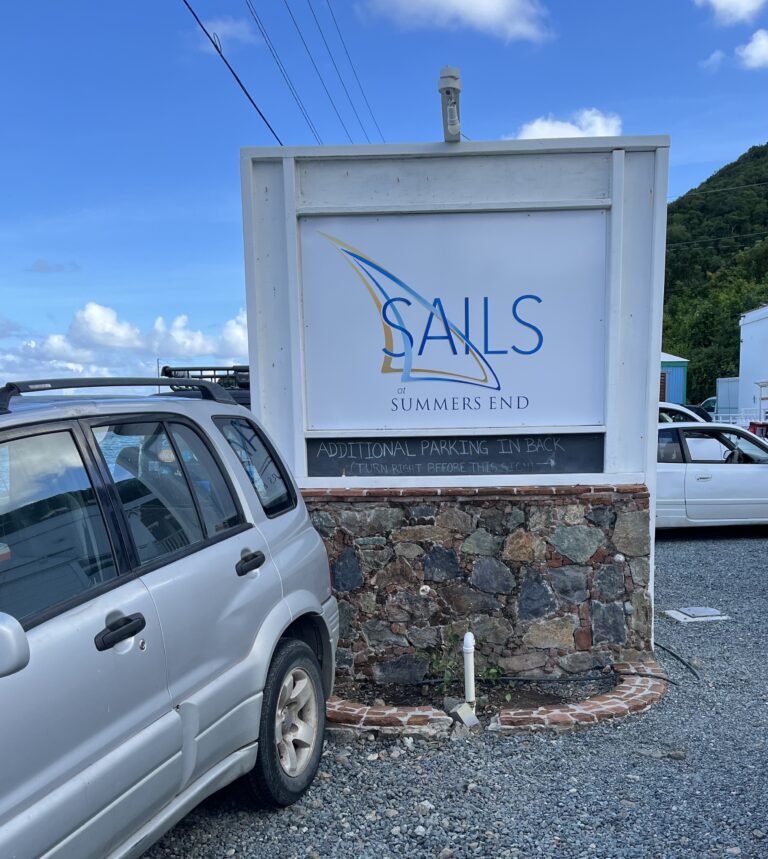
Summer’s End Group has bought the former Cocoloba Complex and renamed it as “Sails.” (Photo by Carol Beckowitz)

Op-Ed: State of the Territory | A Red Suit Cannot Hide the Truth: The Senator At-Large, the 60-Day Rule, and Accountability

In her biweekly column, “State of the Territory,” former Sen. Janelle K. Sarauw delves deeper into issues of concern for V.I. residents.

Accountability is the cornerstone of public service. Without it, the people lose trust, and democracy itself begins to erode. The recent controversy involving Senator Bolques is not only about one individual’s conduct, but also about how the Legislature chose to handle the matter. The way this case was managed raises serious questions about the Senate’s willingness to uphold the standards it was elected to defend.

Much has been made of the sixty day rule, the statutory limit for reporting a complaint. That rule was treated as an immovable wall, as though nothing could be done once the window had closed. Yet the truth is that nothing prevented the Legislature from convening in session and voting to waive that rule, just as it has waived countless rules in the past when it was deemed necessary. Procedure should never become a shield against accountability. When the Senate chooses to apply rules rigidly in one instance but freely set them aside in another, it sends a troubling signal about priorities.

Equally concerning was the expectation that senators would vote on a recommendation without being given the full details of the charges. To their credit, several members raised this very point. It is unreasonable to expect legislators to cast a vote on so serious a matter without having the facts laid before them. By withholding the charging documents, the Legislature did not just weaken the process. It failed the public and, most importantly, it let the victims down.

One of the charges fell outside of the sixty day window, and yet the Legislature still did not have the decency to disclose what that charge was. Instead, they reduced the matter to a vague violation of the oath of office. That lack of transparency deprived the people of their right to know the seriousness of the conduct and shielded the senator from the full weight of public accountability.

The conduct of the senator at the center of this controversy further complicated matters. On the day of his reckoning, he arrived in a bright red suit, describing it as his “fire suit” to a local reporter. To many, that appeared less like humility in the face of scrutiny and more like a performance of defiance. Leadership is not about mocking accountability or celebrating technical escapes. Leadership is about facing the public squarely, acknowledging mistakes, and showing a willingness to rebuild trust. That is what the people of this territory deserve.

This situation also raises a broader policy question: why should there be a strict 60-day reporting window on allegations of harassment or misconduct? Victims often need months, even years, to summon the courage to come forward. A timeline that cuts them off so abruptly does not serve justice. When former Senator Steven Payne was investigated, the body proceeded with full transparency through a charging document. That openness allowed senators and the public alike to consider the matter with clarity. This time, secrecy and technical limitations prevented a full airing of the facts.

The people of St. John and the wider Virgin Islands deserve better. They deserve an at-large senator who reflects humility and accountability, and they deserve a Legislature that upholds transparency and consistency. The 60-day rule must be revisited so that victims are not silenced by arbitrary deadlines. More importantly, the Legislature itself must show that it can hold its members to the same high standards it asks of others.

True leadership is not about technical victories. It is about doing what is right, even when it is painful or inconvenient. It is about being willing to admit mistakes, to apologize sincerely, and to take steps to restore public trust. Anything less diminishes the office and betrays the people who placed their faith in it.

Editor’s Note: Opinion articles do not represent the views of the Virgin Islands Source newsroom and are the sole expressed opinion of the writer. Submissions can be made to visource@gmail.com

Jobs - Click Here