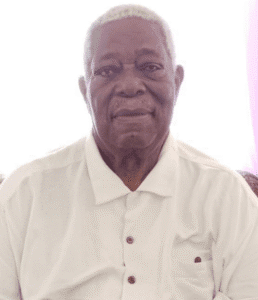
It is with profound sadness that we share the passing of Jose Quinones Ortiz on Sept. 29, 2025. He passed away peacefully at home at the golden age of 90 years old.
Jose Quinones Ortiz
Jose or as many people knew him as “Che Che” was our dearly loved father, grandfather, great grandfather, brother, uncle, and cousin and he will be greatly missed by his loving family and close friends.
He was preceded in death by his mother Aurora Ortiz, father Augustin Quinones, ex-wife Petra Perez, and sons Jose Antonio and Jose Enrique Quinones.
He survived by his daughter Carmen Milagro Quinones; Sons: Hector and Jesus Quinones; Grandchildren: Anna Luisa Serrano, Jose Luis Serrano, Carmen Milagro Serrano, and Rose Marie Charles; Great Grandchildren: Joshua Ladriye, Dion Meyers, Allan Greaux, Destiny Montanez, Amarion Greaux, Joatan Rosado, Myah Montanez, Luis Miguel Rojas-Serrano, and Zaliyah Angeliz Charles; Great grandson in law: Jaime Navarro II; Great Grandchildren: Jaime Antonio Navarro III, Miguel Antonio Navarrro, De’Nailah Meyers, and Aasira Greaux; Brother: Francisco Robinson; Sisters: Maria Mclat, Nydia Raley, and Migdalia Garcia. Special friend: Marcos Rijo. He also survived by many nieces, nephews, cousins, friends and family members too numerous to mention.
His viewing will be held on Thursday, Oct. 16, from 3 p.m. to 5 p.m. at the Divine Chapel, 129 Peter’s Rest.
His going home ceremony will be held on Friday, Oct. 17, at the Holy Cross Catholic Church, Christiansted, St. Croix. Viewing will begin at 9 a.m., with the Eulogy at 9:20am, and the service at 10 a.m. Interment will follow to the Kingshill Cemetery
Jeannette Marie Richards-Iles of Frederiksted St. Croix U.S.V.I. transitioned into eternal life on Sept. 20, 2025. She was 91 years old.
Jeannette Marie Richards-Iles
She was preceded in Death By: Parents, Claude J. and Evelyn M. Richards; Brothers, Arthur A. Richards, Russell D. Richards, Louis Richards, Donald Richards; Sisters & Sisters-In-Law, Rita Grant, Alice Nielsen, Myrna Richards, Elena Richards; Nephews & Niece, Clyde Grant, Russell D. Richards, Jr., Anthony Richards, Pamela Richards, Aaron Derrick.
She is survived her: Siblings, Claude R. Richards and Dr. Claudette P. Richards Derrick;Sisters-In-Law,Bernice Richards, Aurelia Richards and Hanna Richards; Nephews & Nieces, Evelyn Brathwaite, Claude L. & Paula Richards, Jr., Robert E. & Genitta Richards, Daryl A. Richards, Sr., Donna M. & Edward Richards, Steven A. Richards, Linda D. Richards, Wesley E. & Anna Richards, Duane & Gigi Richards, Lawrence J. & Nataki Richards, Leroy Grant, Betty Nielsen, Claudia M. Richards, Claude M. Richards, Amanuel J. Richards, Daniel C. Richards, Samuel Gabremariam, Gregory A. & Almitra Richards, Evelyn L. Richards, Troy M. Richards, Michael A. Richards, Chimoy N. Richards, Dorna F. Werdelin, Chanel & Wayne Alleyne, Tamika Richards, Daryl Richards, Jr., Geron Richards, Che Richards, Kia N. & Randall Sharpe, Shayne Richards, Alyx Richards, Joshua Richards, Aswad Richards, Bomani Richards, Tayma Richards, Don Richards, Lena Richards, Ashton Richards, Jodeci Richards, Brice Richards, Malia Richards, Deja Bellamy, Ahmad Williams; Special Friends, Claire Roker, Elba Proctor, The Carrington Family, The Arnold Family, José Ventura, Dianne Hendersen, Ray Iles and Family, Joy Santoli. Other relatives and friends too numerous to mention.
Funeral service will be held on Tuesday, Oct. 14 at St. Patrick Catholic Church, Frederiksted St. Croix. Viewing will begin at 9:30 a.m. with service at 10:30 a.m. Interment will follow at Frederiksted Cemetery.
Professional services are entrusted to James Memorial Funeral Home, Inc.
Cyril Anderson Daniel Sr., aka “Andy,” of Enfield Green, transitioned into eternal life on Sept. 23. He was 80 years old.
Cyril Anderson Daniel Sr.
He was preceded in death by his mother, Sarah A. Daniel; father, William Daniel; spouse, Magarita Daniel; sisters, Enid Flemming, Ruth Tyson, Gladys Greenaway, Linda Morris; and brothers, Roy Daniel, George Daniel.
He is survived by his daughters, Beverly Williams, Ernestine, Margaret, Audrey and Rosetta Daniel; sons, Allister Hanley, Cyril Jr. Richard and David Daniel; grandchildren, Sheon Hanley, Danielle Hanley, Otis, Shantel, Shevonne Hanley, Patricia and Bevrick Williams, Adritony Browne, Ian Daniel, Daleianna Roberts; great grandchildren, Joseem, Jeanine, Judah Frances; nieces, Janet Panris, Cynthia, Mary, Joan Fleming, Myrthlyn, Hilda, Helen, Audrey, Sandra, Olivia, Denise, Marylinda, Eugenie; nephews, Bishop- Ernest Flemming, George, Esmon, Paul, and Sinclair Flemming, Calvin, Cecil, Cyril, and Virgil Daniel, Daxta, Lenny, Donald Daniel, Melvin Morris; great niece, Rhea Johnson, Jaime Richards; daughters-in-law, Shawndra Daniel; brothers-in-law, Hollis and David Prentice, Trevor, Carl, and Tracy Hanley; sister-in-law, Brenda, Beulah, Petronela and Vadencia Hanley, Marcia David, Paulina Hendrickson, Adline Tobus and Delita Slack, Selma Hanley; godchildren, Annaliza Joseph; cousins and other relatives, Candice Brown, The Liburd, Daniel, Hendrickson and Hamilton, Family of Barnes Ghaut Village Nevis, The Nesbitt Family, Oliver Hanley and Family, Arch Deacon Rudolph Smithen, Tyrone Petersen; special friends, Oliver Smithen, John French, Melvin Hanley, Mr. Leland Walcott, Janette Mafford, Monica Jacobs, Daphne Christian, Samuel Tyson, Patrick Williams, Pastor Carty, Grace, Christian, Adasa Edwards, Carmelita Roame, Members of the St. Johns Choir, and the Men’s Chorale; other precious relatives and friends too numerous to mention.
Funeral service will be held on October 16 at St. John’s Episcopal Church, Christiansted, St. Croix, USVI. Viewing will begin at 9 am with service at 10 am. Interment will follow at Kingshill Cemetery.
Professional services are entrusted to James Memorial Funeral Home, Inc.
In profound sorrow, the management and staff of Turnbull’s Funeral Home & Crematory Services announce the passing of Marion Roslin Brooks, 80, of St. Thomas, U.S. Virgin Islands, who entered eternal rest on Thursday, Sept. 18, 2025.
Marion Roslin Brooks
Marion is survived by her husband, Daniel (Donald), her children Nira (boom boom), Michael (Mickey) and daughter-in-law Ellen (El) , Her Grandchildren Avery Jr. (Terry), LaTricia (Trisha), Natoshia (Toshia), Sydney (syd) Amelia, and Charolette (Alex), her great-grandchildren, Shawn (Shawnee), LaNiece ( NeNe) and,Ciara (CiCi) Also, her remaining sisters, Evangeline, Edris, and Grace. Along with many Nieces andnephews, God children, and dear friends.
Viewing will be held Sunday, Oct. 12 at 9:30 a.m. – 10:30 a.m. at Shiloh Seventh day Adventist church followed by 10:30 a.m. service. Internment Eastern Cemetery
Arrangements entrusted to Turnbull’s Funeral Home & Crematory Services.
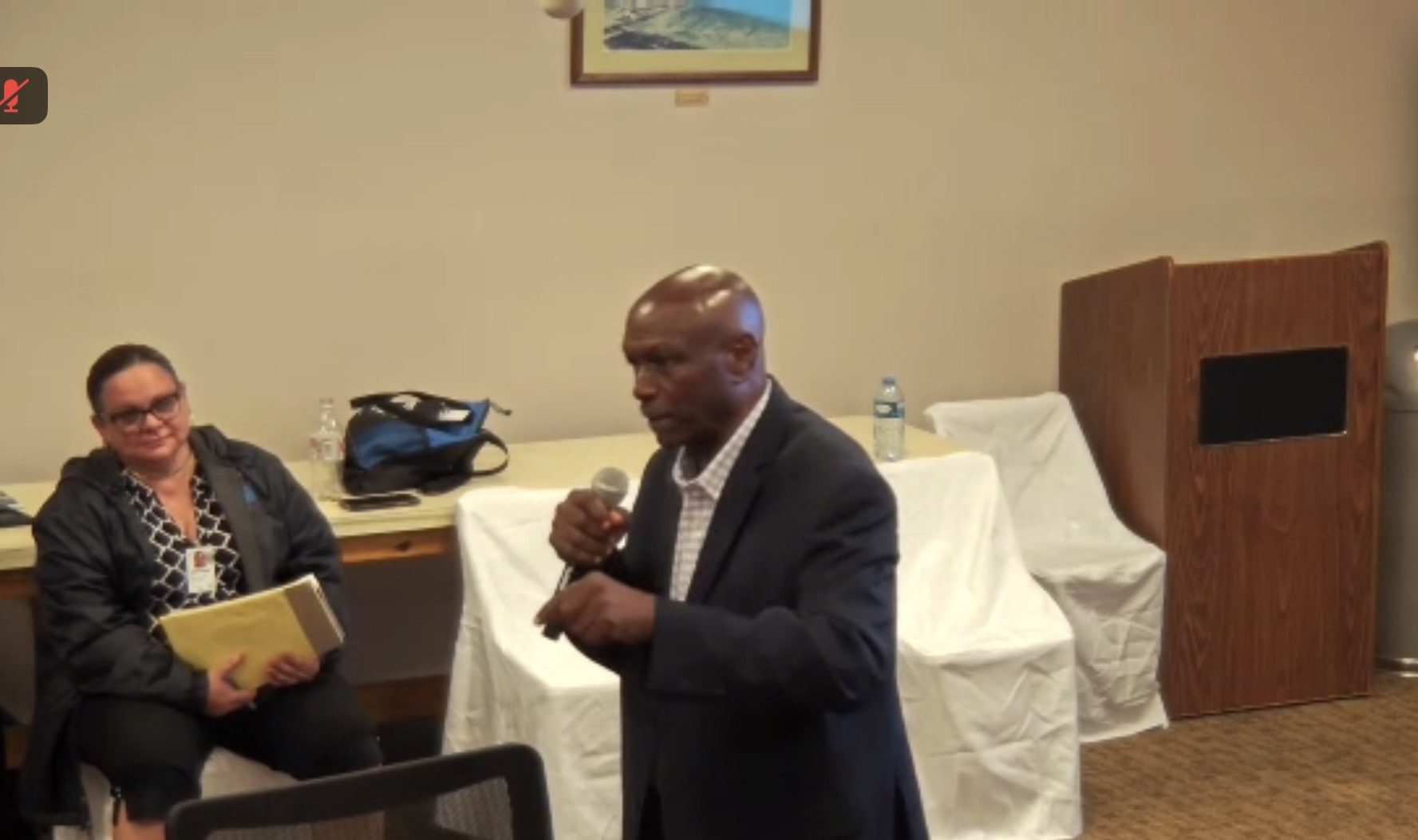
Carlton Dowe at the Henry E. Rohlsen Airport on Wednesday. (Screenshot from Zoom meeting)
The V.I. Port Authority held its third and final forum on St. Croix Wednesday night at the Henry E. Rohlsen Airport to discuss the contentious proposal to raise marine fees.
Earlier public hearings on St. Thomas and St. John drew significant interest, with residents voicing strong objections to the proposed changes.
During the latest public gathering, officials from VIPA discussed ongoing infrastructure improvements across the territory, financial projections for the next fiscal year, and further details of the proposed increases in marine dockage fees. The session drew a mix of praise, concern, and calls for greater transparency from residents and business owners who rely on the ports for their livelihoods.
Some of the proposed fees include a $2 per passenger marine tariff for the Red Hook barge ramp, new fees for cargo staging, and a new parking fee at the Victor Sewer Marine Facility in Cruz Bay, among others. For a full list of the proposed increases, click here.
Executive Director Carlton Dowe opened by reaffirming that VIPA is an independent, self-sustaining government agency, not reliant on annual government appropriations.
“We are not part of the central government budget,” Dowe said. “The Port Authority operates based on the revenues it generates — from leases, user fees, and federal grants. That’s how we fund our operations, pay our employees, and maintain our facilities,” he said.
He explained that VIPA’s revenues are reinvested into maintenance, dredging, and expansion on St. Thomas, St. John, and St. Croix, citing improvements at the Gallows Bay Marine Facility, Red Hook Transportation Center, and both airports.
“These projects are being paid for through bond financing and internal revenues,” he noted, referencing a 2014 bond. “If we don’t modernize, we fall behind. The industry is changing and ships are larger, passenger traffic is increasing, and we must keep up.”
Addressing questions about a projected $5 million revenue increase for the next fiscal year, Dowe said those numbers remain preliminary.
“Once the conclusion of those negotiations is completed, then we’ll reassess our operations and have a better outlook as to how our future would look,” Dowe explained.
Several attendees demanded greater transparency around how VIPA develops such projections.
Audience member and entrepreneur Jed JohnHope said, “The public is asking for more information. Projections help us in business — they help us plan.”
Dowe cautioned against reading too much into a debated $7 million profit figure.
“Remember, the reporting period that was referenced was through July,” he said. “We still have a few months to go. I don’t want anyone to believe it’s going to be $7 million and some of that is timing. Projects that were in design or delayed in construction meant certain expenditures didn’t yet happen.”
He reiterated VIPA’s openness to further stakeholder engagement. “We’ve been transparent,” Dowe said. “We show you exactly how and where our money comes from. Our offices are open if you want a deeper discussion, we’ll have it,” he said.
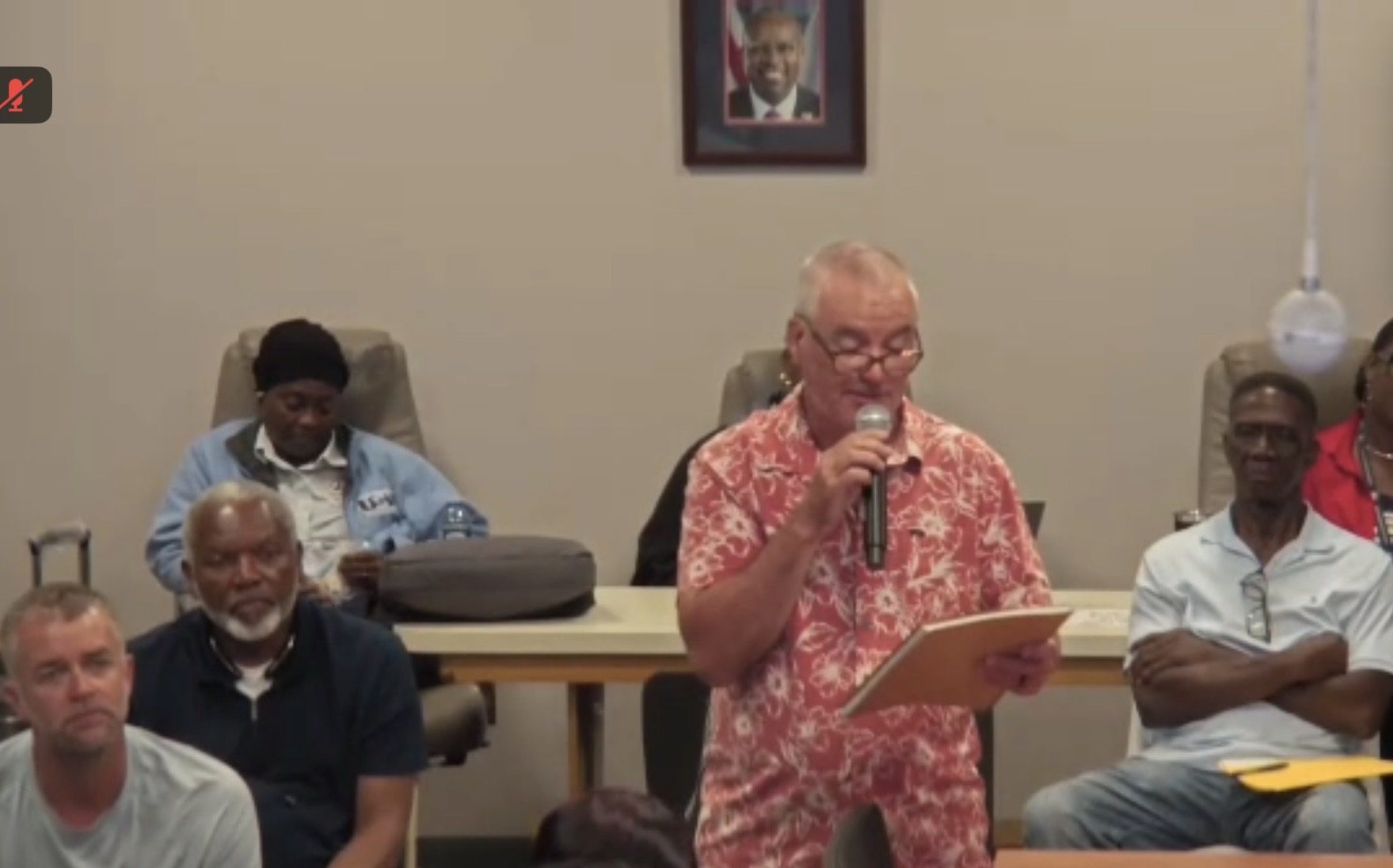
Another objection came from Mike Simpson, a marine operator in Frederiksted, who challenged the proposed 150% increase in dockage fees.
Mike Simpson, a marine operator in Frederiksted, challenged the proposed 150% increase in dockage fees. (Screenshot from Zoom meeting)
“The company I work for is family-owned and has supported the Frederiksted community for the past 10 years,” Simpson said. “This increase would add up to about $3,000 per month for our vessel. That kind of change could drive small operators away from Frederiksted,” he said.
He warned that sudden increases would not align with existing contracts and could have ripple effects on local commerce.
“Our cruise ship charter contracts are signed for two years,” Simpson said. “We can’t suddenly raise rates to cover the added hardship. This could hurt not just operators, but the restaurants, shops, and workers who rely on that business.”
Simpson also pointed to ongoing maintenance deficiencies at the Abramson Marine Facility, noting poor lighting, no public restrooms on non-cruise days, and insufficient bollards for moorings. He proposed a more moderate increase of $1.25 per foot for the 2025–2026 season, phased in incrementally to allow businesses time to adjust.
“This fee hike would put a knife into the very heart of those operations,” Simpson warned. “Frederiksted and its pier are unique, and the businesses there deliver a superior tourism product.”
Dowe responded that VIPA remains open to negotiation. He noted that several ferry operators to the British Virgin Islands had expressed willingness to support smaller increases.
“Three of the major operators we met with said they’d be willing to support a 50-cent increase,” Dowe said. “Your suggestion of $1.25 will certainly be taken into consideration. That’s the purpose of these meetings: to get real feedback before final decisions are made.”
He added that VIPA will address concerns at Frederiksted, including lighting and mooring infrastructure. “We appreciate your observations,” Dowe said. “I’ll look into the lighting and the bollards you mentioned. At the end of the day, I take full responsibility for what happens at the Port Authority. You can always reach out to me directly,” he said.
As the public feedback continued, Dowe reiterated that nothing has been finalized.
“This is not a done deal,” he said. “The reason we come to the public is to get real discourse. We want everyone to understand that any adjustment we make is tied to the cost of maintaining and improving the ports.”
Throughout the meeting, Dowe emphasized VIPA’s unified approach across all three islands.
“We are one Virgin Islands,” Dowe said. “When we improve one port, we improve them all. That’s what keeps this economy moving forward.”
St. Croix is ready to lead the Virgin Islands into a new era of clean, renewable energy. For decades, our dependence on imported fuel has left us vulnerable to high costs and unreliable service. The time has come to invest in our own energy independence—powered by the sun, the wind, and the strength of our people.
Omar B.U. Henry (Submitted photo)
The St. Croix 2026–2051 Economic Plan envisions a fully renewable island economy that creates local jobs, attracts green investment, and lowers energy costs for families and businesses. By developing community-owned solar projects, training residents in green technology, and modernizing our power grid, we can build a stronger, more resilient future.
Renewable energy is not just an environmental choice — it’s an economic opportunity. It’s a chance to keep more of our dollars circulating locally, to empower our youth with new skills, and to protect the natural beauty that defines who we are.
Let’s make St. Croix a model of sustainability for the Caribbean and the world. The future is bright if we choose to power it ourselves.
When Karl Knight stepped into the role of CEO at the Virgin Islands Water and Power Authority, the utility was, in his words, “on the brink of insolvency.” Expenses were outpacing revenue by nearly $8 million a month, deferred maintenance was catching up, and public confidence was at an all-time low. A year later, Knight says the hole is narrowing — but the climb out is far from over.
“It’s better than when I first started,” he said during an interview with the Source for the kickoff of Public Power Week. “We’ve shrunk that monthly deficit from around $8 million to about a million and a half. We’re still operating in the red, but we’re rapidly working to close that deficit.”
Knight credits that progress to a series of tough fiscal and operational reforms — renegotiating diesel contracts, pursuing a lower-cost long-term propane supply, trimming payroll, and cutting expenses wherever possible. He confirmed that WAPA has also made strides in lowering its diesel costs and securing a temporary LPG agreement that’s less expensive than before. Procurement is underway for a new, permanent LPG supplier, which Knight hopes will “bring more favorable pricing and help really offset some of that expense.”
The deeper challenge isn’t just cutting costs — it’s structural. WAPA’s financial pressure comes largely from its deferred fuel balance, a running tab of fuel costs that have been paid but not recovered from customers through the fuel surcharge, or Levelized Energy Adjustment Clause. That balance ballooned as WAPA froze rate increases to spare residents from higher bills, despite global spikes in oil prices. “We’ve been spending more on fuel than we’ve been able to bring in,” Knight said, “but we didn’t want to raise rates and hurt people. There’s a balance between what’s affordable and what’s sustainable.”
That balance is now formalized in a settlement agreement with the Public Services Commission, holding the LEAC rate steady through June 2026 while WAPA and the PSC evaluate both its base rate and fuel surcharge structure. The Source previously reported that the PSC approved the settlement in August, with WAPA agreeing not to seek new fuel surcharges during the period — a decision that locks in revenue but limits flexibility if fuel prices rise again.
In the meantime, WAPA continues to rely heavily on federal capital funding to offset the cost of major infrastructure projects — but as Knight emphasized, “those funds can’t buy fuel or pay salaries.” Federal dollars can rebuild power plants and fund resiliency projects, but the authority’s day-to-day operations must still come from customer payments. “We are a public utility,” Knight said. “We’re accountable to the people of the Virgin Islands, but we also have to function like a business. Every dollar that pays for maintenance, fuel, or salaries comes from the bills we send out.”
WAPA currently budgets roughly $40 million annually for fuel, an amount that fluctuates depending on generation needs and global prices. Knight estimated the authority faces around $35 million in deferred maintenance — the cost of fixing aging units, restoring turbines, and addressing years of postponed repairs. “If you’re supposed to change the oil in your car every 5,000 miles, and you don’t do it until 15,000, eventually something breaks,” he said. “That’s what we’ve been dealing with for years.”
Still, there are signs of progress. Knight said that solar generation on St. Croix has already reduced operational costs, and with additional renewable projects coming online on St. Thomas next year, he expects efficiency to improve further. WAPA has also reduced what it pays for diesel deliveries and projects lower overall fuel costs once propane conversion on all Wärtsilä units stabilizes, he said.
Looking ahead, Knight believes 2026 will mark a turning point. “By the end of next year, we expect to be operating in the black,” he said. “That means we’ll finally be cash-flow positive — paying our vendors on time, catching up on our payables, and being able to pass at least a portion of the savings back to our customers who’ve been so patient.”
The optimism is tempered with realism. The authority still carries tens of millions in debt and must continue negotiating with the PSC to find a sustainable long-term rate structure. But Knight says the difference between now and a year ago is that the utility is no longer in free fall. “When I came in, we were in what the EY report called the ‘zone of insolvency,’” he said. “Now, we’re managing that risk. We’re cutting expenses, we’re seeing results, and we’re starting to rebuild trust.”
For residents still grappling with outages and billing frustrations, that trust may take longer to restore. But if the financial turnaround holds — and if WAPA can stabilize its revenue while reducing costs —solvency and stability could be around the corner, he added.
Virgin Islands Attorney General Gordon Rhea is pushing back against suggestions that his recent opinion affirming the validity of the Summer’s End Marina permit in Coral Bay was politically motivated, saying his conclusions were based strictly on law — not pressure from Government House.
In a public statement issued Thursday, Rhea called recent insinuations that his legal opinion had been influenced by outside forces “simply untrue.”
“I was asked by Government House to provide a legal opinion concerning the applicability of statutory deadlines to contingent coastal zone permits that require approval from the Federal Government,” Rhea said. “The resulting opinion was researched and drafted by an experienced attorney in DOJ’s Solicitor General’s Division, reviewed by the Solicitor General, and then reviewed by me before being issued and forwarded to Government House.”
Rhea emphasized that neither the governor nor his staff sought to influence the outcome. “At no time has anyone from Government House suggested or implied what my conclusions should be,” he said. “The law is the law, and my job is to state it clearly and correctly.” He added that Gov. Albert Bryan Jr. “has always respected my independence in this regard.”
The statement follows a week of scrutiny over Rhea’s opinion, which was first disclosed Monday by Government House Communications Director Richard Motta Jr. during a press briefing. According to Motta, the attorney general concluded that the five-year-old Major Coastal Zone Management permit for the Summer’s End Marina remains valid and has not expired.
“Specifically, he clarified that the 12-month commencement deadline outlined in Title 12 of the Virgin Islands Code, under subsection 910, does not begin until all federal approvals are secured,” Motta said Monday. “This interpretation provides certainty where there had been questions as of late, and it confirms that the Summer’s End permit has not lapsed. Nor has it expired.”
Motta said the opinion means the permit will remain active pending final clearances from agencies like the U.S. Army Corps of Engineers, after which the developers can proceed with construction.
The opinion comes just months after a contentious Senate debate over the controversial project. In July, lawmakers voted 9–3 to reject a request from Gov. Bryan to ratify the same permit, which had been issued in 2019 and remained tied up in litigation and procedural challenges. Several senators argued that the governor’s proposal appeared to sidestep the Coastal Zone Management process, while others said the project’s lengthy delay had already invalidated its authorization.
During Monday’s briefing, Motta said the attorney general’s interpretation “reassures our community, our developers, and our federal partners that this project continues on a lawful and transparent path,” and that it “underscores our administration’s commitment to striking the right and appropriate balance between progress and preservation.”
Rhea’s statement on Thursday reinforced that distinction. While his analysis may clear a key legal hurdle for the Summer’s End developers, he said his role is to interpret the law — not weigh the political or environmental implications of the project.
“The Attorney General’s opinion that I have issued concerning the Summer’s End permit represents my office’s carefully considered legal analysis, and I stand by it,” Rhea said.
As federal reviews continue, the question of when — or whether — Summer’s End will break ground remains open. The U.S. Army Corps of Engineers has yet to issue its final permit, which would authorize work in the Coral Bay Harbor.
Sen. Carla J. Joseph holds up a copy of the United States Constitution during a Senate Rules and Judiciary Committee hearing. (Screenshot from V.I. Legislature livestream)
The Virgin Islands Senate Rules and Judiciary Committee voted Thursday to send two bills, one on firearms and another on hemp, back to committee for further amendments, with six senators in favor and only Sen. Carla J. Joseph opposed.
The majority of the committee emphasized the need for further refinement of the bills before moving forward. Several senators cited requests from the bill sponsors themselves, as well as feedback from the public, as reasons to send the bill back.
Sen. Milton E. Potter explained his support for the referral, saying, “In communicating with the bill sponsor, the bill sponsor advised me that … based on the information he received from many of you in this audience today, he opted to make some significant amendments to his legislation, so the bill really will not look the same as it looks today.”
“If the prime sponsor of a bill advises you that I would like the bill to be held because it is not ripe to be heard, it needs to be amended. The common practice is to hold a bill and allow the sponsor an opportunity to make the necessary adjustment that he requested,” he continued.
Potter made clear that his vote was not an attempt to obfuscate. “It’s not an attempt to usurp anything or to sneak anything through. This is a bill that’s going to be impossible to quote, unquote, sneak through. Right? I’m a licensed gun owner myself, and I respect everybody’s right to bear arms. I do, but specifically this bill, we all recognize needed significant adjustments. And that is what the bill sponsor indicated. He recognized the deficiency with the bill. And he’s saying, give me time to fix it.”
Collectively, the majority of senators framed their votes as a commitment to give the bill sponsors more time for amendments and to ensure the legislative process remains thorough and inclusive. A few expressed dissatisfaction with the decision by Joseph.
Sen. Kenneth L. Gittens, who made the motion to refer the bills back, said the intent was “to allow the committee of jurisdiction to have additional time to go back and refine the proposed amendments before the bill proceeds forward in the legislative process.”
“It’s a crying shame that my colleague would do such a thing to put it on the backs of the members of this committee fully well knowing that she received information in writing from the bill sponsor asking that the measure not be placed on the agenda, to give him ample time to address the amendments needed,” he added.
Sen. Alma Francis Heyliger echoed the need for more work, stating, “We communicated with them, and it is because of these conversations that we decided to send it back, because we understand their concerns, we understand the constitutionality, we understand the issues with the medical and the health issues that potentially might come across when it comes to the hemp and these gun laws.”
“So we collectively made a decision to do so, and we had one colleague on her own, even though we told her we want to send it back to make sure we do our best to not make criminals out of law-abiding citizens, to make sure the laws are going to be best serving the people of this territory. One person on their own … she did what she wanted to do,” she added.
The bill’s sponsor, Sen. Clifford A. Joseph, said he plans to hold a hearing on Oct. 17 and encouraged individuals to share their input. “I am open. I am listening to all my colleagues, and I’m listening to individuals in the public as well,” Joseph said. “But we are lawmakers, and at the end of the day, we have to bring forward what’s in the best interest of the people. I have not denied anybody the chance to put their information forward for us to listen to.”
He added that he is continuing to refine the measure. “I will say again, I’m looking forward to getting my amendments from legal counsel and making the adjustments that are needed to move these bills forward. It will happen.”
Sen. Angel L. Bolques Jr. also addressed the audience, saying his vote was intended to return the measure to the committee for further review.
“My vote was to take it back to the committee of jurisdiction, which I’m a member of, to have my opportunity to vet the bill thoroughly before we come to this juncture,” Bolques said. “So I do appreciate each and every one of you for coming out here today.”
He acknowledged that while there would be no testimony on the bills that day, the discussion still served an important purpose.
“I apologize that it may seem like time wasted, but I believe this discussion, even though it may have felt a little back and forth, was still healthy for you to have today,” Bolques said. “So that you may all go back to your daily lives knowing that we’re going to be doing our part 110% to make sure the next time you take a look at this bill, it looks a lot more like it should.”
Joseph, the lone dissenting vote, voiced strong disappointment with the committee’s decision to send the bills back without hearing from the public and scheduled testifiers.
She noted that any senator, especially a chairperson, has the right to hold meetings like this one. “It is very well in order, according to our rules,” Joseph said. She added that, as chair, she had communicated with all involved and followed proper procedures but ultimately objected to what she viewed as a missed opportunity for open debate and public input.
She argued that many residents, including representatives from the Attorney General’s Office, had taken time to attend the hearing and deserved the opportunity to speak. To underscore the level of public interest, Joseph requested that the livestream show the gallery of attendees, highlighting the strong community presence at the meeting.
“Show the gallery here, of the persons who came out today, show the gallery. This is a full amount of our residents who pay our salaries and work hard. We have representation here from the Attorney General’s Office, and not to allow them to have an opportunity and to dismiss them, is very unconscionable.”
“We want to make sure our citizenry knows that this is the people’s house and that the people have a voice,” Joseph said. “As long as I remain the chair of this committee, they will have a voice. They needed to be heard and not dismissed today, and that’s why I objected, because I understand, clearly, our constitutional rights …” she said, while holding a copy of the U.S. Constitution, noting the importance of free speech.
Joseph emphasized transparency and public participation in the legislative process, warning against dismissing the voices of those most affected by proposed legislation.
“We cannot be a body that does not include persons who are affected by certain legislation. That’s hypocritical,” Joseph said. “We are their servants, and they have every right to be heard. They shouldn’t be dismissed.”
The committee’s decision means both bills will undergo further review and possible changes before returning for consideration. Lawmakers indicated that additional hearings will be scheduled, giving the public and stakeholders more opportunities to weigh in as the legislative process continues.
A protest outside Bertha C. Boschulte Middle School Wednesday morning drew attention to ongoing maintenance problems in the territory’s schools, including failing air conditioning units.
Craig Benjamin, executive director of the Bureau of School Construction and Maintenance, acknowledged the issues and pointed to staffing and funding shortages as major obstacles to making repairs.
“The thing that I know is bothering them, and us, is that the classrooms are hot,” said Benjamin, referring to the protesters voicing their frustration over the failing air conditioning units on campus.
Benjamin explained that the bureau is responsible for maintaining more than 760 air conditioning units across the district, with only two government-employed technicians available to handle repairs.
The limited staff means that repairs are often delayed, a growing problem as failures occur frequently. “We could lose at least three [units] every other day,” Benjamin said. “We have a limited staff to address these issues with the air conditioning units.”
He noted the side effects of this: “If the air conditions fail, the classrooms become hot. When it’s hot, the buildings actually perspire. When the building starts to perspire, you create a situation where it becomes musky. So this is why it’s important, it’s imperative, that we have the air conditioning in these facilities functioning.”
The protest was prompted not only by reports of malfunctioning air conditioning units, but also because of suspected mold or mildew in classrooms. “There was evidence of mildew forming because the rooms were hot and the rooms were closed,” said Benjamin
Benjamin explained that while mold was not confirmed, and there was only evidence of mildew, affected classrooms were treated as if mold was present. “We just took a precautionary treatment.”
According to Benjamin, the bureau is doing what it can for BCBMS with the resources currently available. “We are addressing the issues as quickly as possible, and we are doing the best that we can with what we have available to us, and that’s including staffing and funding,” he said.
Recent efforts include the installation of a new large-capacity AC unit on the gymnasium roof and the cleaning and treatment of classrooms with mildew. However, further repairs are on hold until the government’s financial system reopens at the end of the fiscal year, expected to be the first week of November.
“We’re at the mercy of this financial system opening back up with the government so that we can engage in the contracts with the air conditioning companies to help with the installation of new units and repairs,” said Benjamin.
“We won’t be able to issue purchase orders or bring in contractors until the first week of November, when the financial system opens back up. The first phase of modernization is supposed to kick start, tentatively, in December when school closes for the Christmas holidays,” he continued
Benjamin emphasized that the community should understand that they are not waiting until November to make improvements. “We are doing what we can right now, until the financial system is opened, by engaging the technician we have on staff to deal with the situation,” said Benjamin. “We could utilize the second AC technician once he’s freed up from what he’s doing at the other schools.”
He cautioned, however, that help from the district’s second AC technician isn’t guaranteed, noting that with more than 760 units to maintain, roughly three failing every other day, and only two technicians currently available, resources are stretched thin.