



Sargassum levels surged to record highs across the Atlantic Ocean and Caribbean Sea in May, with the U.S. Virgin Islands among the areas affected by increased coastal inundation. Additional seaweed is forecast to arrive across the local region in June.
“As predicted last month, while the spatial distribution patterns of sargassum remained stable, sargassum amount in each region increased in May considerably,” according to an update from a sargassum outlook report released May 31 from the University of South Florida Optical Oceanography Lab.
The OOL at USF uses satellite imagery to monitor the presence of sargassum across the tropical Atlantic, Caribbean Sea, and the Gulf via satellite.
Record Amount of Sargassum
“In every area but the Gulf region, sargassum amount exceeded its historical record,” USF said. “In particular, total sargassum amount from all regions combined further increased from 31 million tons in April to 37.5 million tons in May, making a new record,” according to the update.
This reflects a major 6.5 million ton increase in total sargassum across all monitored regions from April to May.
“Most of these increases are due to both local growth and physical transport. Corresponding to these increases, significant sargassum inundation events may have occurred around most Caribbean nations and islands, including the Mexican Caribbean coast,” the USF report said.
“Small to moderate amounts of sargassum may have reached some of the Florida beaches along the Florida Keys and southeast coast of Florida. A small amount of sargassum was also observed in the Mississippi Delta and along the Texas coast,” USF continued.
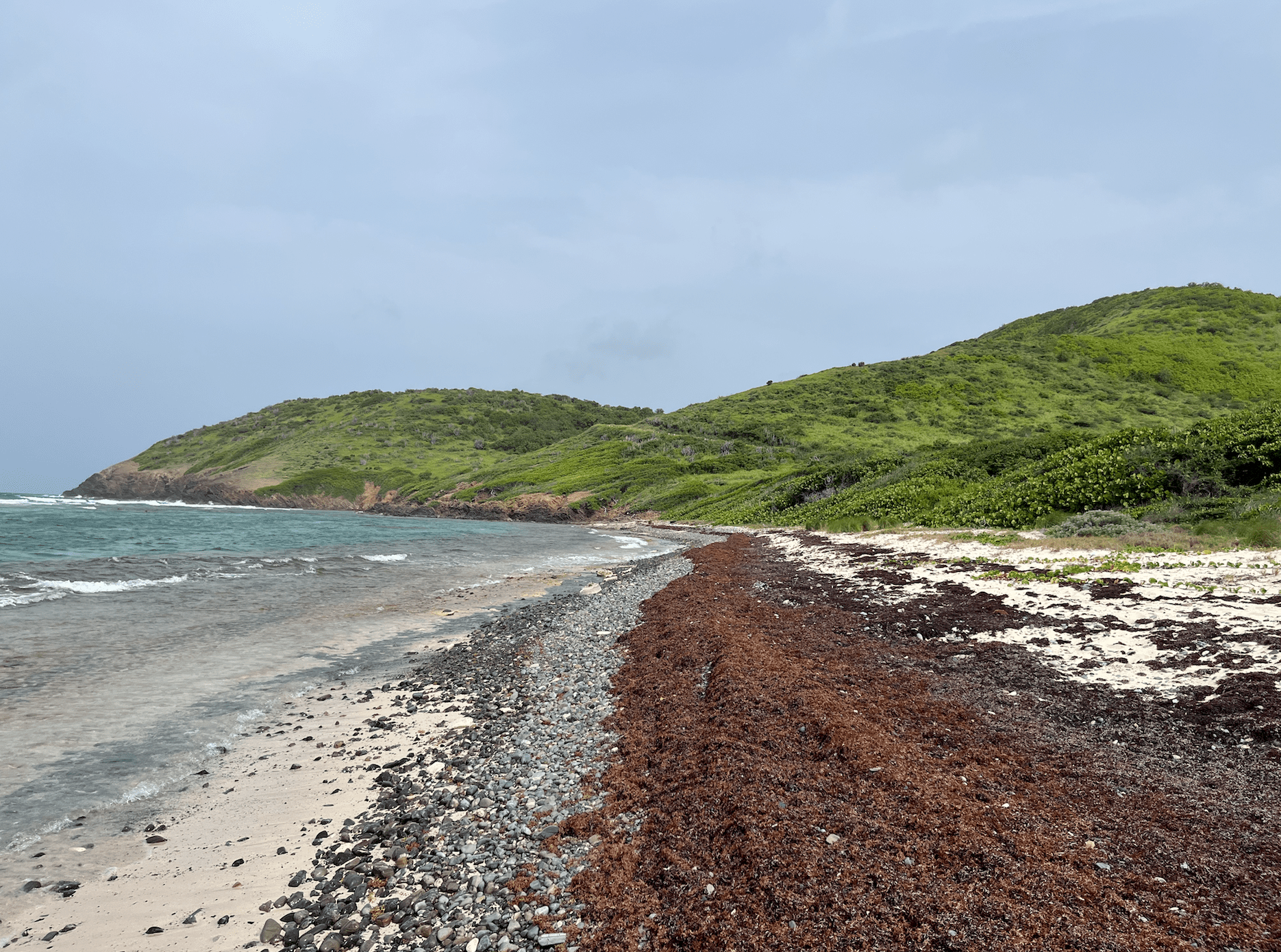
Indeed, the U.S. Virgin Islands have seen a significant increase in sargassum recently. A Source article, written by reporter Amy Roberts and published May 26, highlighted the heavy sargassum buildup on St. John, where the seaweed is affecting local fish populations.
“In recent days, dying fish and other forms of marine life have washed up along the shoreline, adding to the already unpleasant odor created by the rotting sargassum as it piles up on the shore,” Roberts wrote.
Information About Sargassum
Another Source article included additional information about sargassum through an interview with Yuyuan Xie, Ph.D., a research scientist at USF. Xie is involved with the university’s OOL.
“Pelagic sargassum seaweed is a brown macroalgae floating on the ocean surface,” Xie said. “It was first reported in the 15th century by Christopher Columbus, and a regional sea in the North Atlantic Ocean, the Sargasso Sea, was named after this plant. Sargassum serves as a habitat for many marine animals, such as turtles, fish, shrimp, crabs, and so on. These macroalgae can grow to a length of several meters and form floating mats on the ocean surface,” Xie continued.
Health Impacts
The previous interview between the Source and Xie noted that sargassum has positive and negative benefits for the environment. Fortunately, the arrival of the algae is not extremely dangerous to people. However, the seaweed can cause several significant negative risks, including harming marine life.
“Most of the time, moderate amounts on beaches would not represent a risk factor for humans. However, there are exceptions,” cautioned Xie. “After a couple of days onshore, sargassum starts to decompose and release noxious and stinking gases such as ammonia and hydrogen sulfide. The bad smell can cause respiratory problems. There are reports that in some of the Caribbean islands, the hospitalization rate has gone up during the sargassum season,” he said.
“Sargassum can be both good and bad for the environment. In the ocean it is a critical habitat for many animals, so they should like to see increased sargassum. Sargassum on beaches can also stabilize sand dunes, thus helping to avoid beach erosion. But too much of a good thing can also make it bad — excessive amounts of sargassum can also cause environmental and economic problems,” Xie added.
The Environmental Protection Agency shared the following details regarding the possible effects on marine life due to the seaweed:
“Sargassum inundation events can harm seagrasses and corals by blocking the light the grasses need for health, reproduction, and survival,” the EPA said. “This in turn impacts the availability of food and habitats for other aquatic species, reduces the amount of oxygen in the water, which can stress or kill plants and animals in the water, and makes it easier for invasive species to establish or grow,” the EPA stated.
“Sargassum may also affect aquatic species and their ecosystems by accumulating marine debris, including microplastics, and leaching heavy metals, pesticides, and other pollutants, some of which may be generated from its decomposition,” the EPA added.
More Sargassum Expected
According to the May sargassum update, residents and visitors across the USVI can anticipate seeing — and smelling — more seaweed in June.
“As in most previous years, May will likely see continued increases in most regions. More sargassum is expected to be transported to the west Caribbean Sea and then to the Gulf through the Yucatan,” the USF report predicted. “Sargassum inundation will continue to occur in most of the Caribbean nations and islands as well as along the southeast coast of Florida,” USF added.
Monthly Sargassum Updates
Individuals can follow the progression of the current mat of seaweed and stay up to date each month on where sargassum may be headed.
“For the general audience, we’re generating a Sargassum Outlook Bulletin on a monthly basis, which can be downloaded via accessing our Sargassum Watch System (SaWS) page,” Xie told the Source. “This bulletin provides a general picture of the current bloom conditions and future bloom probability for the regions under watch. The SaWS system also provides satellite imagery every day for the current sargassum situation, where a user can download the images and surface currents,” Xie concluded.