


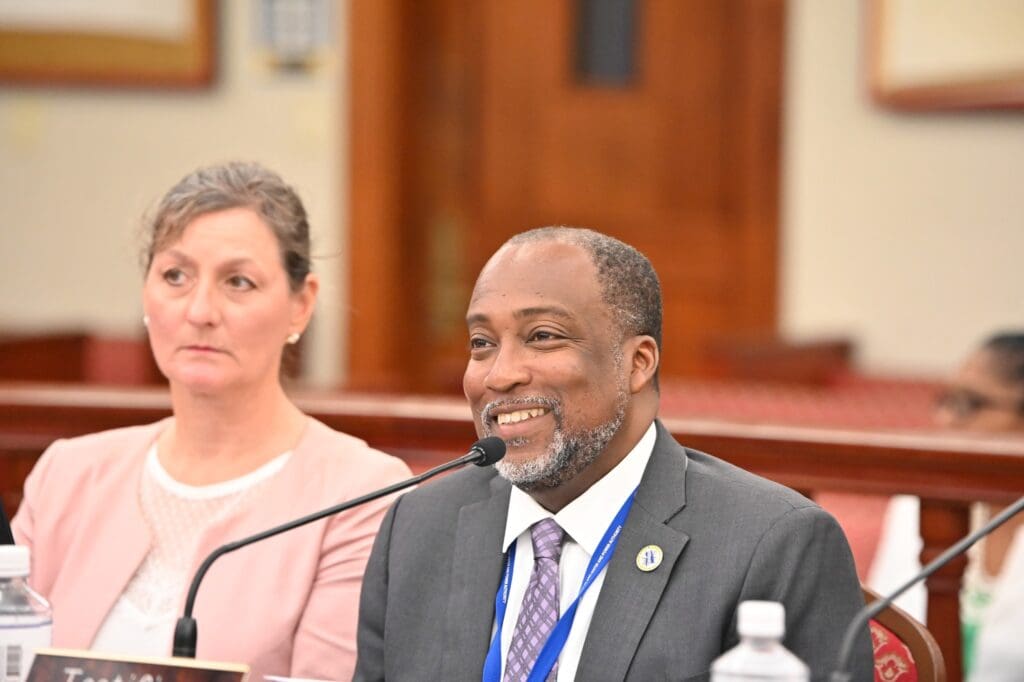
Malfunctioning meters, high customer bills and a utility running on debt were front and center during Monday’s legislative hearing, as senators pressed the Virgin Islands Water and Power Authority on its operations, finances, and the long road ahead. Lawmakers demanded answers while WAPA’s leadership outlined ongoing challenges, pledged reform, and made the case for more time — and more support.
WAPA Chief Executive Officer Karl Knight told the Committee on Government Operations that while the authority’s monthly deficit has improved — dropping from $8 million last March to around $2–3 million — it remains steeped in debt. WAPA is still carrying $87 million in unpaid vendor bills, $88 million in long-term debt, and an estimated $27 million in deferred maintenance. “We are taking methodical and purposeful action to bring the authority back from the brink of insolvency,” Knight said, “and we will be successful.”
A significant portion of the hearing focused on WAPA’s widespread billing issues — largely caused by malfunctioning or unreadable meters that have forced the authority to rely heavily on estimated bills. “We’ve been underbilling quite a bit,” Knight acknowledged. “We’ve seen an increase in demand on our generators, but revenues are stagnant or declining.”
To fix the problem, WAPA recently approved a four-year, $30 million contract with Itron to replace the entire Advanced Metering Infrastructure across the territory. The FEMA-funded project is expected to take 18 months to complete and will begin on St. John. In the meantime, 2,500 electrical meters are being installed for new connections and replacements, with another 2,500 in transit, Knight has said.

But senators weren’t satisfied with a long-term solution alone. Sen. Franklin Johnson raised concerns about senior citizens receiving exorbitant bills — sometimes in the thousands – and paying them out of fear of being disconnected. Knight said staff have been instructed to flag suspicious charges and offer payment plans or adjustments when appropriate. “If something looks wrong, it should be treated as wrong,” he said.
Still, lawmakers were alarmed by WAPA’s use of back billing to recover unpaid charges. “If you’re sending out bills months late, that’s back billing,” Sen. Kenneth Gittens said, which Knight didn’t deny. However, WAPA CFO Lorraine Kelly explained that while the authority is legally allowed to back bill, it can only do so within a 35-day window. Beyond that, Knight added, “that’s lost revenue.”
He said the authority is often forced to estimate because the current 30-day billing cycle doesn’t allow enough time to get accurate reads. “Extending the window to 35 days would allow us to get more accurate reads and recover what we’re actually owed,” Knight said. And the issue isn’t small: “It’s not a one-sided affair,” he noted. “When we overbill, we credit. But when we underbill, we have to recover.”
WAPA Chief Operating Officer Lemuel Lavinier said the utility is also exploring alternative billing models, such as prepaid metering systems used elsewhere in the Caribbean — like Dominica’s, where customers pay daily based on usage. Knight said those options could be implemented after the AMI rebuild is complete.
While much of the testimony focused on billing problems, lawmakers also pressed WAPA on its overall financial health — and what’s being done to fix it. Knight told senators that WAPA will be looking to hire a municipal adviser to help consolidate and refinance its long-term debt, a step he said is critical to long-term stabilization. The move follows the engagement of Ernst & Young, the turnaround firm contracted in October 2024 to assess WAPA’s finances and operations. Their full report is expected soon, but Knight warned that it may take up to three years for WAPA to stabilize its rates based on EY’s analysis. “We hope to make that sooner,” he said.
That outlook, however, was challenged Monday by Public Services Commission Executive Director Sandra Setorie, who told senators during the hearing that with the current Levelized Energy Adjustment Clause rate, WAPA “should now be recovering more than its current fuel costs” and could begin paying down accounts payable as early as the second quarter of 2025. Knight pushed back, however, telling lawmakers WAPA has been under-recovering for years and estimates the authority is short roughly $130 million in fuel costs alone.
“The real contention with the PSC,” he said, “will be to what extent they allow us to recover some of that.” While a drop in the LEAC may be possible, Knight warned the base rate remains below what WAPA needs to cover actual operating costs.
Lawmakers also raised concerns about WAPA’s generation capacity and equipment reliability, with committee Chair Sen. Avery Lewis questioning the performance of the Wartsila Phase II generators, whose commissioning was recently celebrated with a ribbon cutting but went offline shortly after. Knight said two of the four are now back online, while a third — most heavily damaged — is expected to return in the coming weeks under warranty. A technical consultant is conducting a root cause analysis, which Knight will be the only cost to the authority.
Meanwhile, fuel costs remain one of WAPA’s biggest challenges. Knight told Sen. Carla Joseph the authority currently pays $2.15 per gallon for diesel – 71 cents of which is transportation — and around 85.88 cents per gallon for LPG under the current contract with Vitol. A new diesel shipment from Borinken Towing & Salvage costs WAPA $2.2 million, but Knight noted that if all Wartsilas are operational, only one such shipment would be needed per month.
WAPA is negotiating with Peerless for improved fuel terms and preparing to release a solicitation for a new LPG supplier. “If all Wartsilas are online,” Knight said, “we’ll only need to buy one diesel shipment per month, which is a major savings.”
While electricity dominated the conversation, water service issues weren’t ignored, with Johnson raising long-standing complaints about low water pressure in Kingshill on St. Croix. Knight admitted the issue has been ongoing and called it “pervasive.” Water COO Noel Hodge said the likely cause is leaks, which are currently being investigated using new equipment. Repairs to pumping stations at Contentment and Concordia are underway, and Knight noted that line loss affects not only service but WAPA’s bottom line. “We have to absorb the cost of line losses,” he said. “It’s in our best interest to get them down.”
Despite the challenges, Knight stood by the authority’s workforce and trajectory. “Our employees are some of the most dedicated and competent public servants in the territory,” he said. “They’re not just working for WAPA — they’re working for their families, their neighbors, and this community.”
Still, senators made it clear that words alone won’t cut it. “People need to be able to trust their bills,” Johnson said. “And right now, that’s not the case.”