



Regular beachgoers in the Virgin Islands have noticed that the water temperatures are unusually high for early July, and although this might be pleasing to swimmers and water sports enthusiasts, it’s bad news for corals.
In fact, temperatures in many places in the Virgin Islands have been averaging around 86 to 87 degrees Fahrenheit, according to Nicholas C. Durgadeen, a coral restoration specialist at the University of the Virgin Islands.

When water temperatures exceed 84 degrees, corals become stressed and expel the symbiotic algae, which provide the corals with nutrients — and ultimately the energy they need to survive. When this happens, corals first become pale and then turn white as their skeletons become more visible in a process known as coral bleaching.
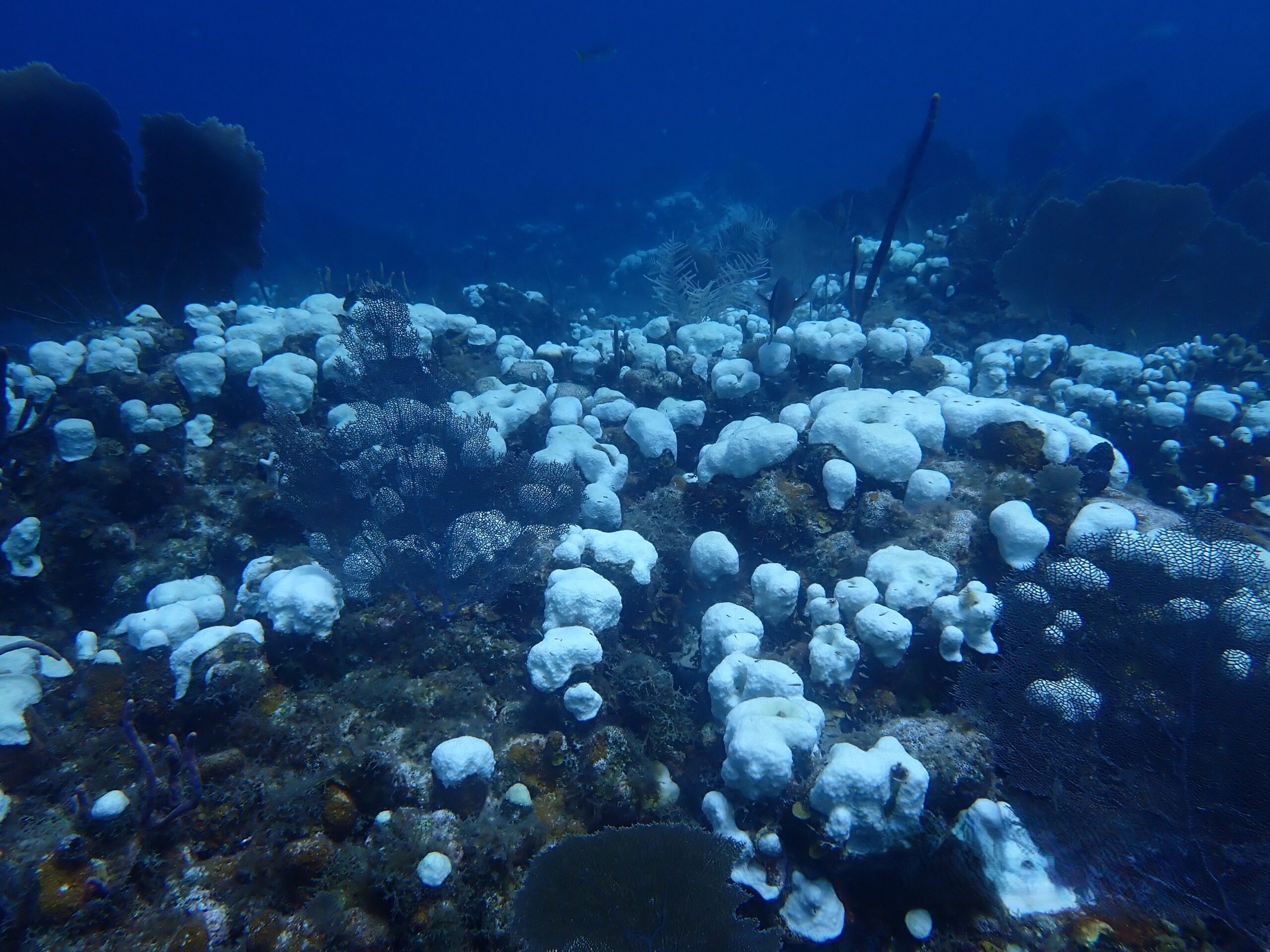
UVI researchers are now seeing bleaching in corals at reefs they regularly monitor in waters around St. Thomas and St. John, according to Durgadeen.

In the face of rising sea temperatures, lethal coral diseases, destructive storms and pollution from multiple sources, UVI students, faculty and staff are united in their efforts to preserve corals and find new ways to make them grow.
At the end of a major bleaching event from 2014 to 2017, graduate students at UVI founded Reef Response, a collaboration to address the loss of coral diversity and establish coral restoration programs. They are now primarily funded by the National Park Service.
“Bleaching is continuing to get worse,” said Durgadeen, “and we have to change some of our approaches.”
Among those hoping to find a solution is Sonora Meiling, a UVI marine disease specialist who is currently involved in a project to relocate staghorn coral fragments to depths of about 125 feet. She hopes to find out whether decreased sunlight at those depths will reduce water temperatures enough to result in healthier conditions for corals to survive.

Brad Arrington, a coral restoration specialist, is working on creating an artificial reef in Fortuna from deliberately designed cement blocks. He’s researching whether the artificial reef can provide the same ecological benefits as an actual reef and restore local fish populations.

Courtney Tierney, a graduate student in the Masters of Marine and Environmental Science program at UVI, is trying to assess how bleaching affects the reproductive health of corals.
Other UVI marine researchers, part of Professor Marilyn Brandt’s lab, are experimenting with “frame” coral nursery structures near Great St. James, Flat Cay, Lovango, and Brewers Bay.

“These structures are made from rebar and then coated with resin and sand. This mimics the rough texture of the surface that coral larvae prefer to settle on,” said Durgadeen.
“After we’ve coated the surface with resin and sand, we leave the structure underwater at the site for a few weeks. This essentially washes away the artificial smell of the structure and allows more natural substances to settle, mimicking a natural environment,” he continued. Researchers then attach coral fragments that have been broken by storm action or bad anchoring, hoping to see them thrive.
Other researchers are experimenting with techniques to grow corals in a laboratory at UVI, including microfragmentation. University staff have managed to preserve samples of pillar coral (Dendrogyra cylindrus), a species that was almost entirely wiped out by Stony Coral Tissue Loss Disease that devastated local reefs starting in 2019.
“Growing corals in nurseries has actually been found to be successful,” said Durgadeen. “We have over 800 coral fragments growing in our land-based nursery and a few hundred in our in-water nurseries. We at UVI are looking to see if we can help corals become more resilient to the heat stress.”
But whether growing corals in nurseries can make up for the loss of corals in the wild is an open question. Ultimately, for reefs to flourish, corals grown in nurseries have to be “out-planted” in the ocean where sea temperatures continue to rise and other natural and man-made stressors could prove lethal to young corals.
This year, researchers are recording water temperatures in June that were not seen until August last year. In April, NOAA announced that the world is entering its fourth major bleaching event, the second in 10 years.
Mass coral bleaching has been confirmed in at least 62 countries and territories worldwide.
Although scientists understand many of the effects of rising ocean temperatures and storms on coral reefs, there’s still much to learn about the effects of other environmental stressors that are prevalent during warmer months.
For example, massive influxes of sargassum can transport invasive exotic species, cut down on the amount of sunlight corals need for energy production, and release harmful chemicals as they decompose.
Scientists also don’t know the extent of the damage to coral reefs caused by particles transported in the Sahara Air Layer, which peaks during the summer months. Researchers suspect that particles including microorganisms and toxic chemicals could be harmful to reefs.
Marilyn Brandt, who directs Reef Response, often describes the degradation of coral reefs as ‘death by one thousand cuts,’ said Durgadeen. “There are so many different stressors. Our task is to find one problem and take it a step at a time. One of our challenges is trying to find ways to manage so many projects.” He said volunteers are needed to assist in a land-based coral nursery at UVI St. Thomas.
One of Durgadeen’s tasks is to go out into the community and educate the public about what they can do to help preserve coral reefs: use mineral-based sunscreens and help assure that no chemical-based sunscreens are brought to the territory; cut down on the use of plastics that may become ocean-bound; keep land-based runoff containing pesticides, sewage and fertilizers from reaching our waters; and ensure that safe anchoring practices are followed.
At this point, Reef Response is active only in the St. Thomas-St. John district, but St. Croix has its own corps of experts and volunteers who are dedicated to preserving our reefs. In fact, June 30–July 7 was Reef Week on St. Croix with a slate of family-friendly activities.
For further information about Reef Response, follow them on Facebook or contact Durgadeen by email at nicholas.durgadeen@uvi.edu.