


The Source sat down with Gov. John deJongh Jr. recently and discussed his 2013 State of the Territory Address, his agenda for his final two years in office and how he hopes to move forward with some of the major issues facing the territory. The governor shared additional detail on an array of topics, from capital improvements to relations between the executive and legislative branches.
Bridging a Budget Shortfall
DeJongh said in last week’s address that the territory is looking at a $50 million budget shortfall this year.
"That projection is based on our revenue performance through the first quarter of 2013," deJongh said. "I’m hoping that with the collections that we realize … that we will be able to see some uptick in the revenues. But I wanted to be very transparent and very upfront with the senators that they understand, based on our current projections, that we are looking at that sort of a shortfall."

If revenues do not improve, deJongh said, he would opt for budget cuts first to some contracts and government rentals. After that, he said, he hopes the government’s tax collection task force can make a dent in the shortfall.
"That’s an area we have been very successful in," deJongh said. "Last year real property taxes went from an average delinquency collection of $4 million to where we have got it up to $12 million. … It is a very concerted effort on our part and I am hoping that bears some fruit, that we get some returns on that in the first six months of this year.”
"But ultimately,” he said, “what we will look at is just cutting back also on allotments to the departments."
Those cuts would not necessarily be evenly distributed across the board, he said.
"I don’t think one size fits all. I think that is the historic mistake we made that we believe that we have to have one universal percentage cut across the board. I think that, at a time like this, there are certain areas we will have to look at and evaluate and my priorities, particularly at this point in time, has been law enforcement.” 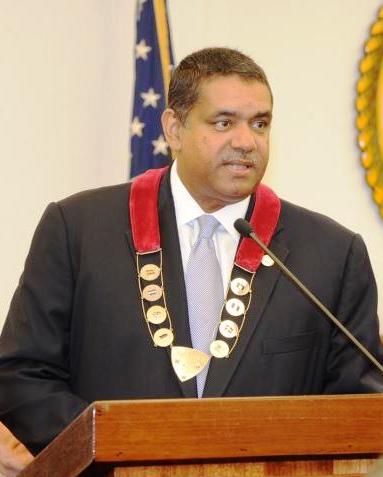
“I have tried to mitigate the amount of cuts we would have in law enforcement," he said. The governor continued to say he wants to ensure the classes, educational programs and all other requirements of the federal consent decree affecting the police department happen as planned.
Lengthening the School Year
DeJongh said last week he wants to see the public school day and school year lengthened, which raised concerns among some senators and others about its impact on teacher contracts and school budgets. Speaking with the Source, deJongh emphasized the change would not be unilateral or immediate.
"I’d like to negotiate some days with the teachers and administrators rather than going in with a specific, set-in-stone date," he said. "More than anything else, we want to reduce the amount of summer loss … particularly with our young children."
How much of an increase and how to implement it, deJongh said, are both up for discussion. He hopes to sit down with teachers and administrators and work out a way to gradually implement the changes, he said.
"We would have to look at compensation as part of the process. And I think that is the one area that the teachers have a concern about — that I recognize that there would have to be additional compensation," deJongh said. "But the whole package, the longer day, the longer year, teacher evaluations and compensation: If I can get them to the table to talk about it, then I think we can find a way to implement it and both be on the same side."
Relations with Government Unions
Some government employee unions are suing the government over across-the-board 8 percent pay cuts enacted by the Legislature and financially based layoffs by the administration. Asked what he could do to assuage or work with the unions, deJongh said, "The biggest thing I can do with the unions is communicate."
"Every time that we are having a financial challenge or dilemma, I have met with the union leadership. They could never say they were surprised."
DeJongh also emphasized that many jurisdictions have seen much worse cutbacks and layoffs, while at least in the territory the pay cuts are temporary.
"I think the difficult position I am in is that I have to actually run the day-to-day government. I’ve got to be concerned about meeting the most basic needs, whether it is from turning on the lights to meeting payroll every two weeks, and right now, in this economic environment, even though they are not happy, the fact is we continue to make payroll. We continue to make sure there is the provision of insurance coverage when even many in the private sector may not have good insurance coverage. We have been able, in many cases, to still be able to do trainings and make investments in our employees.”
He said that, on one hand, “the 8 percent has had a tremendous impact.”
“On the other hand, we have tried to maintain as much stability as possible,” he said.
The governor mentioned the school system’s extracurricular activities, saying that just being able to keep the gymnasiums open at night “has been very much a balancing act."
Rumors and Cynicism
During last week’s speech, deJongh said he wanted to "dispel rumors" about the possibility the territory might run out of gasoline if negotiations with Hovensa go south. The Source asked deJongh to comment on the array of rumors floating through the territory and the cynicism that prompts many to believe the worst on little evidence.
"I think that is because we are a very small community and a very connected community," deJongh said. "People sometimes look at the negativism and absorb it much quicker rather than sort of accentuating the positive."
The problem with it is sometimes it makes us blind to the "opportunities that are right in front of us," he said.
"While we have these tremendous challenges in front of us we’ve got a lot of opportunities. You know we continue to have ports that are attractive. We are making investments in technology that are allowing for new sorts of jobs to open up.”
And noting the ongoing installation of broadband Internet cable, “Virgin Islanders can now apply for jobs on the Net that allow them to access sources of income outside of the Virgin Islands.”
Speaking on the territory’s medical facilities, deJongh said, “Even though challenged, we do have a cardiac center. We have a cancer center. We have two hospitals.”
He said, “I think it is incumbent on me and on other elected leaders to get people to see beyond just what is happening in this moment and to take that hand and sort of walk them down where that potential is and that is the difficult part of our jobs altogether."
FAA Grants and Anguilla Landfill
In his speech last week, deJongh highlighted the fact that the territory is again able to apply for federal grant funding from the Federal Aviation Administration. But FAA funds for St. Croix had been withheld over the status of the Anguilla landfill, which the FAA considers a risk to air travel because of birds attracted to the trash.
And last year the Legislature killed plans to replace the landfill with a trash-burning power plant, leaving St. Croix with no long-term place to put its garbage. While a long-term solution must still be found, deJongh told the Source that FAA funding should not be threatened for half a decade or more because of the opening of a transfer station that is sorting and baling the island’s trash.
"That does not take the pressure off of us in terms of actual closure but at least has given us the ability to go back and apply for the grant funds," deJongh said. "The FAA, more than anything, wanted us to make sure we address the bird situation, and the EPA wants to make sure we address its closure.”
He said, “Now we are capping it with bales and that gives us five, six, seven, eight years we still have it available. … That gives us some breathing room," he said.
Good News in Tax Benefit Programs
In his address last week, deJongh pinned some hopes for future prosperity on the territory’s tax benefit program, through which the Economic Development Commission confers substantial tax breaks to companies who commit to set up office and hire in the Virgin Islands.
"Since 2010, we have had a steady increase in the number of applicants and the jobs to be created," deJongh said in the address, saying "(t)his is the model of our economic future."
Asked for some specifics about that growth, deJongh said that in 2007 the EDC program saw 19 applicants, which dropped to 14 in 2008 and only seven in 2009. The numbers declined because of the recession, he said, temporary federal tax cuts and changed rules on residency, among other factors.
Since then, the EDC began "a much more focused effort, targeted in terms of financial management companies and asset managers," deJongh said. That new focus, along with an improving national economy, helped bring about increases. In 2011 applications rebounded to 16, and 2012 saw 21 applicants – more than before the recession.
On top of that, deJongh said the Research and Technology Park affiliated with the University of the Virgin Islands, which offers similar tax breaks but targeted at technology companies, started running. "The Research and Technology Park now has 21 approved applicants, of which about 16 are actually up and running right now. So combined, when you look at both together, we have had growth in the Economic Development Program," deJongh said.
Pier and Berthing Improvements on St. Thomas
In the State of the Territory Address, deJongh spoke of building a new pier at the West Indian Company property on St. Thomas and improving some of its berthing at Crown Bay. He provided the Source some more depth and detail.
"At Crown Bay, with the size of the ships like the Allure and the Oasis, what we are finding is we have to do some additional dredging just so the ships will be able to turn, because we are getting more of the larger ships," deJongh said. "Right now we are going through the whole process of what would be required with respect to the additional dredging," he said.
A new pier is needed at WICO to help make St. Thomas more competitive, he said.
"One of the challenges we have is … ships are getting larger, but at the same time, because they are larger, the cruise lines no longer like to do tendering in. It is not an option, particularly, for some of the more attractive lines," he said.
And because some competitors can berth six or seven ships at a time, and St. Thomas can only berth five, he said, "We have to figure out a way to grow."
"So we are looking at a new pier in the area of the West Indian Company, Yacht Haven, that will give us an additional two berths."
He said that currently "WICO is in the process of utilizing a consultant to look at the feasibility and do cost projections."
St. Croix Capital Projects
In his address, the governor talked about three Frederiksted projects: renovations to the Oscar E. Henry Customs House; requests for proposals to rebuild the Paul E. Joseph Stadium; and RFPs for an adventure or water park north of Frederiksted.
"One of the challenges within Frederiksted is finding real estate that is of a large enough square footage that we can attract some larger firms. And the Customs House, the Oscar E. Henry House, gives us a fantastic location at the end of the pier. It also has the additional square footage, and we think if we can get that square footage cleaned and renovated and get a good tenant, it will be an attraction both for the area and as an additional amenity with respect to the cruise lines," deJongh told the Source.
As for a timeline, staff are working on the Customs House now, he said.
"We are also coming out within the next week with an RFP for the Adventure Park," he said. "That was a piece of legislation Sen. (Nereida Rivera-) O’Reilly had passed.” The governor said the commissioners of Tourism and Property and Procurement have worked on an RFP and “we should be issuing that shortly.”
He said the commissioner of Sports, Parks and Recreation is near complete on an RFP for Paul E. Joseph Stadium.
Overall Capital Improvement Vision
On St. Thomas, the pier work should be seen as part of a larger context of infrastructure improvements, the governor said.
"When you look at the entire scope of what we are trying to achieve, we are looking at water transportation within the port of Charlotte Amalie. We are completing the main street enhancements. With part of the capital projects money approved in December, we are going to start refurbishing Fort Christian.”
“And then within the next six months we will go out for a bid for Veterans Drive for improvements,” he continued.
“So we are looking at the entire corridor, going from WICO and Yacht Haven all the way down to downtown, being very much improved," deJongh said.
The governor said he hopes infrastructure improvements throughout the territory will trigger private investment to start snowballing.
"Hopefully by the government at least addressing the basic infrastructure, the private sector will then begin to step in and take on some capital projects themselves," deJongh said. "Those capital projects would have to do with retail, with land-based activities, things that make the destination, both St. Croix and St. Thomas and St. John, much more attractive. I can go with the basic infrastructure but I need for them, at the same time, to see what they can do to be able to add to the other amenities that are required – things like different sort of retail shopping experiences, like zip-lines or new and different tours."
Relations with the Legislature
At times in the past few years, relations between the executive branch and the Legislature have been contentious.
"I think the relationship will be a little bit different this time," deJongh told the Source. "I hope it started with a meeting we had on Sunday, but also the fact we reached out to all of them after the election.”
“I really think a lot of the problems we are facing and a lot of the challenges require us, more than ever, to try to work together," he said. Moving forward, the governor said he would try to bring the Legislature in earlier in the process.
"In the address, when I spoke about our hospitals, for example, I didn’t put it in the context of ‘Here, I’ve submitted a piece of legislation to the Senate president,’ but really what I said is ‘I’d like to work with you.’"
"A lot of this really is trying to work with them on these problems because, clearly, they have ideas.”
"They may have different approaches,” deJongh said, “and I don’t think there is just one approach that works."