


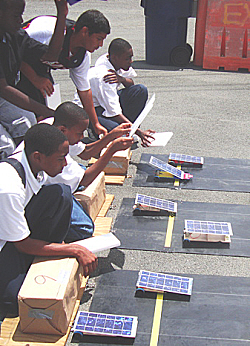
 The future — in the form of student-built, sun-powered model cars — zipped down the racetrack laid out for the Junior Solar Sprint in the Sunny Isles Shopping Center parking lot Thursday.
The future was also parked right next to the race, in the form of an electrical car that its owner, Arlen Wheeler, had brought by to show the students that such vehicles are a reality here and now.
Friday’s first leg of the 15th annual Junior Solar Sprint featured teams from a dozen schools across St. Croix. Students from Arthur Richards Junior High School took first and fifth place and will travel along with three other teams to St. Thomas to compete for the title of best in the territory March 26 at the Tutu Park Mall parking lot.
The top five two-man teams were:

- Channoy Milligan, Kareem Wynter of Arthur Richards;
- Naisha Emanueilli and a partner whose name was not available from the Church of God Academy;
- R..J. Ollie and Jean Devera of Good Hope School;
- Enoch Gravey and Adail Viera of St. Patrick School;
- Evanson Mathew Jr. and Marco Cruz of Arthur Richards.
The other seven schools competing were Elena Christian Junior High; School of the Good Shepherd, John H. Woodson Junior High, The Manor School, St. Mary’s, IQRA Educational Center Inc., and Kingshill School.
The St. Thomas schools competing March 26 at Tutu Mall are: Antilles School, Bertha C. Boschulte Junior High, St. Peter and Paul, All Saints School, Addelita Cancryn Junior High, Montessori School, Moravian School, and Church of God Academy. The St. John Schools participating are the Julius Sprauve School and the Gifft Hill School.
The competition has grown in the 15 years it has been sponsored by the V.I. Energy Office. In the past, schools from all over the territory traveled for a one-day running. But with the number of participants rising each year – this year organizers had 20 schools entering about 100 students – scheduling all the heats threatened to become overwhelming. Instead there are two sessions planned. Friday’s was the first. Next week, on March 26, the session will take place on St. Thomas, with the top finishers from that session going up against the St. Croix winners for the top overall prize.
The students are given kits which include a solar cell, an electrical motor and other equipment needed to build a car. They must use the solar power cell and motor, and the car has to be able to hook onto a line strung down the length of the track. But beyond that they are limited only by their ingenuity. They can substitute lighter material for the body, they can us other wheels and make other adjustments. Anything to squeeze a tiny bit more speed from their machine.
The result is that students spend a lot of time researching traction, friction, gear ratios, and the physics of coaxing electrical power directly from sunlight.
According to Sandra Lashley, science teacher from Manor School who brought three teams to the contest, the angle of the solar panel is a critical issue, one that each design team struggles with. Angling the panel so that it most directly faces the sun helps it generate more energy – if it happens to face the sun. Keeping it flat gives it a more general exposure to the sun’s rays, at the expense of perhaps a tiny bit of extra electricity.
One of her students came up with a way to mount it so that it could be adjust to always face directly at the sun. Sadly, the car ended up not running, probably because of a loose wire.
The competition gets students thinking and problem solving, Energy Office Director Bevan Smith said.
“We’re trying to get our students interested in science, math, engineering and renewable resources,” Smith said. The work they do as a team under the tutelage of a teacher, the tests and redesigns, all pay off in performance on the track. “The design and workmanship gives them an edge.”
Albert Huggins, the teacher who saw two of his teams from Arthur Richards place in the top five, said the contest spurs the students’ imaginations. Asked how he got them interested, he said, “I didn’t have to do anything. Once I mentioned solar cars to them, they couldn’t stop.”
The Arthur Richards team worked on the cars for at least an hour every school day for a month, Huggins said.
While the students were racing their cars on the track, they also couldn’t help casting glances just a few feet to the east, where Arlen Wheeler’s electric car was parked. The car, made by Global Electric Motors of Fargo, N.D., seats four comfortably and has a range of around 30 miles before recharging, which is plenty for the driving he has to do, Wheeler said. It has a governor to keep the speed from exceeding 25 miles an hour, but another model can reach 42 miles an hour.
And Wheeler had a web article about a new car, made in Romania, that is reported to be able to exceed 80 miles an hour with a range of more than 200 miles. This car, which will be available in the states soon, comes in a sedan, station wagon and pickup model, according to Wheeler. It retails for more than $30,000, whereas the Global Electric vehicle that Wheeler drives can be had – fully outfitted and delivered to the island – for $14,000, he said.
And though it has to be plugged in to recharged, the additional cost to a WAPA bill would work out to something in the neighborhood of the cost of buying gasoline at 80 cents a gallon. And in Wheeler’s case, he has solar panels at his home that does the charging, so even though his car runs on six 12-volt batteries hooked up in series, it is still solar powered.
Wheeler’s electric car was a source of constant interest throughout the day, as students came to ask him about it, where it came from, how it drives, and – most importantly – whether they could drive it. Wheeler had to turn them all down for liability reasons, but that didn’t stop student after student from asking.
Apparently, having gotten the taste for driving their solar model cars on th4e track, they wanted a taste for the real thing.