



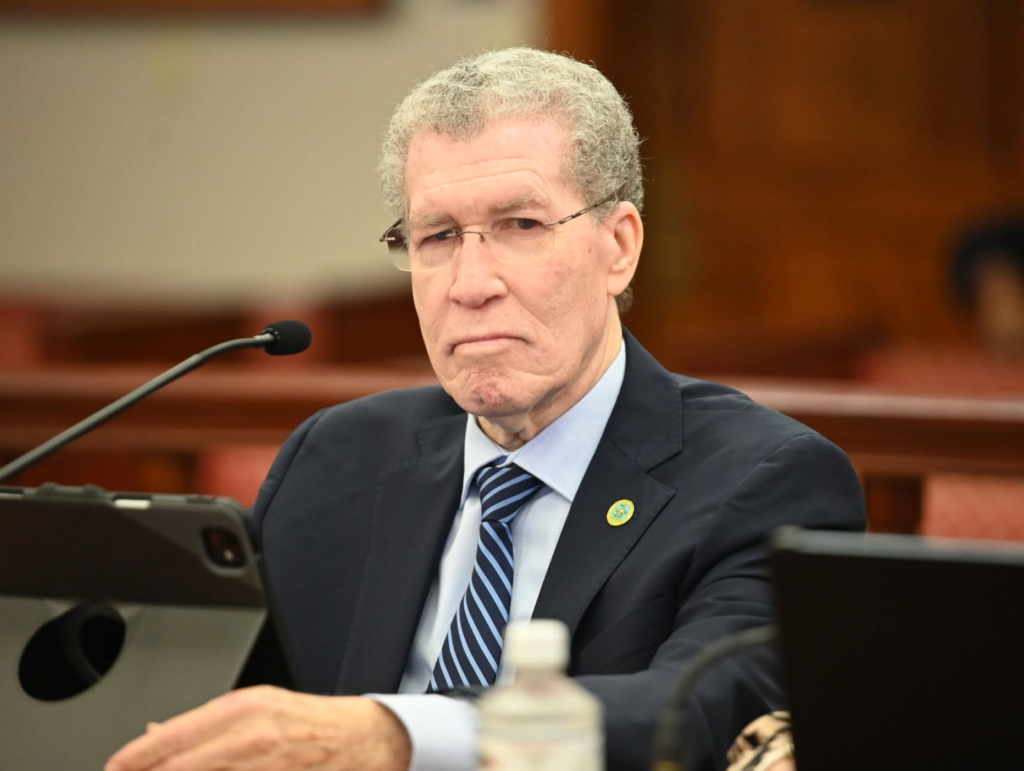
The Virgin Islands’ top judge asked lawmakers Thursday to increase funding for the judicial branch and tie future court budgets to a fixed share of the General Fund budget, arguing that years of constrained appropriations have placed sustained pressure on the courts.
Chief Justice Rhys S. Hodge told the Legislature’s Committee on Budget, Appropriations and Finance that the courts are seeking a larger appropriation than the governor proposed, along with separate funding for the Judicial Council and the Office of Conflict Counsel. Hodge, making what he said would be his final budget presentation before retiring later this year, argued that the judiciary is being asked to handle more cases with aging facilities, vacant positions and pay scales that lag behind the executive branch.
Hodge said Virgin Islands law requires the judiciary to submit its budget request directly to the Legislature, with a copy going to the governor. But he said the governor’s budget still includes a lower “placeholder” amount for the courts, and lawmakers have routinely funded that figure instead of the judiciary’s own request.
To change that, Hodge proposed guaranteeing the judiciary at least 5% of the General Fund budget each year so court funding is not driven by the governor’s recommended ceiling. He said the formula would provide a stable funding baseline and,under the proposed General Fund budget of $958.2 million, would produce roughly the amount the courts are seeking for fiscal year 2027.

In all, Hodge said the courts are seeking about $48.6 million for their core operations next year, plus separate appropriations for the Judicial Council and the Office of Conflict Counsel. He said the $48.6 million request includes about $25.5 million for salaries, $11.8 million for fringe benefits, $5.9 million for services and charges, $2.3 million for capital projects, $1.9 million for utilities and $650,000 for supplies.
Hodge said the judiciary has faced years of stagnant funding despite increasing demands. From fiscal years 2017 through 2021, he said, annual appropriations for the courts stayed at about $35.2 million even as judicial budget requests climbed as high as $46.6 million and the General Fund grew by more than 30 percent.
He told senators it was not reasonable to conclude that the courts needed the exact same appropriation in each of those five years, given administrative consolidation, Hurricanes Irma and Maria, and the COVID-19 pandemic.
Several senators expressed support for increasing court funding, though they also cited competing priorities including hospitals. Committee Chair Sen. Novelle E. Francis Jr. called the idea of earmarking a percentage of the General Fund “reasonable” and said it would be considered during budget discussions.
Hodge pointed to case‑clearance statistics to argue that the judiciary has continued to perform despite funding constraints. In fiscal year 2025, he said, the Superior Court’s civil division resolved about 1.6 cases for every new filing and reduced its pending caseload by 8%, while the criminal division reduced its pending caseload by 48%. He said that trend has continued into this year, with the courts resolving more criminal cases than new filings and nearly keeping pace in civil matters.
Hodge and other court officials said, however, that some areas continue to face pressure. Hodge reported that juvenile delinquency filings increased 77% in fiscal 2025 and that in the St. Thomas–St. John district the Family Division saw more filings than dispositions in juvenile delinquency, guardianship and involuntary commitment cases. Overall, he said, the pending family caseload decreased in St. Croix but increased by about 15% in St. Thomas–St. John.
The Magistrate Division also reported a heavier workload, with filings increasing 35% from the previous year, excluding marriage licenses and traffic citations. Eviction filings more than doubled, small claims cases rose 37%, and probate filings increased 63%. Hodge said the magistrate division nonetheless closed 432 probate cases in FY 2025, achieving a 90% clearance rate, even though the pending probate caseload increased by 6% at the close of that year before falling by 13% through May 2026 as more cases were resolved.
Despite those caseload improvements, Hodge and other judiciary officials said staffing shortages, high turnover and pay disparities pose a significant threat to continuity of operations.
Hodge said the judiciary’s FY 2027 budget request includes funding for 59 vacant positions across the marshal’s office, probation and pretrial services, clerk’s offices, administrative divisions and the Supreme Court.
Hodge said the judiciary continues to experience high employee turnover, with 48 employees leaving in fiscal year 2025 and another 35 separating so far in fiscal 2026. He told senators that a compensation and classification study completed in early 2024 with the National Center for State Courts recommended an initial 4% market adjustment for judicial employees, but that request was included in multiple budget submissions and a supplemental request and “was not funded.”
Court officials also pointed to aging facilities and delayed capital projects. Hodge said underfunding and delayed funding releases caused a 69‑day work stoppage on the phase‑two roof replacement and office expansion project at the R.H. Amphlett Leader Justice Complex on St. Croix, before work resumed on June 29. The judiciary is requesting about $2.3 million in capital outlays for fiscal year 2027, including funding for building improvements and equipment.
Hodge also requested continued funding for the Office of Conflict Counsel, which was established with nearly $3 million in American Rescue Plan Act grant funds that are scheduled to expire on December 31, 2026. The office, described as an alternate public defender’s office for indigent defendants, is seeking local appropriations to continue operating once federal funds run out.
Closing the hearing, Hodge urged lawmakers to adopt a more predictable funding system for the courts. “I just simply want to ask that the Legislature actually consider formulating a process so that not every year the chief justice and the staff has to come here and ask and ask for a budget only to get an inadequate amount,” he said.