

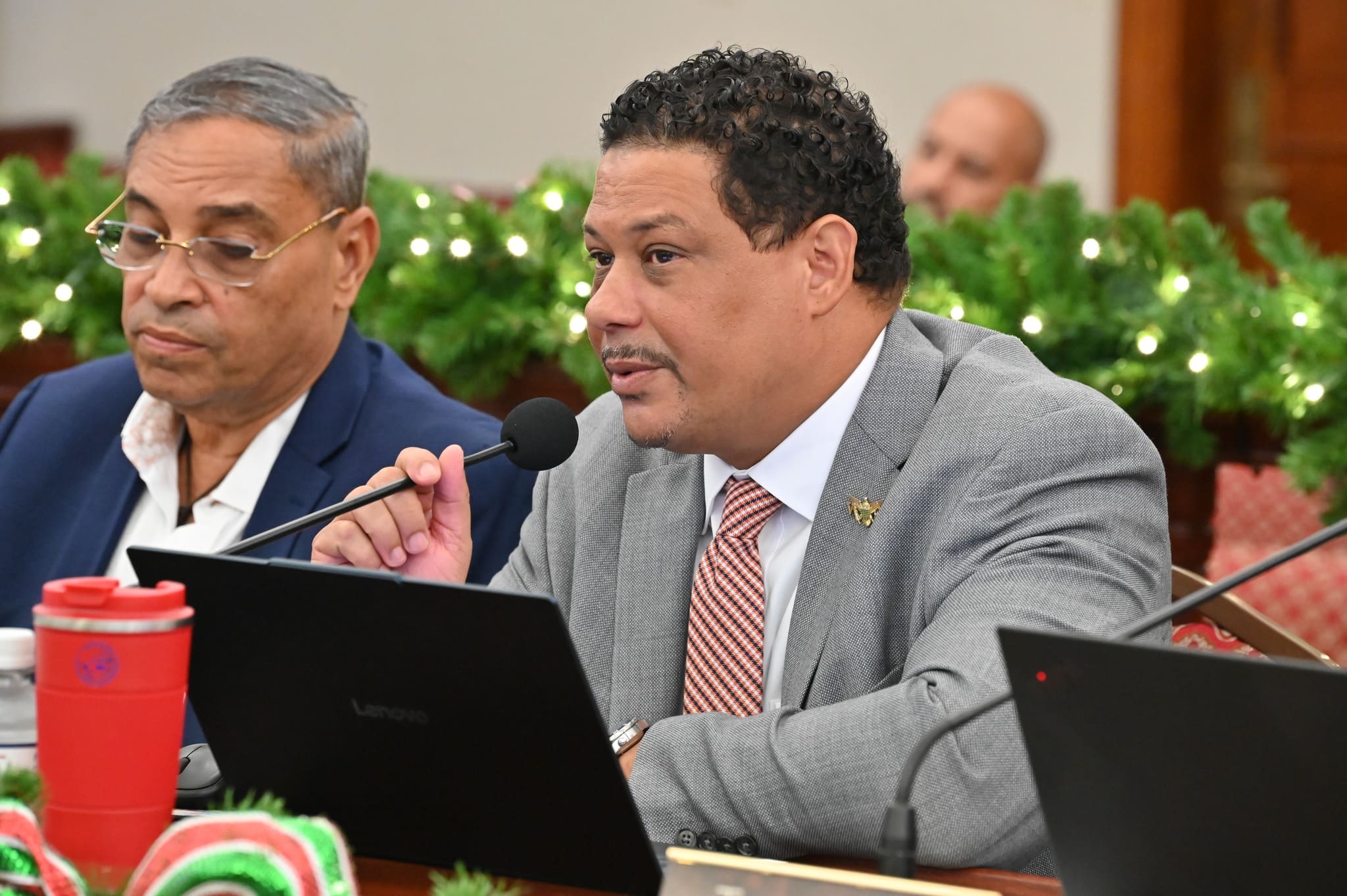
During Tuesday’s Committee of the Whole meeting, the Department of Planning and Natural Resources proposed zoning amendments to facilitate mixed-use developments, athletic complexes, and essential infrastructure. Four major rezoning applications targeting underutilized or abandoned plots in St. Thomas and St. Croix have been recommended for approval by the department.
“This project is about more than sports; it’s about community and opportunity,” said Jeffrey Boschulte, the project’s architect. “A FIFA-certified field will allow us to host tournaments and training camps, putting St. Thomas on the regional map for athletics.”
Boschulte noted that the project will be completed in three phases over two to three years, providing much-needed infrastructure for local and international soccer programs.
The proposal received unanimous support at the public hearing held on Sept. 16. “This facility will provide our youth with a top-tier space to play, compete, and dream,” said one community member in a letter of support.
Another application focuses on revitalizing an abandoned residence on Parcel 41-5-1 Estate Frydenhoj on St. Thomas. The 0.30-acre lot, located along the busy Nicholas Friday Memorial Drive, is slated to be rezoned from R-2 to B-4 (Business-Residential) to accommodate a new two-story commercial space. The project envisions a modern structure that will host a restaurant and office spaces, with 25 parking spaces.
“This property has sat vacant for far too long,” said Clifford Graham, the authorized agent representing the applicants Carvelle Rogers, Colette Rogers Anthony, and Jacklin Rogers. “Our goal is to bring economic activity to this high-traffic area and create a space that serves both residents and visitors.”
The project is expected to be completed in nine to 12 months once construction begins. Despite the site’s long-standing abandonment, public response has been overwhelmingly supportive, with no opposition voiced at a public hearing Sept. 17.
DPNR noted that rezoning the parcel aligns with the mixed-use nature of the surrounding area, which already includes businesses, marinas, and waterfront zones. “Properties like this represent prime opportunities to repurpose residential spaces into vibrant hubs for economic activity,” said Leah Laplace Matthew, territorial planner for DPNR.
In a third proposal, Parcel 3J-1A Estate Mariendahl on St. Thomas will be rezoned from R-2 to B-2 (Business-Secondary/Neighborhood) to facilitate the development of a potable water standpipe and office space. The standpipe, which will provide water to haulers and private citizens, seeks to address growing concerns over water access on the island.
“This project will fill a critical gap in infrastructure,” said George Rogers, co-owner of the property. “It reduces the need for water haulers to travel into town, saving time and resources while ensuring our communities have access to clean water.”
The site’s redevelopment includes an office for the standpipe’s operations and designated space to accommodate waiting water trucks. At the hearing, only one concern was raised about property boundaries, but otherwise, the project faced no opposition.
DPNR acknowledged the area’s gradual shift toward mixed-use and industrial activities. “The rezoning reflects the evolving needs of the Mariendahl community,” said Oriol. “It’s about ensuring that critical infrastructure keeps pace with development.”
On St. Croix, the largest application under review involves Plots 13-A Combined and Remainder of Parcel 4 Combined, Estate Hogensborg. The 21-acre site, located north of Queen Mary Highway, is slated for rezoning from R-1 (Residential-Low Density) to a combination of R-2 (Residential-Low Density-One and Two Family) and B-3 (Business-Scattered). The mixed-use project envisions residential lots, commercial spaces, and a green space buffer to separate development from existing neighborhoods.
“Our primary goal is to create a balanced development that brings housing, business opportunities, and much-needed green spaces to Hogensborg,” said Clarence Browne, managing principal of Design District Architects and representative for the applicant, Ashwash Enterprise LLC.
However, the project has faced concerns from adjacent property owners. Issues such as flood mitigation, traffic flow, and sound buffering were raised at a public hearing on Oct. 23.
“We understand the community’s concerns,” Browne said. “We are committed to working closely with the DPNR and the residents to ensure we address flooding and other impacts as part of our design.”
Despite these reservations, DPNR’s analysis supports the rezoning, citing its consistency with surrounding land use patterns. “The Hogensborg proposal reflects the type of mixed-use development that can drive growth while maintaining community character,” said Oriol.
The zoning amendments reflect a focus in the Virgin Islands on balancing development with sustainability and community priorities. Each project has been reviewed for economic potential and its alignment with the Comprehensive Land and Water Use Plan, which serves as a framework for managing the territory’s growth.
“These rezonings demonstrate what’s possible when we work collaboratively with communities, planners, and developers,” said Oriol. “We’re not just changing zoning maps; we’re setting the foundation for a more vibrant and resilient Virgin Islands.”
With public hearings concluded and recommendations submitted, the final decision now rests with the Legislature. The outcome of these applications may influence future development across the territory as residents and planners work to balance growth and preservation.
“This is about moving forward responsibly,” said Boschulte. “We’re building for the future, but we’re building together.”
Sens. Novelle E. Francis Jr., Marvin A. Blyden, Angel L. Bolques Jr., Samuel Carrión, Diane T. Capehart, Dwayne M. DeGraff, Ray Fonseca, Alma Francis Heyliger, Donna A. Frett-Gregory, Kenneth L. Gittens, Marise C. James, Franklin D. Johnson, Carla J. Joseph, and Milton E. Potter.