

A child sexually abused by an adult may face further trauma in the courtroom when he or she is called upon to testify in public.
Sen. Franklin Johnson said Tuesday children can become “victims twice.”
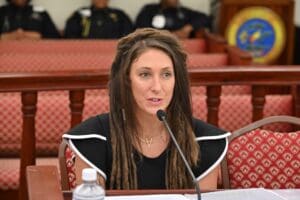
Clema Lewis, director of the Women’s Coalition of St. Croix, said children may have nightmares about their experiences in the courtroom. She said courtrooms are open to the public, the media can report what a child has said in the courtroom, and all her schoolmates could know what was done to her.
Sen. Angel Bolques has written a bill to alleviate that trauma. His colleagues at the Committee on Homeland Security and Justice voiced support for the Child Victims’ and Child Witnesses’ Rights Act Tuesday. Testifiers from the Department of Justice, Department of Human Services, and the Women’s Coalition also called the bill good, but there were proposed amendments.
Sen. Javan James, Sr., said, “There is nothing to debate here. It is a great bill.” He said the only work to do was to add the proper amendments. He was the only committee member to vote against forwarding the bill with a favorable recommendation to the Rules and Judiciary Committee. James said he would support the bill when it came before the full Senate but could not vote in favor of it Tuesday because he had not seen a copy of an amendment added to it.
Lewis highlighted three critical areas of the bill. The bill would allow children to testify on closed-circuit TV from a room other than the courtroom. The judge would also be allowed to close the courtroom to the public if necessary. She said appearing in court can be psychologically damaging for children already in a fragile mental condition.
Thirdly, she added that the bill would allow establishing a multi-discipline child abuse team. This team, made up of professionals in the private and public sectors, would work in the best interest of the child victim.
Darian Torrice-Hairston, director of Nana Baby Children’s Home, said the bill was necessary because children may struggle to comprehend the gravity of the judicial process. They might misinterpret questions or feel confused about the roles of various individuals in the courtroom. She added, “The stress of participating in a legal case can be overwhelming for a child. Unlike adults, children might not have fully developed coping mechanisms to manage stress, anxiety, or fear associated with legal proceedings.”
Sen. Alma Francis Heyliger echoed that sentiment, saying that even adults suffer anxiety in courtrooms.
Sens. Franklin D. Johnson and Marise James expressed concern about the victim’s care after the legal proceedings. Johnson said, from what he has seen, child abuse can become a chain through generations. James said it is a “poison” passed down.
Torrice-Hairston said a pivotal strategy to minimize re-traumatization is “providing access to mental health professionals and support services before, during, and after the legal proceedings to help children manage their emotional well-being.” This support can include counseling, play therapy, and other interventions tailored to the child’s needs.
Committee Chair Kenneth Gittens said. “We have to protect the vulnerable in our community,” and the Senate “should do whatever it takes.”
Carla Benjamin, assistant commissioner at the Department of Human Services, testified it was understood that those who are victims of crimes are revictimized by being made to talk about their experiences repeatedly and, in some instances, required to sit in court, in the same room as the person that harmed them.
William Appleton, deputy attorney general for the St. Croix district, raised concerns about the bill’s definitions.
The bill’s detail that raised much discussion was that a child under 16 should not be kept at home to watch other children. Several senators said the age should be 18 to confirm compulsory education standards.
Senators present at the committee meeting were Gittens, Bolques, Jr., James Sr., Diane Capehart, James, Ray Fonseca, Francis Heyliger, Dwayne DeGraff, Novelle Francis, Jr., and Johnson.