


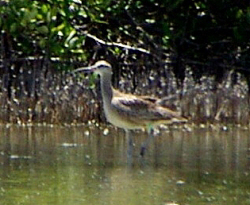
 A small bird, an adult female Whimbrel called Hope, arrived on St. Croix recently after a 3,500-mile nonstop flight from Hudson Bay in Canada, part of a more than 9,000-mile migration the bird has logged since May.
Hope is one a number of Whimbrels, wading shorebirds, captured in Virginia by biologists from the Center for Conservation Biology and The Nature Conservancy. According to a news release from the U.S. Fish and Wildlife Service’s St. Croix office, the biologists are investigating the life-cycle requirements of the species, and as part of the study the five largest birds were fitted with solar-powered satellite transmitters and identifying leg bands and released unharmed.
Hope was one of those five and has taken the scientists on a vicarious wild ride since then.
By tracking these Whimbrels, the biologists are able to identify the migratory routes and significant breeding, wintering and staging areas used by this species. Their findings will greatly increase the scientific understanding of Whimbrels and in turn contribute to the protection this declining species.
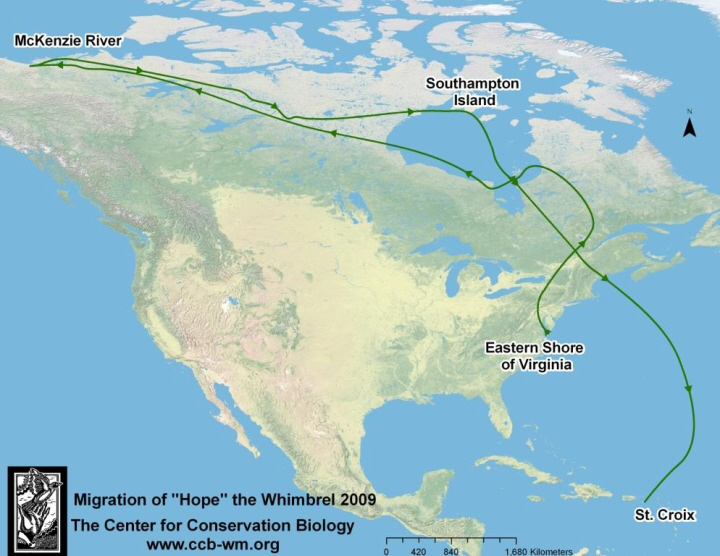
Since the capture on the Virginia shoreline, Hope has flown 9,174 miles, according to the information from her transmitter. First she flew from the Atlantic coast north to the southern shore of Hudson Bay. Then she was off on a long westward flight to the mouth of Canada’s McKenzie River, then back east to South Hampton Island in the northern Hudson Bay.
Then the real marathon began. According to the news release, Hope flew 3,500 miles in four days from the shore of South Hampton Island to Great Pond on St. Croix, where she has been feeding and resting ever since.
Hope’s flight is the longest continuous flight ever recorded for this species of shorebird.
On August 21, St. Croix, local bird monitors Lisa Yntema and Sheelagh Fromer were alerted to Hope’s presence at Great Pond by an online shorebird newsletter. Since then, they have observed this wary bird foraging, walking, stretching and flying in the mangrove wetland.
Hope has remained on St. Croix for 46 days as of Friday’s news release, well past the two to three week “refueling” stopover initially anticipated by the CCB biologists. Nonetheless, they still expect that she will continue on to South America for the winter.
Whimbrels are large, long-legged, brown and buff colored shorebirds. Females are larger than males, weighing up to 22.5 ounces. Whimbrels are long-distance migrants, with summer breeding grounds as far north as the Arctic Circle and wintering grounds as far away as southern South America. During migration, they stop for two to three weeks at “staging” areas where nutrient-rich food is plentiful and they can build up energy reserves in body fat, critical to their stamina during long flights.
Whimbrels’ broad diet is well suited to their wide range of habitats: mudflats, marshes, coastal beaches and subarctic tundra. Their distinctive, long, down-curved bills are the same shape as the fiddler crab tunnel so they can easily remove these crabs from their burrows. Whimbrels also eat worms and other invertebrates found in the mud or sand and even capture insects and pick berries when in the far north.
Hope is just one of the thousands of birds which depend on Great Pond, a rich and biologically diverse mangrove wetland, as a source of plentiful food and as a safe roosting and resting site. More than 75 bird species, along with a myriad of fish, crabs, jellyfish and other wetland organisms, inhabit Great Pond during any given year.
Great Pond is recognized by BirdLife International as an Important Bird Area because significant numbers and species of birds regularly use this pond and the surrounding mudflats. A regionally significant number of territorially endangered Least Terns nest on the mudflats from April through August and congregate there in large groups prior to migration in September. White-crowned Pigeons, also territorially endangered as well as near threatened status worldwide, nest in the inner pond mangroves and continue to roost in the hard-to-reach interior even after the young have learned to fly.
Great Pond’s open mudflats and mangroves also provide nesting habitat for 13 other native bird species.