


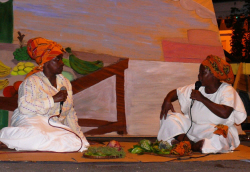
 Hundreds came out Friday to Frederiksted to commemorate the 131st anniversary of the Fireburn labor revolt of 1878 which marked the beginning of the end of near serf-like legal status for black workers on St. Croix.
Ras Lumumba of St. Croix and Sen. Terrence "Positive" Nelson blew calls on the conch shell as the crowd slowly gathered after dusk in the courtyard of the United Caribbean Association, adjacent to Buddhoe Park and Fort Frederik. UCA has been commemorating the day for the past 36 years. This year, radio host and historian Mario Moorhead retold some of the history leading up to the tragic but pivotal event in Virgin Islands history, and there was a performance of a short play about the events.
From Emancipation in 1848 until after the Fireburn, Oct. 1 marked the end of a plantation laborer’s contract, giving the laborer the ability to contract on a different plantation for the next year. The rest of the year, laborers were not allowed to leave their plantation without permission.
Every year after 1848, employers promised better wages and working conditions but never delivered. On Contract Day in 1878 four women on St. Croix, traditionally called queens, organized a revolt to demand all plantations pay the same or better than the St. Croix Central Factory and to repeal the Labor Act of 1849 that kept workers in serf-like conditions. These Virgin Islands heroines were Queen Mary Thomas, Queen Mathilde Macbean, Susanna "Bottom Belly" Abrahamson and Axeline "Queen Agnes" Salomon.
For five days, much of the west end of the island burned. Over 120 black workers and 20 or more planters were killed before soldiers came in and crushed the revolt.
Nelson, who is pushing to have the day made an official holiday, said Fireburn is an important milestone in the progress of the majority of the population that is of African descent.
"We must remember our African forefathers who paved the way for better living conditions," Nelson said.
Speaking to some visitors staying up at Creque Farm before the commemorations began, Lumumba said the day is a reminder the struggle against oppression continues.
"Now it is not chattel slavery anymore but mental slavery," Lumumba said, citing the effects of the policies of the International Monetary Fund as a source of oppression in the modern world. Personally, he would like to ultimately see the Virgin Islands become an independent nation, Lumumba said.
Opening the evening’s talks and performances, Sister Kamaria of UCA spoke about said she had been coming to UCA since not long after its founding 40 years ago.
"UCA’s mission is mental emancipation, which is why every year they put this on, " she said before introducing Moorhead.
"Slavery is what built capitalism, what built all the countries of Europe, and it was upon the back of our ancestors it was built," she said.
Telling a tale of slow, painful progress up from the very worst of conditions, she said when Danish Governor Peter Von Scholten took office, prior to the 1848 Emancipation, conditions improved somewhat. Before him, slaves were regularly punished by the cutting off of a foot or slicing off of a tongue, and work days were often 12 to 16 hours; after he took office, work hours were reduced to 7 a.m. to sunset, because of rebellion from the slaves, she said. But even after Emancipation, the working populace was heavily controlled and restricted.
"We couldn’t leave La Grange and go to Christiansted without a pass," she said. Black workers could only leave the plantation once a year, on Oct. 1 — referred to as Contract Day, to enter into a new contract at a new plantation.
Moorhead discussed the living conditions of the partially emancipated workers. They could not leave the plantation, they could not choose where to live, and if they lived under the stars, under the Labor Act of 1849, they could be arrested and be put to forced labor for vagrancy, he said.
As with company towns in the U.S., though workers were paid a pittance, they were then charged by their employer that entire amount, so in effect worked for free.
"You would work for five cents a day, but they would charge you five cents a day for rent, food and clothing, so you worked for free," he said. "Any way you moved you had to do hard labor for no pay."
In some respects, life was even less secure than before Emancipation, because when you did not allow a slave to own anything, then there was no question but the master had to provide food, clothing and shelter, he said. But once you begin paying them, though the pay may be taken right back, people had to try to fend for themselves for basic necessities.
The only exceptions to the restrictive labor laws, the only places blacks could live if they were not working on a plantation were areas called Free Gut in both Frederiksted and Christiansted, where some tradesmen and others eked out a living and a handful owned small shops, he said.
It was in this environment that, 30 years after formal emancipation, tempers reached the boiling point. Trouble was already brewing, but the spark that started the conflagration was when gendarmes beat and killed the father of Queen Mary, he said.
For five days, riots and fires blazed. Dozens of sugarcane estates were burned. A handful of white planters were killed.
Moorhead said hundreds were killed by soldiers putting down the revolt, 12 men executed by firing squad and 14 women burned at the stake.
Hundreds were arrested and ultimately the queens who were regarded as the ringleaders were sent off to prison in Denmark.
After Moorhead spoke, UCA members performed an original play by Richard Schrader Sr. entitled "1878: Queen Mary and Dem" that presents the events leading up to the Fireburn from the perspective of the several "queens" who are credited with instigating and organizing the uprising. Afterwards, the crowd marched to the beating of drums through the streets of Frederiksted with torches in hand in a peaceful reenactment.