


Editor’s Note: This is part 4 in the series Sacred Geography, Ancestral Memory & the Restoration of Meaning, which explores the natural and cultural history of the recently designated Maroon Sanctuary Territorial Park in northwest St. Croix. Previous articles in the series can be found here, here and here.

“The people who made Maroon Country their sanctuary and stood for freedom and human dignity have names and identities. They are part of the ancestral history of St. Croix and are connected to the people alive on St. Croix today.”
—Olasee Davis
“They hid in the hills, sequestered in the unpredictable security of caves at craggy shores, scratching out a subsistence with stubborn dignity. A presence once, they were all but forgotten in the aftermath of colonial slavery.”
—Bernetia Akin
Tall, stately Royal Palms punctuate the grounds and tower imperiously over the crumbling, flower-strewn ruins of Estate Fountain in northwestern St. Croix. A ghostly silence settles over the sloping meadow where the eroding facades of several buildings, topped with muted red notes of bougainvillea, are gradually subsiding into the earth. The voracious limbs of a strangler fig have seized one of the south-facing walls of the former plantation in a slow-motion wrestling match in which vegetation has triumphed over stone. Amidst the colonial rubble and the twisted detrital machinery of Danish West Indian sugar production is a rusted-out boiler drum lying askew in the wet grass. It has been set upon and overtaken by hardy weeds and tangled bush and has become a feature of the landscape itself. The forest creeping back in, reasserting a prior claim to the territory. Nearby a recently erected bronze plaque affixed to a low wall of crumbling stone memorializes the slaves who built the plantation here in 1750:
Built by the enslaved and oppressed, brought/born/sold/toiled/buried on this ground:
THEY ARE NOT FORGOTTEN
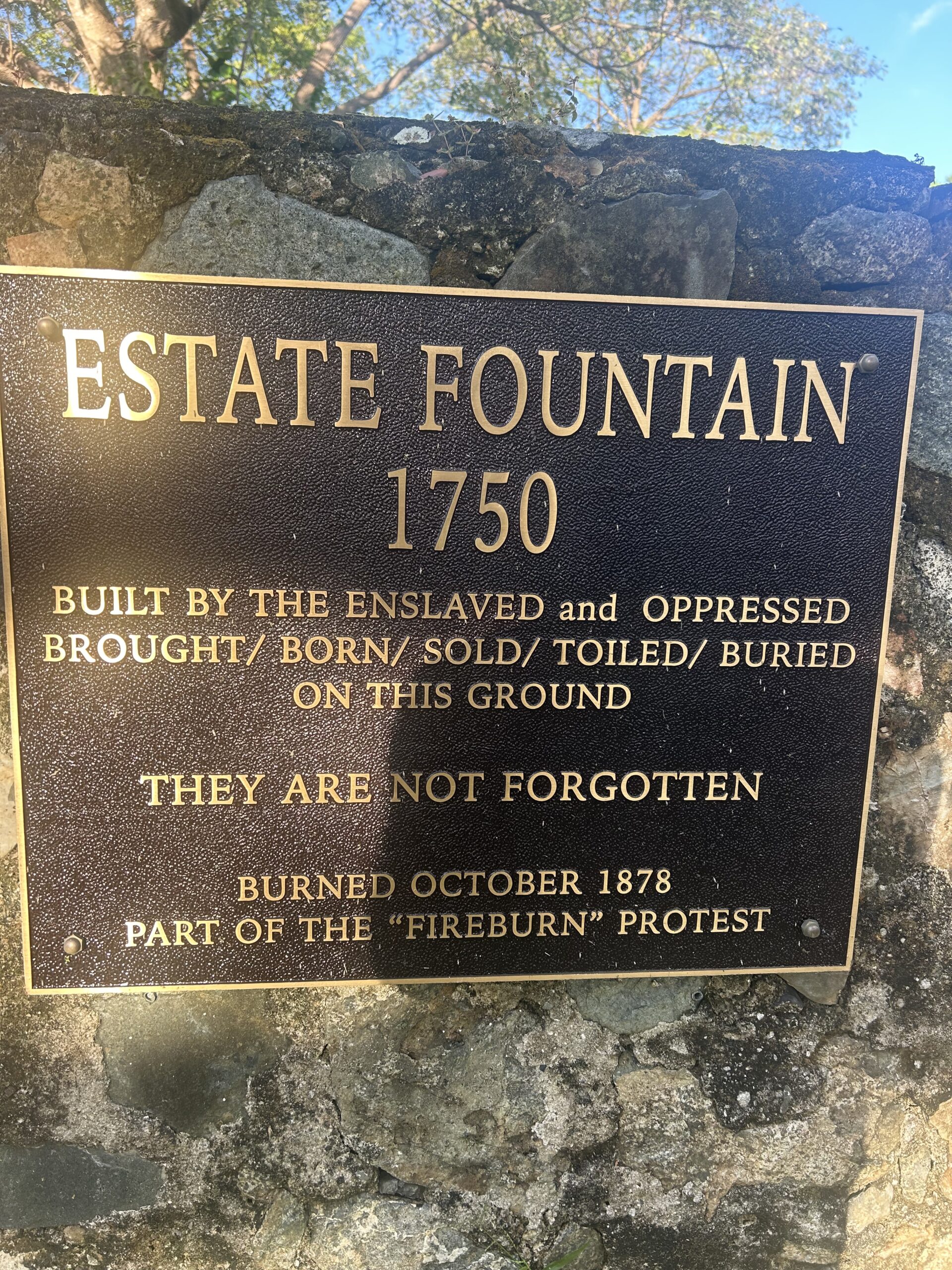
In October of 1878, nearly a century and a half after those enslaved Africans erected it, the estate was set ablaze during the legendary “Fireburn” labor riot, a conflagration of defiance that would sear itself into the fabric of island memory, becoming an enduring touchstone in the history and lore of Crucian culture.
Standing here within the vestigial remains of the estate and looking about into the encircling hills at the periphery of the recently designated Maroon Sanctuary Territorial Park, I marvel at the dense wave of green vegetation that crests the ridgeline before spilling over onto the downhill slope, marking the forest’s edge. Beyond that edge the dense wall of forest abruptly swallows all traces of human agency and the forest rolls, largely intact, over the crumpled terrain of the island’s northwest quadrant and all the way to the distant west end: Maroon Country.

The palpable legacy of self-emancipated former slaves who once took refuge here hangs over the territory like a mist. It rings through the silent air, hangs from the branches of trees and broadcasts from the secret-keeping stones. The unanswered questions about who these people were and where, in this shadowed landscape, they might have lived, continues to impart upon them a pervasive sense of mystery which infuses the newly established park with historical gravitas and a shadowy mystique. Absence has a way of energizing an awareness of traces.
Standing here at the park’s edge, peering into the encircling forest vastness, one can imagine an enslaved man or woman poised for flight, the temptation they must have felt, freedom and refuge seemingly so near at hand, to simply disappear into the thick encompassing sea of greenery, to dip into the shadows and be gone into a new life of refuge and fellowship among a gathering tribe of escapees who would become known as “Maroons.”
The word “Maroon” refers broadly to descendants of enslaved Africans who escaped captivity in the Americas, forming independent, free communities in remote, rugged areas starting as early as 1512. Exploring the etymology of the word sheds meaningful light: “Maroon” is believed to be derived from the French word “marron,” which in turn is derived from the Spanish word “cimarrón” meaning “wild” or “untamed.” The word itself seems to convey the spirit of defiance and independence that characterized runaway slaves such as those who once took refuge in the steep hills and deep valleys, among the precipitous cliffs and within the sheltering caves of the rugged terrain that surrounds me as I stand here on a quiet March morning, my mind alert to the mystery.
Perhaps because of the transient nature of their fugitive settlements or the desperation that fueled their stealthy passage through this landscape, the Maroons left few traces behind them; few dots to connect; few clues from which an accurate picture of their lives here might emerge. While the concerted efforts of teams of archaeologists, aided by complex, cutting edge geospatial mapping technology, have not yet produced much in the way of definitive material evidence of Maroon settlements in this remote and wild region, turning to the historical record and to written accounts does yield some provocative hints including numerous references to a legendary settlement known as “Maronberg” which was said to have been a well-populated haven and refuge for fleeing slaves. 

“For a long time now, a large number of escaped slaves have established themselves on lofty Maroon Hill in the mountains toward the west end of the island,” wrote C.G.A. Oldendorp, a Moravian missionary who visited the Danish West Indies between 1767 and 1768. “They are there protected by the impenetrable bush and by their own wariness.” Oldendorp’s account of what became known as “Maronberg” is the most substantial one that exists amongst the historical records of the Danish West Indies. The existence of Maronberg among these rugged hills of northwestern St. Croix was corroborated by its inclusion on the Küffner Map of 1767. Its exact location, however, remained somewhat vague reflecting the vested interest that the Maroons had in remaining undetected. Earlier colonial maps had routinely labeled the region now known as “Maroon Country” as “Uoptagne Grunde” or “uncharted ground.” One imagines a kind cartographic hole in the map through which fugitive slaves disappeared.
When the Danish West India-Guinea Company purchased St. Croix from France in 1733, it quickly expanded the island’s sugar and cotton production. As Dr. Justin Dunnavant, an archaeologist and Associate Professor of Anthropology at UCLA explains, “This also meant expanding the slave population to harvest lucrative plantations. But the Danes were never able to fully control the island – or the enslaved. By the end of the 1700s, nearly 1,400 people – more than 10% of the enslaved population – successfully escaped captivity. But where did they escape to? Only recently have researchers started to shed more light on this centuries-old mystery.”
Few people have committed more time and energy to plumbing the depths of that centuries-old mystery than ecologist, activist and historian Olassee Davis. Olasee has also been more responsible than any other individual for successfully shepherding the Maroon Sanctuary Territorial park into existence. Certainly these two endeavors are inextricably interwoven and one senses in Olasee an abiding and deeply rooted spiritual commitment both to the legacy of the Maroons and to this landscape which enshrines that legacy in perpetuity.
On a Saturday evening this past winter some friends and neighbors gathered at our home to hear Olasee present a talk entitled “The Hardships of the Maroons.” His talk provided a detailed overview of what is known about Maroon history on St. Croix, and as he projected his slides on the wall of our living room, those of us gathered here, on the outskirts of the newly established territorial park, felt that palpable mystery of the Maroon legacy pulse with life.

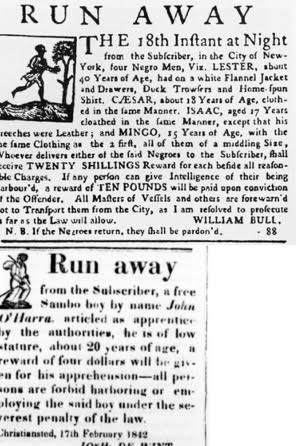
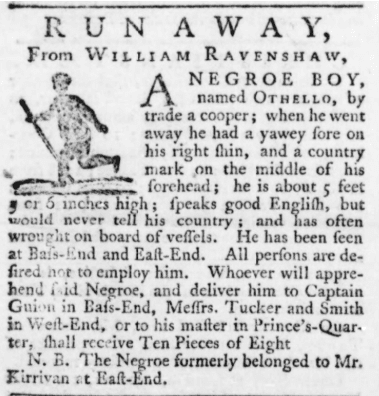
Olasee projects onto the wall of our living room clippings from early editions of the Royal Danish American Gazette from the early 1770s that include public announcements and detailed physical descriptions of escaped slaves and the threats of plantation owners to exact severe punishment on them in retaliation. Olasee’s vivid descriptions and anecdotal accounts of the kind of brutality meted out on those fugitive slaves who were apprehended casts a dark shadow over the entire Danish colonial project. In his book “Negro Slavery,” historian Eddie Donoghue poignantly refers to the history of slavery in the Danish West Indies as a “Rosary of Tears,” describing it as “brutal, harsh, violent and vicious.” He also provides a translation of the five articles of the infamous Slave Code issued by the Royal Council and Promulgated by Governor General Philip Gardelin on September 5th 1773. Article 1 reads “The leader of runaway slaves shall be pinched three times with red-hot iron tongs and then hanged.” Article 2 warns that “each runaway slave will lose one leg, or if the owner pardons him, shall lose an ear and receive one hundred and fifty lashes.” The subsequent articles retain this same sinister and barbarous tone. Those defiant individuals who took their lives into their own hands and fled into the shadowed forest knew full well what hung in the balance for them.
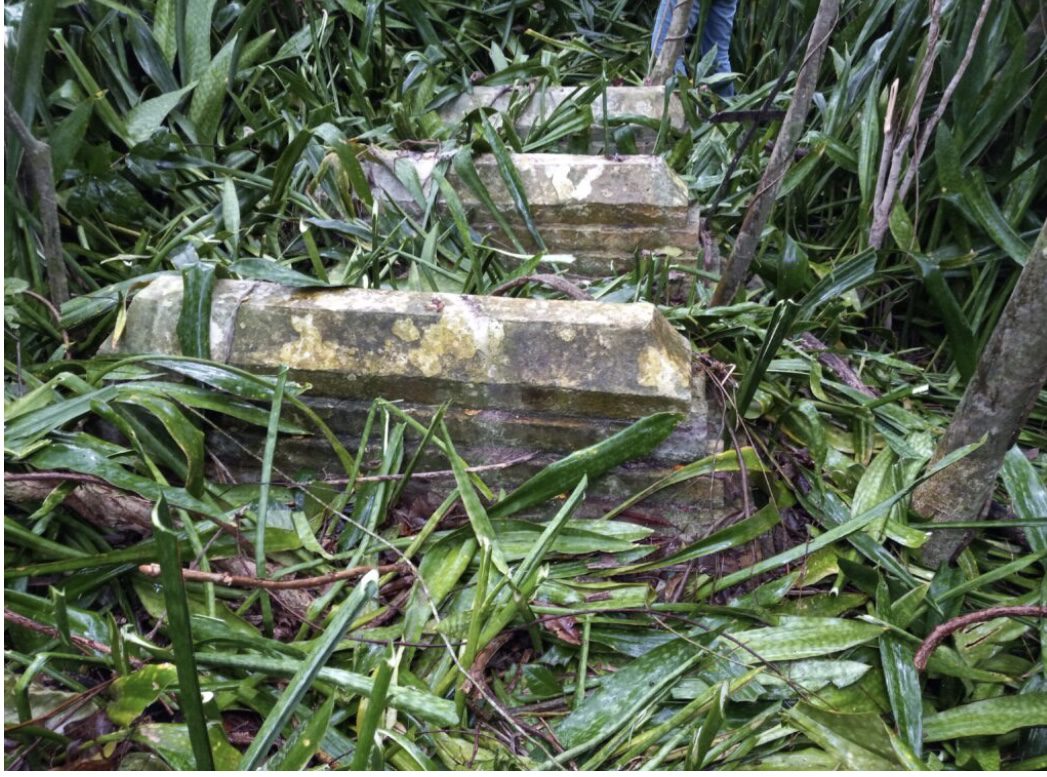
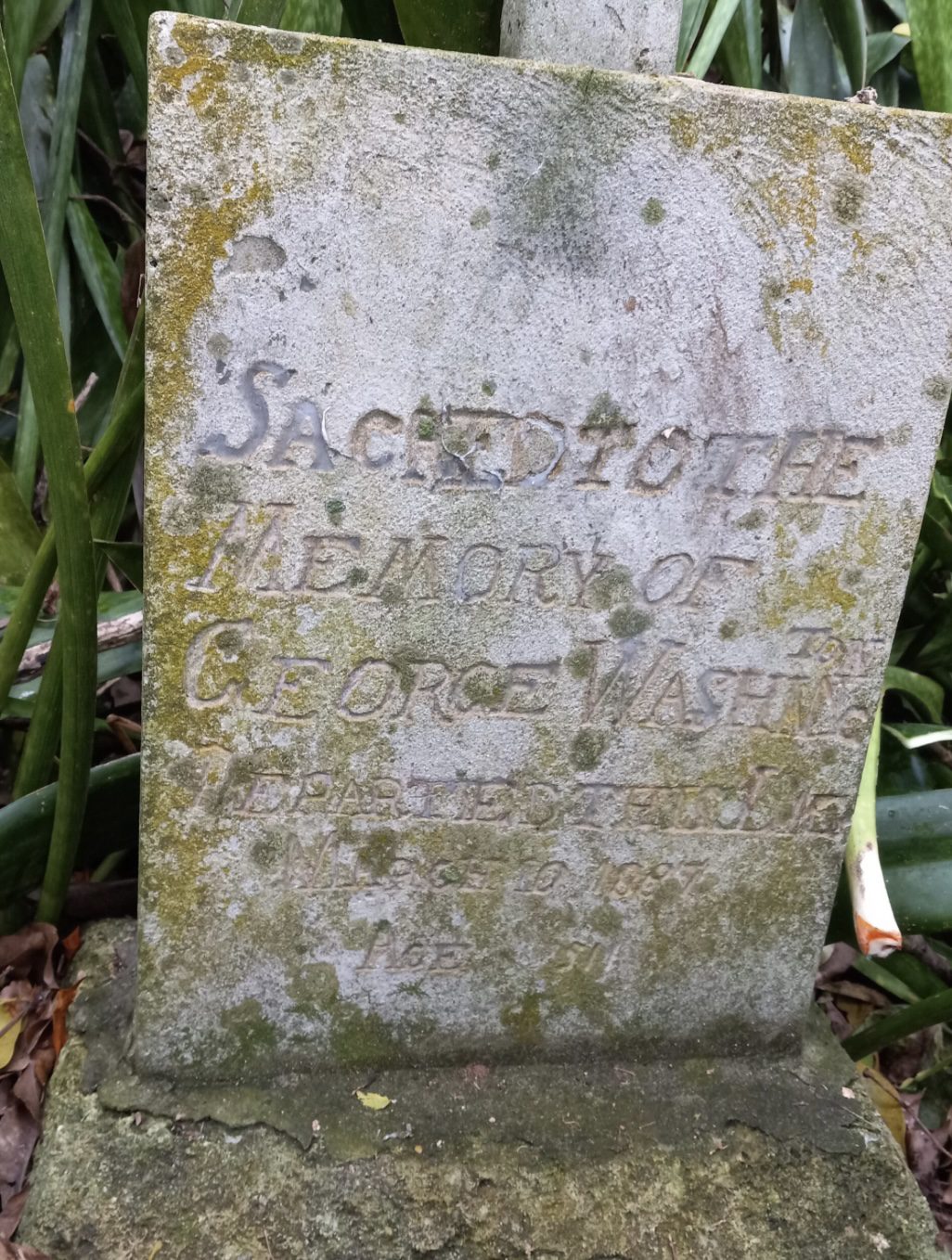
In a dense thicket of bush and tangled snake grass at Estate Anally is a weathered headstone, engraved and festooned with lichen. This is the final resting place of one such defiant individual whose irrepressible human spirit and refusal to be defined by the dictates of slavery fueled his flight from forced plantation labor and into the life of a proud Maroon. “Sacred to the Memory of George Washington” reads the tombstone. The common associations one likely has with the name – the powdered wig, the apocryphal wooden teeth, the mythical cherry tree, the Revolutionary War and the founding of a nation – however, are entirely misplaced here. If the man buried here can be said to have been a “Founding Father” it is perhaps because he helped blaze a trail to freedom and helped “found” a place of refuge for those who would break the chains of slavery. The revolution that he fought was in defiance of human enslavement.
Among the friends and neighbors who gathered at our home to hear Olasee speak about the Hardships of the Maroon was Gerard Doward. “Jerry,” as his friends call him, is a scholar, author, Crucian cultural historian and a volunteer Landmarks Society researcher. We met and talked one morning on the grounds of the Whim Plantation where we sat at a tree-shaded picnic table outside the building that houses the Landmark Society’s offices.

Jerry lived and worked in Denmark for several years and is fluent in Danish – a great asset for him since much of his research has entailed sifting through colonial records, navigating the linguistic divide and helping to piece together aspects of St. Croix’s storied past. His ancestral roots trace directly back to that weathered headstone at Estate Annaly. George Washington is his forebear. Like other current residents of St. Croix, Jerry Doward has traced his ancestry back to Maroons who are today buried in the newly established park and thus he represents a direct line of ancestral descent from the Maroons. “The people who made Maroon Country their sanctuary and stood for freedom and human dignity have names and identities” writes Olasee, “ They are part of the ancestral history of St. Croix and are connected to the people alive on St. Croix today.”
Also there to hear Olassee speak was Mary Roebuck whose tireless work for the St. Croix African Roots Project, has included meticulously transcribing thousands of genealogical records from the colonial era of the Danish West Indies. A few days prior to Olasee’s talk, Mary and I met at Altoona Lagoon where we sat at a shaded table by the water’s edge. As gentle waves lapped at the shoreline, she told me her story, reflecting on her own ancestral connection to the institution of slavery in northwestern St. Croix.

Over many years Mary has helped transcribe tax records, slave lists, census reports, church, school and vaccination records. In the process she read and sifted through thousands of documents, many of which had sat for centuries unread on shelves in the Danish National Archive, the U.S. Archives, and on St. Croix. Thanks to Mary and others involved in the project, these records have been organized online in a way that can help bring the people of the past to life for the people of today and the future. “Most of the records are in Danish,” she says “and some in Latin. They were handwritten documents and often the writing was barely legible. Sometimes it would take two or three people poring over the document to decipher a name or place.”

The Roebuck family also has deep roots in and around Maroon Country. Mary had heard about the slave cemetery at Estate Annaly but was not sure where it was. Years ago Jerry took her to see it. “When we first went up there, we found the headstone but couldn’t read it” she tells me. At the time the stone was caked and encrusted with dirt, obscuring the engraved inscription. Years later, in the aftermath of Hurricane Maria, they returned to the site only to discover that the storm’s devastating maelstrom had ironically had a clarifying impact on the stone’s engraving. “It had been washed off! You could now clearly read it.” Mary decided that this was clearly a sign, an ancestral echo, a signal. “He wants to be found!” she said to herself. Addressing the headstone, she spoke directly to the spirit of the man himself: “George, you really want your story to be told, don’t you?”
—Joshua Grant Canning holds a Master’s Degree in Environmental Journalism and in his writing he pursues projects that involve the intersection of nature and culture. On the basis of his writing about the ecological and cultural implications of the reintroduction of wolves to Yellowstone National Park, he was awarded a Middlebury College Graduate Fellowship in Environmental Journalism 2008-2009. The fellowship enabled him to travel widely in Japan (where he had lived previously for four years) to research and write about pressing environmental and cultural issues. He and his wife Wendy moved from Vermont to St. Croix in 2010 and he taught World Literature and AP English at Good Hope Country Day for over a decade. He is also a musician and jazz guitar enthusiast and performs regularly at events and venues around the island.