


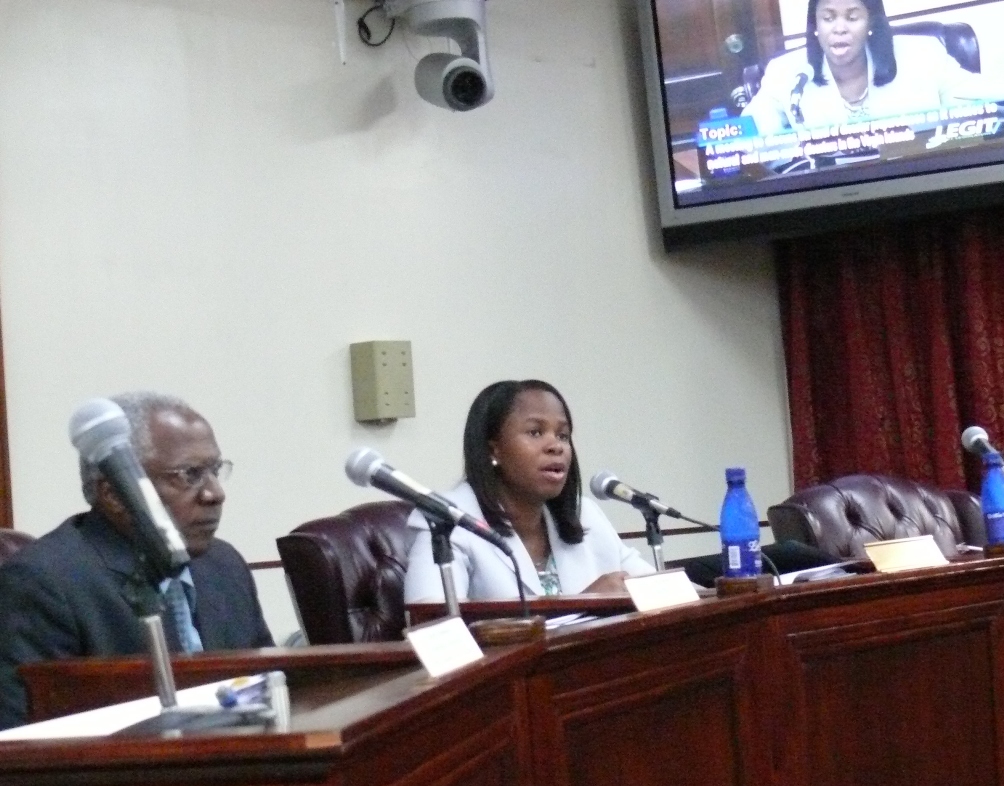
 If a natural disaster should strike, there are clear lines of authority and communication, but medium-term shelter is nonexistent and some preparations are still in the discussion stages, agency heads told a Senate Committee on Public Safety Wednesday.
Sen. Sammuel Sanes, chairman of the Public Safety and Homeland Security Committee, gathered the heads of V.I. Police and Fire departments, the V.I. Territorial Emergency Management Agency (VITEMA), and others to get an overall picture of the territory’s emergency preparedness.
During the committee hearing, Sanes learned that definite progress is being made: shelters are ready, while utilities and Hovensa have emergency plans.
VITEMA Director Mark Walters said his agency and overall preparedness are much stronger since a major restructuring last year. In 2009 the Legislature reorganized VITEMA as an independent cabinet-level agency with clear lines of emergency management in the territory, Walters said.
The legislation put 911 emergency services, emergency communications, homeland security and public assistance under VITEMA, expanding its role, while clarifying lines of authority and responsibility.
These changes made VITEMA compliant with the National Incident Management System (NIMS), developed by the U.S. Department of Homeland Security after the September 11, 2001 terrorist attacks, he said.
The uniform NIMS helps government agencies, nongovernmental organizations and the private sector to work seamlessly together in an emergency, regardless of type or size, he said. Government agencies all have their marching orders, in essence.
In its new role, VITEMA also revitalized the V.I. Emergency Management Council (EMC), a group comprised of the relevant department heads and the American Red Cross. The council plans to update the territorial emergency operations plan, delineating all of the emergency support functions for each department, he said.
After Walters, each agency head spoke in turn about their role and plans in an emergency, often describing their role in terms of numbered emergency support functions (ESF) from the existing emergency operations plan.
For instance, Donna Frett-Gregory, assistant commissioner of Education, said that "as an ESF-6," her department is tasked with emergency feeding, maintaining food storage in both districts and having staff prepare food in public school cafeterias, should it be necessary.
Public Works Commissioner Darryl Smalls said his department is tasked with responsibility for "ESF-3" and would help VITEMA with engineering expertise, technical assistance, construction management, debris removal and other tasks.
Similarly, Police Commissioner Novelle Francis said police were the lead agency in "ESF-13," before describing how the department would muster its officers, enforce curfews and institute protocols specific to the nature of each type of disaster.
While many of the pieces needed for response to a disaster, such as a major hurricane, are already in place, others are more in the planning stage. The V.I. divisions of the American Red Cross are ready to operate emergency shelters at territorial public schools. However, longer-term shelter for those whose houses may be demolished is a problem. Adrienne Williams, chief operating officer for the V.I. Housing Finance Authority, said true emergency housing is virtually non-existent in the territory.
"Residents who moved into emergency housing did so under emergency circumstances, however, once the emergency was mitigated, they continued to reside in units designated for emergency housing," she said. "What was intended for short-term tenancy in numerous instances has emerged into occupancy spanning five to 35 years."
The units are also over 40 years old and in dire need of rehabilitation, but rents averaging $125 a month do not cover utility bills, much less maintenance, she said.
Plans are afoot to use federal stimulus money to build new housing and rehabilitate older units. A plan for 72 units in Estate Donoe on St. Thomas is in the permitting phase, and a similar initiative is planned for St. Croix within a year, she said. Some will be permanent housing, but after it is all done, they expect to have about 30 units in each district for true emergency housing, she said.
While hurricanes are pretty well addressed, other sudden disasters, like tsunamis and earthquakes, are a "top priority" but remain works in progress, Walters said.
VITEMA has hired retired oceanographer and UVI professor Roy Watlington as a consultant to help with tsunami preparedness. After looking at 44 potentially vulnerable sites, Watlington and his crew have identified five areas that will be getting signs to show emergency tsunami evacuation routes.
Cruz Bay on St. John, Gallows Bay on St. Croix and Magens Bay on St. Thomas will be first, followed by Charlotte Amalie and Frederiksted, Walters said. The five areas will also become the focus of publicity identifying the hazard and also training residents on how to respond.
No votes were taken at the hearing. Present were Sanes, Sens. Patrick Sprauve, Terrence "Positive" Nelson and Wayne James.