
Home Blog Page 599

Calls for Road Repairs Addressed During Government House Briefing

Government House spokesperson Richard Motta Jr. addresses public concern over the territory’s roads during a press briefing on Monday held at the Westin Beach Resort and Spa at Frenchman’s Reef on St. Thomas. (Screenshot from V.I. Government House press briefing)

Government House Communications Director Richard Motta Jr. acknowledged concerns about deteriorating or damaged roads during a press briefing on Monday and called road conditions a priority of the Bryan-Roach administration.

“We understand the frustration of navigating roads that seem long overdue for repair — it’s an issue that affects all of us, whether you’re commuting to work, taking your kids to school, or simply trying to get from one part of the island to the next.”

Motta said there are more than a dozen active projects addressing roads and underground infrastructure territory-wide. Those were stalled in recent weeks by days of heavy rainfall, which Motta said “compounded the problem.”

“Our teams are on the ground — working tirelessly — but the weather has created conditions that make certain work unsafe or impractical,” he said. “At the same, this record rainfall is washing out roadways and testing the structural integrity of retaining walls, bridges and drainage systems.”

The rain also brought grass and brush growth at “unprecedented rates,” Motta said, further straining government resources.

Unchecked vegetation was causing headaches with far-reaching consequences even before the latest bout of heavy rain. Tropical Storm Ernesto, which blew through the territory in mid-August before developing into a Category 1 hurricane, left downed trees, branches and piles of green waste in its wake. The debris hampered efforts by V.I. Water and Power Authority crews and contractors to restore power.

WAPA officials acknowledged in the storm’s aftermath that the lack of tree trimming hindered recovery work. Don Gregoire, WAPA territorial incident commander, said during an Aug. 19 press briefing that crews or contractors were hired to perform preventive vegetation management in previous years, but no funding was allocated for the purpose in this year’s budget.

“We’ve had a lot of trouble with bucket trucks and keeping the fleet up,” he said at the time.

WAPA Chief Executive Officer Karl Knight also acknowledged that the utility needed to do more preventive vegetation management, saying during an August governing board meeting that the utility needed “to find our way back to having dedicated tree trimming.”

Bryan requested an emergency declaration after the storm to access federal funds for the cash-strapped utility, which was already under a monthslong local state of emergency because of financial straits and deferred maintenance.

President Biden declared an emergency on Aug. 19. That declaration opened the door for relief from the U.S. Internal Revenue Service, which extended tax filing and payment deadlines for individuals and businesses affected by Ernesto from August to February 2025.

During a Sept. 3 Senate Budget, Appropriations and Finance Committee hearing, Finance Commissioner Kevin McCurdy said that extension — and ensuing delay of revenues — would strain the government’s General Fund to the point that Bryan renewed calls for the Legislature to authorize either extending an existing line of credit by $50 million or opening a new one to help the government meet obligations like vendor payments and tax refunds.

The 35th Legislature eventually loosened restrictions on the existing line of credit, freeing up $50 million to cover vendor payments — but the impact of the federal tax relief measures implemented after vegetative debris contributed to an emergency declaration is still being felt. Ordered by a federal judge last week to show proof that the territory has been paying the court-appointed monitor responsible for overseeing the territory’s prisons, the government attributed a delayed payment in part to the IRS filing extension.

Public Feedback on USVI Land and Water Plan Open Until Dec. 5

0
Community members were able to review the final draft of the “Comprehensive Land & Water Use Plan” at a previous town hall meeting. (Source photo by Diana Dias)

The Department of Planning and Natural Resources has reached a significant milestone in its efforts to shape the future of the U.S. Virgin Islands with the release last month of the final draft of the Comprehensive Land and Water Use Plan (CLWUP).

DPNR Commissioner Jean-Pierre L. Oriol announced that the formatted draft, which spans 198 pages and integrates extensive feedback from the community, is available for public review and comment at www.PlanUSVI.com until Dec 5, 2024. The Land and Water Use Plan is meant to demonstrate a collective community vision that aims to guide sustainable development and land use in the territory.

A Collaborative Journey Spanning Years

The journey to this comprehensive draft has been marked by significant community involvement and internal efforts within DPNR. In an interview with The Source, Oriol explained that the project officially began in October 2023 when the Horsley Witten Group was brought on board to facilitate the planning process. Initial meetings set the groundwork for coordination with other government agencies, ensuring a collaborative approach. From October to February, background documents and data were gathered, including research spanning years of efforts toward establishing a comprehensive plan.

Oriol highlighted that this groundwork paved the way for extensive community engagement. “We have done several rounds of town halls, with 15 meetings across the islands and over 1,400 participants contributing their voices,” he said. Additionally, 91 resident volunteers joined working groups to provide input on various aspects of the plan. By the end of the summer, a comprehensive online survey had gathered more feedback, reflecting the robust planning process.

Key Themes and Community Input

Public feedback throughout the development of the CLWUP has been broad but consistently pointed to critical issues such as enforcement and regulatory practices. “A lot of the complications or the things that are frustrating usually boil back to lack of enforcement,” Oriol noted. This sentiment was echoed in town hall discussions, where residents expressed concerns about the effectiveness of existing policies. DPNR captured these comments, acknowledging that while the current plan serves as a visioning document, future policy work will need to address enforcement and regulation more concretely.

The plan itself is a strategic framework that lays out goals and visions for sustainable land and water use without diving into highly specific legislative changes. Oriol explained the rationale behind this approach, stating, “If you get too specific, you move away from focusing on an overall framework and start dealing with individual and specific needs, which can lead to competing interests. We need agreement on the overall vision before drilling down into policy specifics.”

A Vision Backed by Existing Plans

While the CLWUP is a new document, it builds upon existing plans and data collected over years. “We’re not starting from scratch,” Oriol emphasized. He highlighted that plans already adopted by various agencies are contributing to this comprehensive vision. Examples include economic strategies from the Economic Development Authority, watershed management plans, and initiatives funded by the legislature, such as agricultural development projects.

Importantly, the CLWUP aligns with other major infrastructure and planning efforts in the territory. Oriol pointed out that while billions of dollars from federal and local funding sources, including FEMA and the Bipartisan Infrastructure Law, have been earmarked for development, many of these funds are still awaiting final design approvals. “It’s crucial to set this vision so that we know where we’re going to properly implement these funds,” Oriol said. The plan incorporates approaches for managing stormwater, enhancing solid waste infrastructure, and improving roadways, all of which are critical to long-term resilience and sustainability.

Challenges and Future Implementation

Despite the comprehensive nature of the plan, challenges remain. The practical execution of the vision outlined in the CLWUP will require significant capacity building within government agencies. During recent budget hearings, department heads, including those from DPNR, expressed concerns about staffing and funding shortfalls. The plan’s implementation matrix, a key feature Oriol praised, highlights the need to bolster capacity through strategic partnerships and funding mechanisms. “We have support from federal and local resources, but they haven’t significantly increased over the years,” Oriol admitted, noting that current federal funding opportunities could help bridge this gap.

Oriol stressed that while funding and resources are essential, the most immediate focus should be on adopting the plan and ensuring that the community’s vision is represented. “We want to make sure that the final product reflects what we want as a people before pushing it forward to the legislature for adoption,” he said. This adoption process, expected before the end of the 35th Legislature’s term, would set the stage for more targeted policy and regulatory measures.

An Invitation for Public Engagement

Public engagement remains a top priority. Oriol encouraged residents to review the final draft available on www.PlanUSVI.com, emphasizing that the document is comprehensive yet accessible. “It’s 198 pages, but it’s not overwhelming,” he assured, adding that the plan is broken down by goal areas and includes specific recommendations for each island and even individual towns like Cruz Bay, Coral Bay, Frederiksted, and Christiansted.

Residents are urged to submit their feedback through the online form on the project website before Dec. 5, 2024. This is the community’s final opportunity to weigh in before the plan moves to the Senate for approval. Public hearings will also be scheduled to ensure that any final discussions can take place openly, officials said.

“We have a chance to set a vision that can transform the territory,” Oriol concluded. “It’s a moment for everyone to come together and make their voices heard.”

For more details, to join the email list, and to review the plan, visit www.PlanUSVI.com. Summaries and videos from previous town hall sessions are also available on the website and on Facebook at www.facebook.com/planusvi.

EPA Seeks Input About Refinery Cleanup, Community Engagement

0
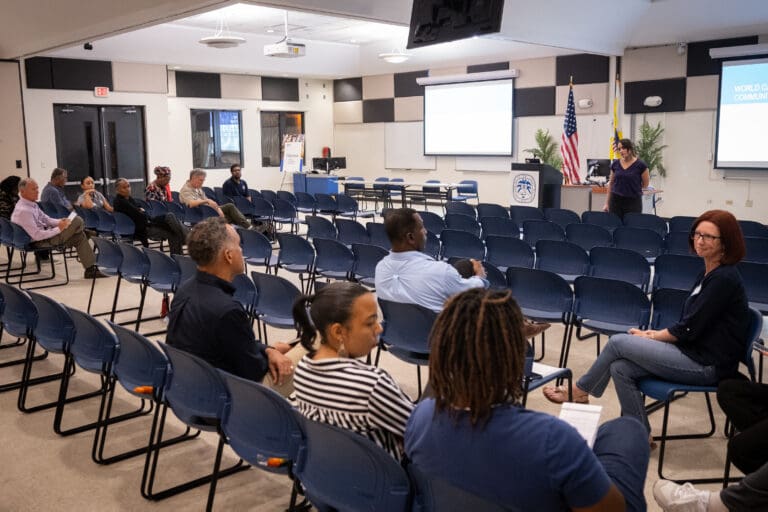
Community members break into groups to discuss topics prepared by the EPA during a workshop about the Resource Conservation and Recovery Act and the St. Croix refinery on Monday night at UVI on St. Croix. (Source photo by Kit MacAvoy)

Amid ongoing discussions about a potential restart of the St. Croix refinery, the U.S. Environmental Protection Agency solicited input from the St. Croix community on Tuesday night regarding the decades-long effort to clean up contamination under the Resource Conservation and Recovery Act, or RCRA.

During a community workshop held at the University of the Virgin Islands Great Hall on St. Croix, EPA Project Manager Ricardito Vargas acknowledged public anxieties and concerns about a potential restart, which he said the EPA is addressing.

“But also there is the legacy work that has existed for decades, and there’s been a lot of effort at cleaning up what is legacy contamination at the former Hovensa site,” he said, adding that sometimes the initiative got “lost in translation.”

The EPA issued Hovensa an RCRA operating permit in 1999 that required the former refinery owner to investigate and clean up contamination. Environmental contamination that occurred before 1999 also falls under the purview of RCRA, and Hovensa was required to assess and investigate any preexisting contamination as part of its permitting process.

The original investigation found 29 solid waste management units and three areas of concern as potential sources of releases to soil and groundwater, according to the EPA’s presentation on Tuesday. Because of leaks in process and storage areas and an “oily-water” underground sewage system, “extensive phase separated petroleum hydrocarbon (PSPH or ‘oil’) plumes are floating on top of groundwater and dissolved phase hydrocarbon constituent plumes are present within the groundwater itself.”

Shamoy Bideau, left, and Ki-Ana Tonge, right, give feedback during a community meeting on the federal Resource Conservation and Recovery Act and cleanup activities at the former Hovensa refinery hosted by the U.S. Environmental Protection Agency on Tuesday evening at the University of the Virgin Islands Great Hall on St. Croix. (Source photo by Kit MacAvoy)

Under an ongoing “Hydrocarbon Recovery Project,” more than 1,060,481 barrels — or 44.5 million gallons — of PSPH have been recovered since the program began. The recovery represents an estimated 99 percent of the leaked oil.

Hovensa ceased refining in 2012 and declared bankruptcy in 2015. Limetree Bay Terminals became the refinery’s owner and operator before going bankrupt amid a shutdown order from the EPA in 2021, which complained in U.S. District Court that the refinery presented “an imminent and substantial danger to public health and the environment.” Port Hamilton Refining and Transportation bought the refinery at a bankruptcy auction, and the fuel storage and marine terminal are owned by Ocean Point Terminals.

Hovensa’s bankruptcy also created the Environmental Response Trust, or ERT, which is responsible for continuing cleanup efforts. Carey Guilbeau, the trust’s representative and technical program manager, said on Tuesday that the scope of leaks from the former Hovensa site often leads to unfavorable comparisons to the Exxon Valdez oil spill of 1989, which released nearly 11 million gallons of crude oil into Prince William Sound.

Guilbeau noted that the leaks on St. Croix occurred over years and the volume of oil was never greater than the Valdez spill at any given time, but she did not diminish the impact of the contamination.

The Hovensa ERT has applied for an RCRA permit renewal, which Vargas said the EPA is reviewing. One of the agency’s objectives on Tuesday was to prepare the public for participating in the permit renewal process, which requires separating recent concerns about the refinery with cleanup activities under RCRA.

“Because we don’t want to go into a permit renewal where we have a lot of negative feedback because I believe that’s been the experience before,” he said. “We want the public to be educated on what is ‘legacy’ versus what else is happening currently at the refinery.”

OMB and Tech Park Nominations Headed Toward Confirmation

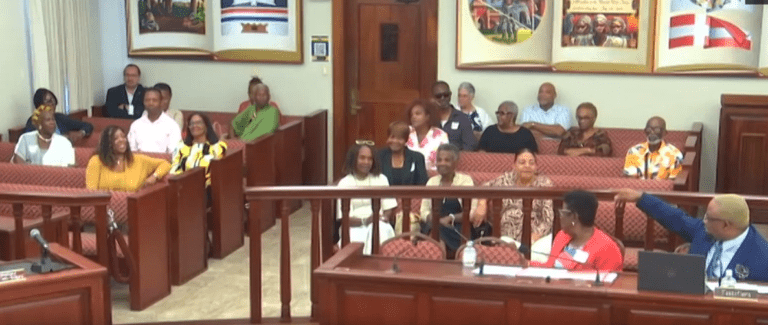
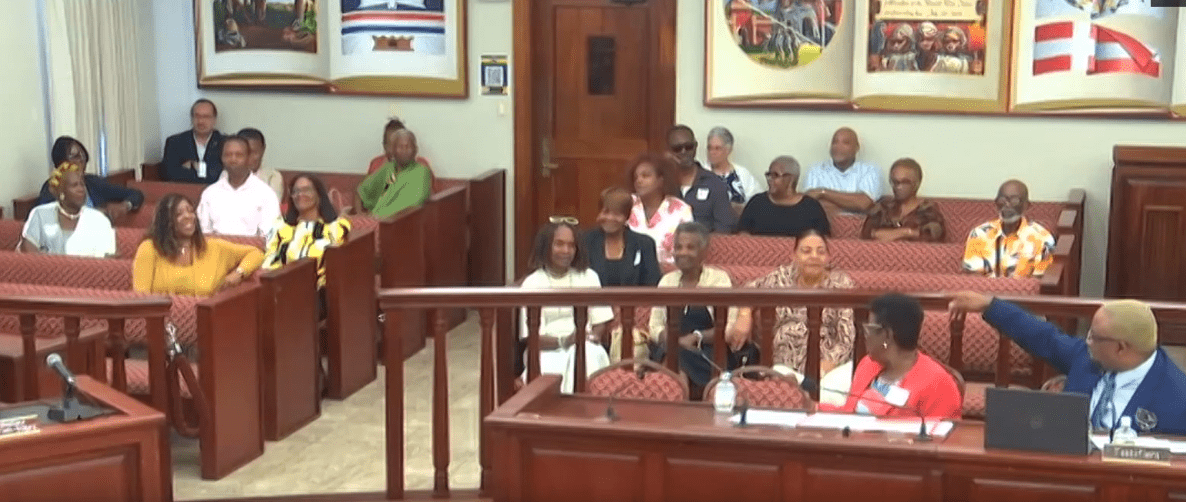
Kyza Callwood, far right, points to a supporter in the gallery Tuesday. (Screenshot from V.I. Legislature livestream)

On Tuesday, the Committee on Rules and Judiciary forwarded two nominations – Kyza Callwood to the University of Virgin Islands Research and Technology Park Board and Julio Rhymer as director of the Office of Management and Budget – favorably to the full Senate.

Gov. Albert Bryan Jr. nominated Rhymer, while the University of the Virgin Islands board of trustees nominated Callwood.

Neither of them received any criticism or negative vote, and they appear to be headed toward confirmation at the Senate Committee of the Whole on Wednesday.

Sen. Carla Joseph said she would vote for Rhymer 10 times if she could. Sen. Franklin Johnson said he was impressed with Callwood’s work ethic and that his resume answered all his questions.

Callwood holds a doctorate from UVI and has been the Bureau of Corrections’ chief strategic officer since February 2021. He has also been a business communication instructor at UVI since 2016 and a marketing ambassador for Diamonds International on St. Thomas for two years.

Averricia D. Williams, a retired public servant, testified, “Much of Dr. Callwood’s success thus far has come from careful planning and hard work. Knowing that he wanted to make a significant difference in the lives of his fellow citizens, he prepared himself by pursuing postsecondary education at the UVI, where he obtained not one, but four academic degrees.”

Rhymer testified that he had over 30 years in the financial industry and over 20 years in public administration and financial management. He served as the chief financial officer for the V.I. Housing Finance Authority and the Water and Power Authority, and he was also the director of the OMB from January 2018 to November 2018.

Among the initiatives he told senators he plans to implement this second tenure at OMB were streamlining budget processes, fostering interagency collaboration, establishing performance metrics, conducting a comprehensive spending review, conducting a federal grants review, and forming an asset management and inventory compliance unit within the federal grants management unit within OMB.

Finally, he outlined plans to create a succession plan within the agency to groom future leaders.

Sen. Novelle Francis told Callwood, “We are rooting for you.”

Sens. Donna Frett-Gregory, Angel Bolques, Jr., Francis, Kenneth Gittens, Carla Joseph, Milton Potter, Franklin Johnson, Diane Capehart, Ray Fonseca, and Marise James attended Tuesday’s meeting.

Government Leases, Abandoned Cars, Daughter of the Soil Subjects for Senators

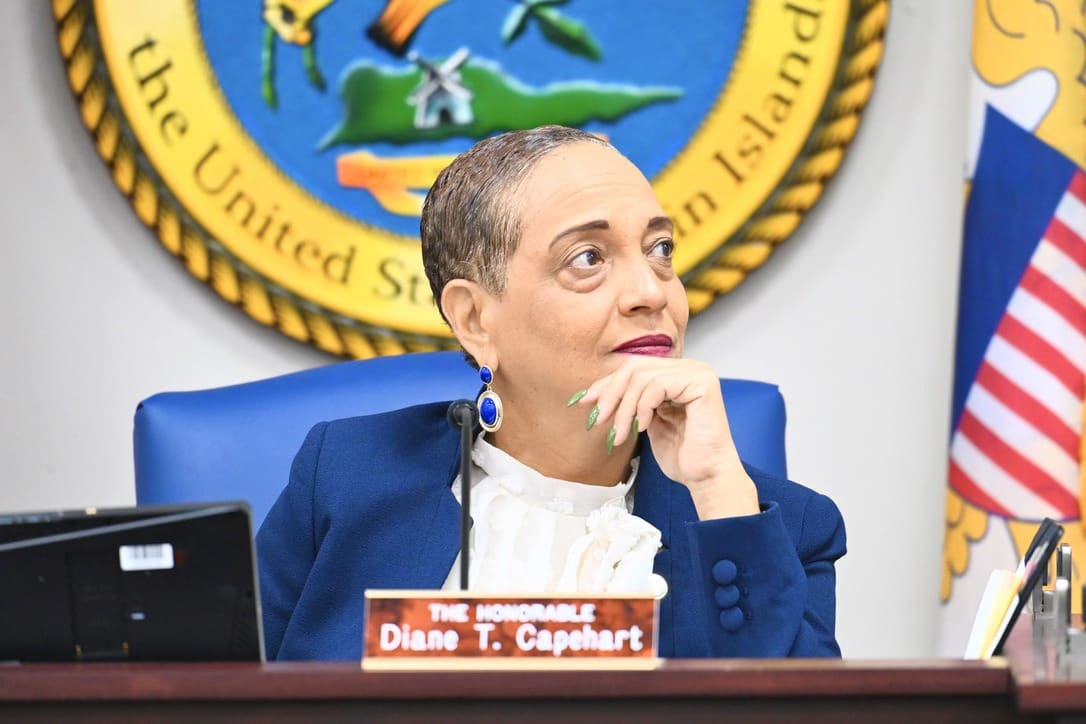
Sen. Diane Capehart chaired Tuesday’s committee meeting. (Photo Courtesy V.I. Legislature)

On Tuesday, the Committee on Rules and Judiciary considered seven bills that garnered few objections. Four bills were for leases that received favorable recommendations from the Senate Committee on Budget, Appropriations, and Finance earlier this month.

Having gained a favorable ruling from the committee, they will likely pass their final legislative hurdle on Wednesday in the Committee of the Whole.

The lease included one for HKT Energy Consulting Group, run by Hugo Hodge Jr., former Water and Power Authority executive director, for office space in a warehouse at 114 Submarine Base, Southside Quarter, St. Thomas.

Another five-acre lease will be granted to the USVI Soccer Federation. Soccer facilities will be built in Estate Nazareth, Red Hook Quarter, St. Thomas.

Star Time Firearms proposes a shooting range on government property in Estate Bovoni, Frenchman’s Bay Quarter, St. Thomas.

The fourth lease is to the Federal Aviation Administration in Estate White Lady, West End Quarter, St. Croix, for the continued operation of a locator outer marker.

Of the other three bills, the one to honor Juel Turnbull Rhymer-Molloy for years of dedicated service and contributions to the community was commented on most. Sen. Milton E. Potter called Rhymer-Molloy “a daughter of the soil and adviser to governors.” Sen. Marise James said, “She has given her best to the community.”

In recognition and appreciation of her long service, including as Human Services commissioner, the bill proposes a perma plaque ceremony in her honor renaming the complex housing the Human Services Department as the “Juel T.R. Molloy Complex.”

The only bill to generate negative votes was strengthening the government’s ability to remove abandoned or derelict vehicles and fine owners. The negative votes and comments only came after an amendment was added.

Committee Chair Sen. Diane Capehart, who refrained from voting on the bill, said the committee was “blindsided” by the amendment and had no time to review it. Sens. Kenneth Gittens and Franklin Johnson voted against the bill, which passed with four favorable votes.

An act honoring and commending police officers for their service to the community and recognizing fallen law enforcement officers posthumously received positive comments and votes from all seven committee members, as did the act honoring Rhymer-Molloy.

All seven senators also approved an act establishing school speed zones, signage, and enforcement measures to promote student and pedestrian safety near schools.

Sens. Ray Fonseca, Carla Joseph, Potter, Gittens, Johnson, Capehart, James, and Angel Bolques Jr. attended the hearing.

Annual Summit Explores the Complexities of Establishing V.I. Health Information Exchange

0
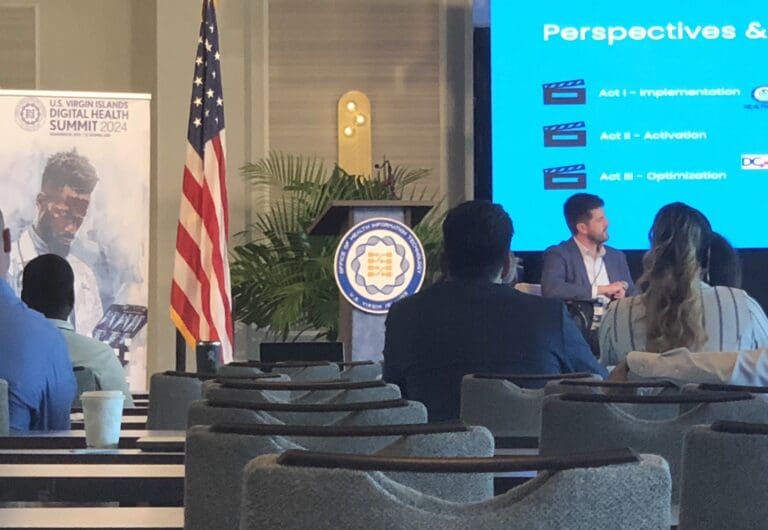
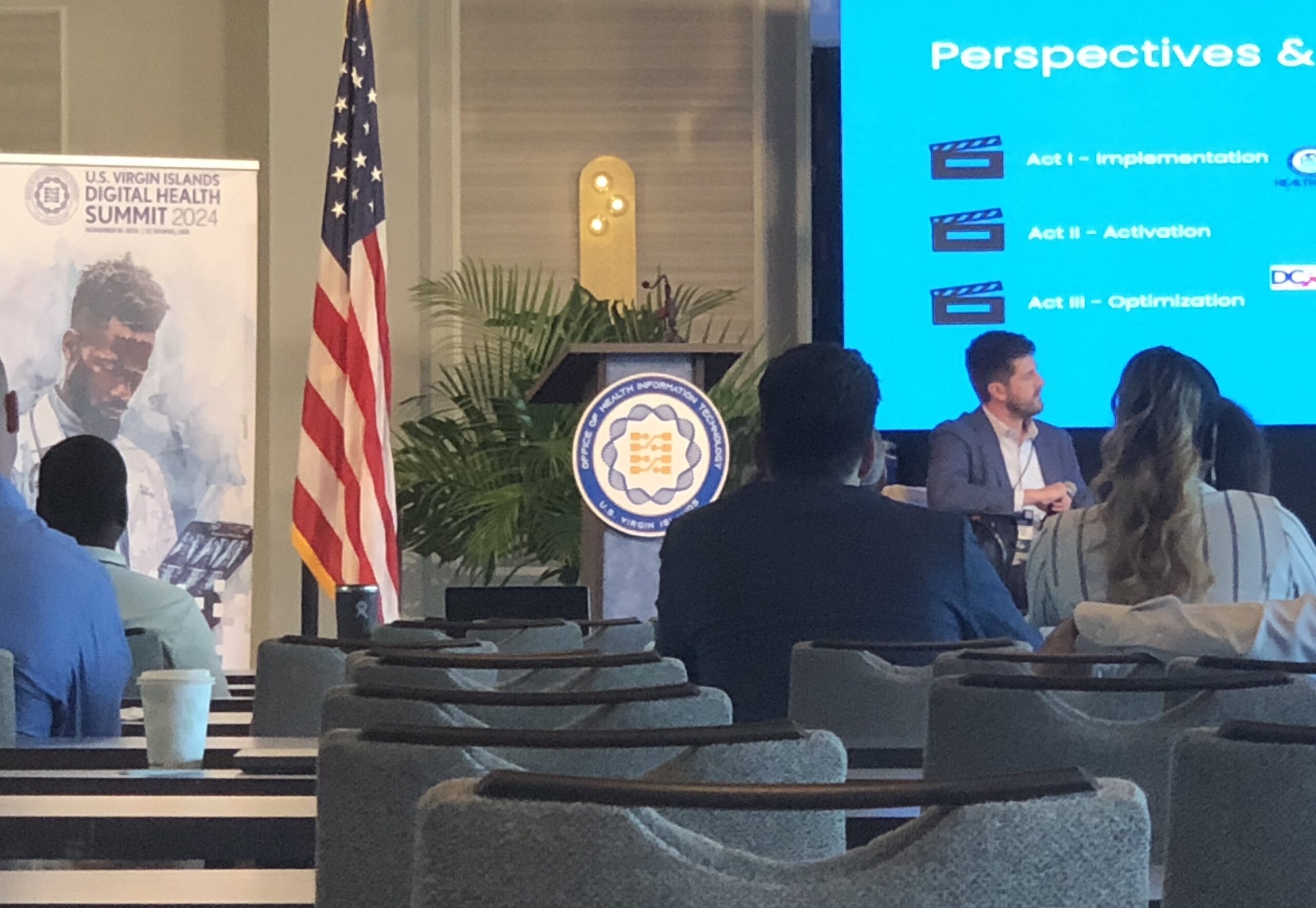
A Tuesday panel discussion on health care information exchanges captures the attention of participants. (Source photo by Judi Shimel)

Health care workers from the Virgin Islands and Eastern Caribbean explored digital systems designed to make patient information more accessible at a three-day conference on St. Thomas. Organizers from the Office of Health Information Technology said they wanted to share what they had learned since launching the territory’s Health Information Exchange.

The Westin Resort at Frenchman’s Reef is the setting of the U.S. Virgin Islands Digital Health Summit from Monday through Wednesday. Aside from establishing the health exchange, participants had panel discussions and took part in breakout sessions presenting topics of concern.

“Today, we stand on the cusp of a major milestone,” said former V.I. Health Commissioner Julia Sheen. “This breakthrough initiative will revolutionize the way health care providers in the U.S. Virgin Islands communicate, collaborate and share vital patient information bringing one step closer to truly integrated and seamless across the territory.

“As we move forward, it is clear that how we use technology is no longer an option,” Sheen said.

Since 2022, government officials and health care and information technology professionals have joined the annual summit to learn more about federal guidelines, policies, resources, services, and solutions. It took two years to put the Health Information Exchange components together and make them work, said Health Information Office Director Michelle Francis, who also served as mistress of ceremonies.

“Right now, we’ve got both hospitals, both of our federally qualified health centers building into the system,” Francis said.

Information exchanges have been around for about 20 years, the director said. “Territorial officials spent the past two years making sure security measures were in place. They also worked to make sure the system adhered to federal health care privacy laws,” Francis said.

Among the day two presentations held at the Reef was one on creating public-private partnerships. Dr. Ernest Carter from the Kennedy Krieger Institute described the process of setting up a partnership.

Because government resources can be limited, bringing in the private sector is one way to overcome that hurdle, Carter said. “Public-private partnerships have to help you solve complex problems,” he said.

One of the problems he faced while setting up an exchange system in Maryland was reducing the use of hospital emergency rooms for patient care. “We did that work; four years, four million dollars. Our result was we saved $8,000 per patient that our community health workers work with,” he said.

But he stressed the need for vigilance in working with a partner and making sure the system they help create serves the needs of the hospital, clinic, or health care provider they’re working with.

“The technology’s been around; the benefits of being later in the game are seeing what other states have succeeded at, and quite frankly failed at,” Francis said during a break between sessions. “We can learn from those lessons and build from them.”

Other entities like the Human Services Department and the Health Department are also working to align their systems for use by the exchange. Private sector representatives and communications experts were included in this year’s summit.

Health care and info tech representatives from Jamaica, Nevis, and the British Virgin Islands were also present. “What can we do now to better share data about others in the Caribbean — some of our own relatives in other islands — so we have a better and more accurate picture of the state of health in the Virgin Islands,” the director said.

Tuesday’s afternoon session included a roundtable discussion with members of the 35th Legislature.

STX Foundation Hosts ‘An Afternoon with Mario Moorhead’

0
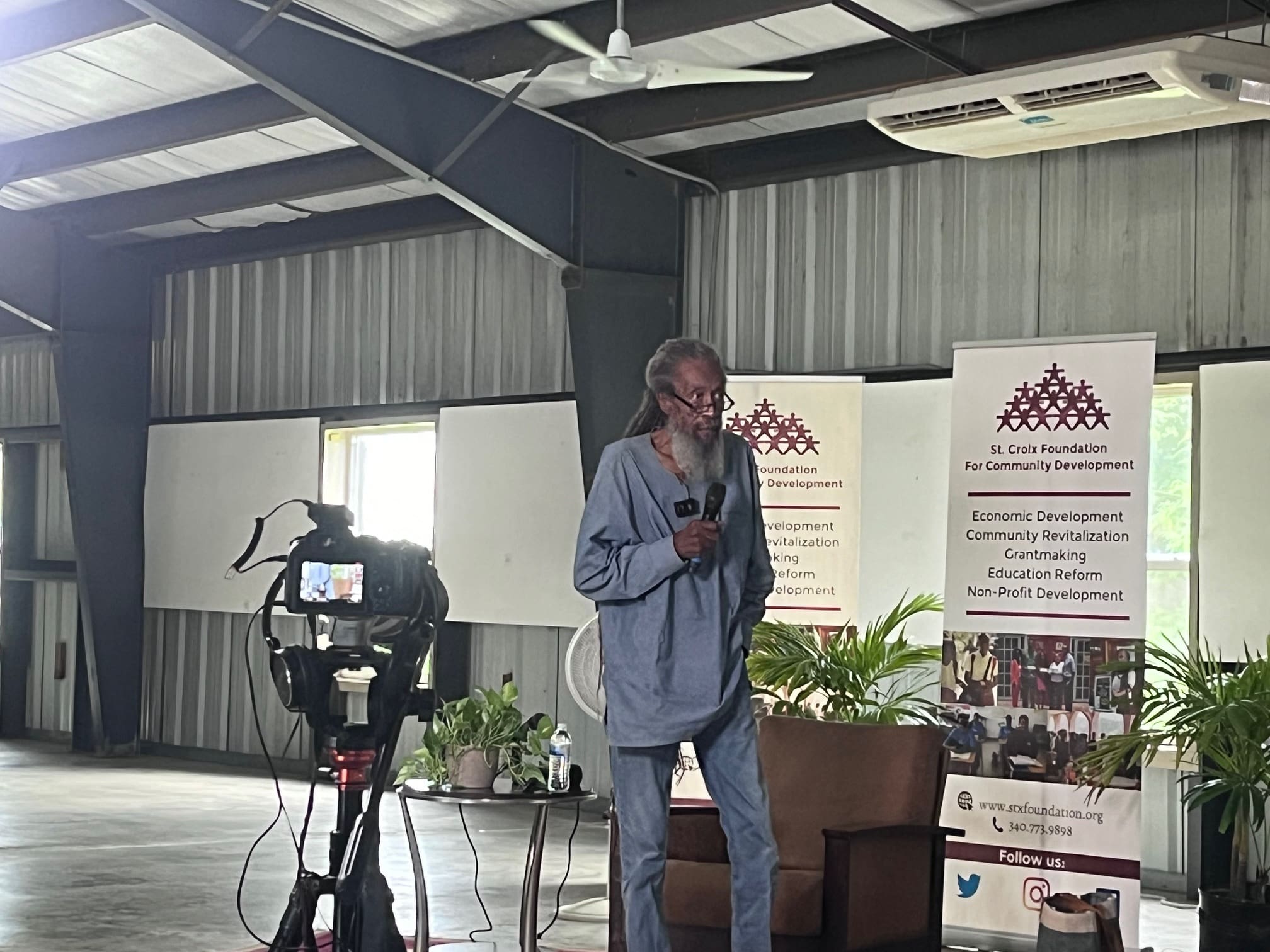
Author, historian, activist, talk show host, and Crucian native Mario Moorhead. (Source photo by Diana Dias)

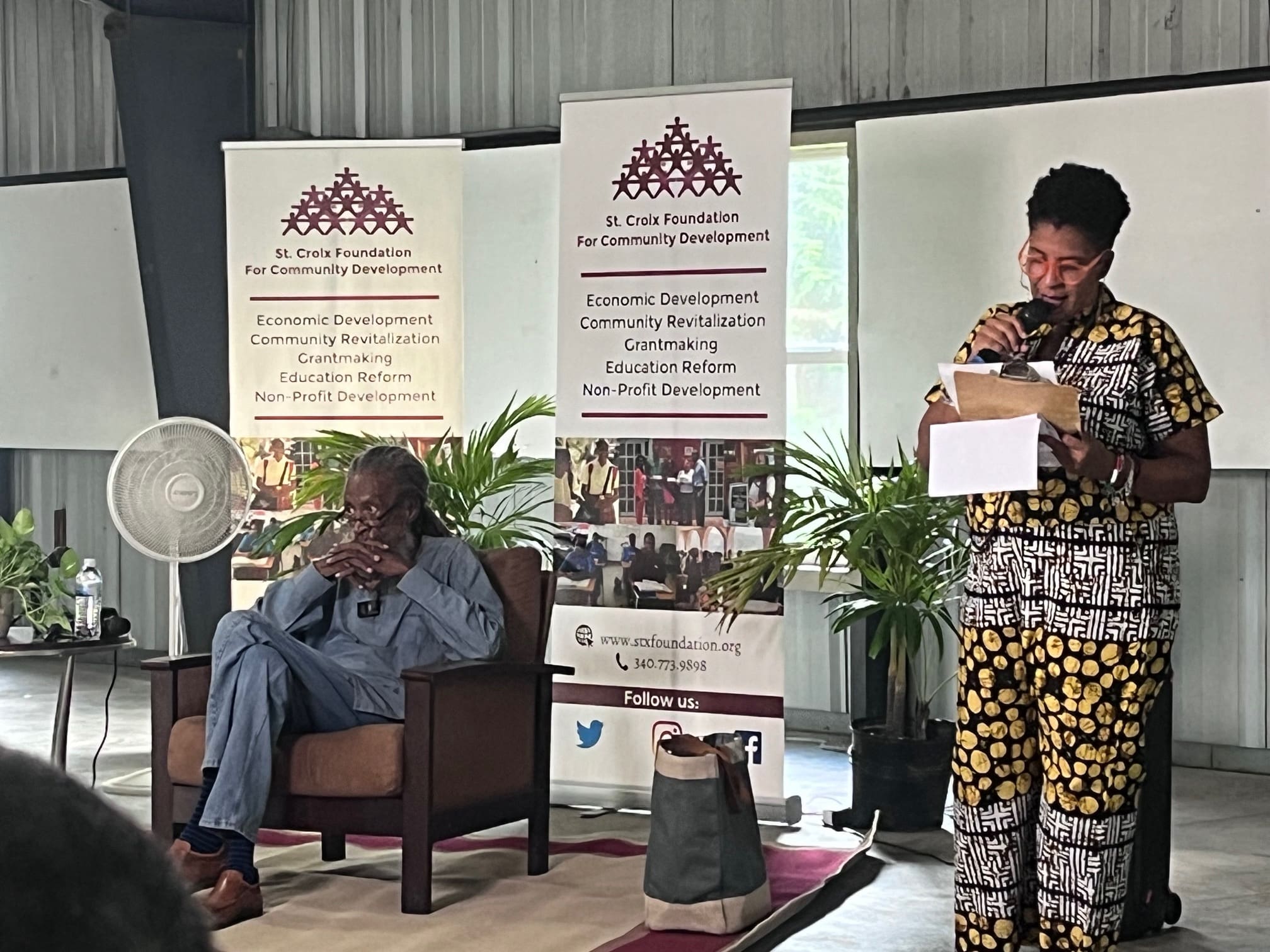
The St. Croix Foundation for Community Development, in partnership with Crucian Heritage and Nature Tourism (CHANT), hosted “An Afternoon with Mario Moorhead” on Sunday at the Old Bethlehem Sugar Factory. The afternoon of learning and exploring Virgin Islands history was also a celebration of the author, historian, activist, talk show host, and Crucian native’s 85th birthday.

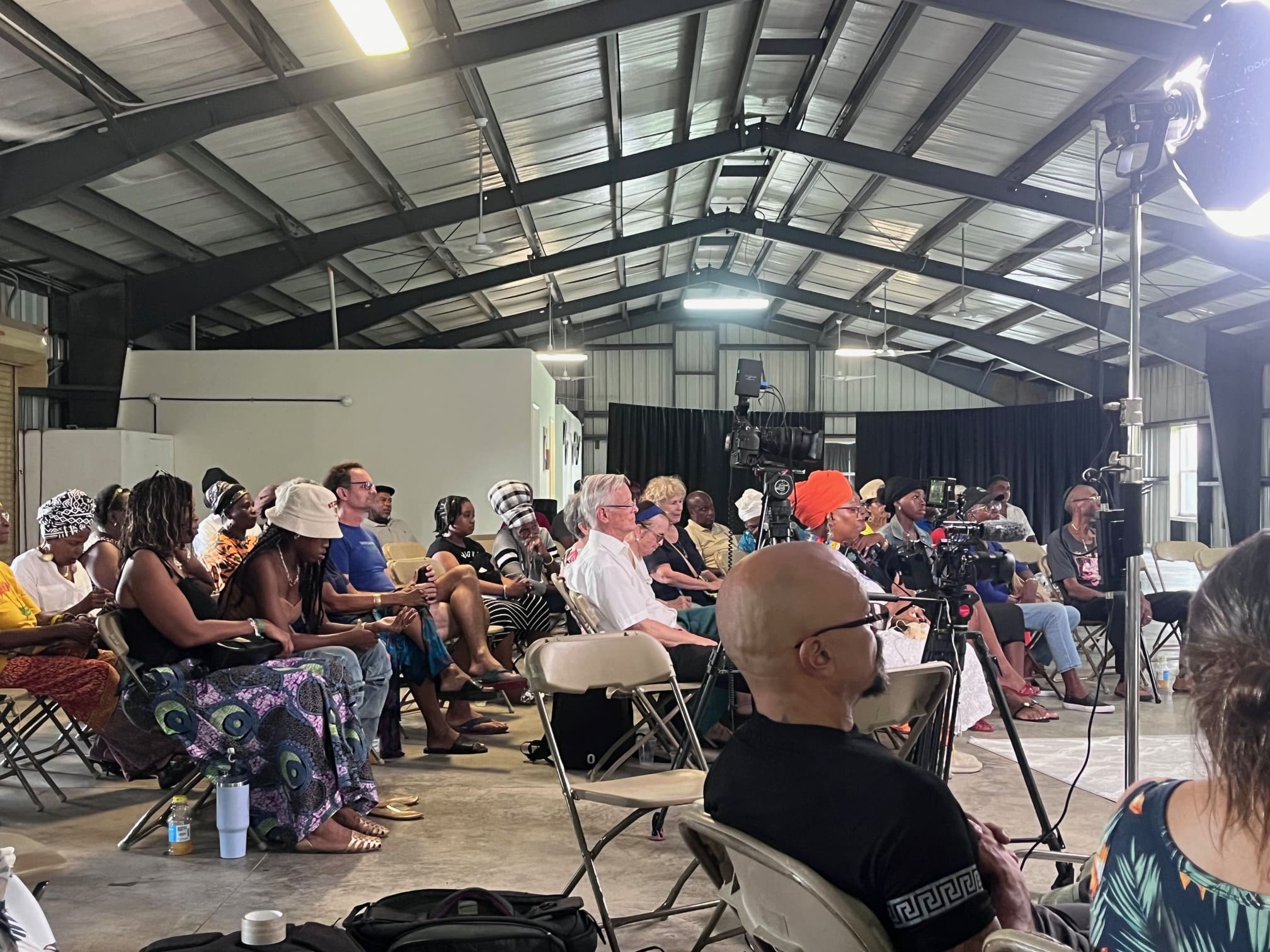
With the blow of a conch shell to commemorate the event, the room filled with a mixture of 60 people ranging from young people to elders to listen to Moorhead’s extensive knowledge of Virgin Islands history.

“Scholars, historians and opinionated people only too often say that our history did not begin with slavery.  I am not familiar with these opinionated historians and scholars telling us. If our history did not begin with slavery, when are you or whoever going to tell us where it began?” said Moorhead, who shared his V.I. history knowledge based on his research and discussions he’s had with historians, physicists, scholars and other experts on history that can be dated back to 30,000 years ago.

Mario Moorhead’s daughter Sayeeda Carter reads a bio and letter from a friend of Moorhead during the “An Afternoon with Mario Moorhead,” event on Sunday. (Source photo by Diana Dias)

St. Croix Foundation President Deanne James reflected on how Moorhead has helped to influence her personal and professional journey. She said that about eight years ago, around this time, she had been questioning many things about where she came from, and she had been encouraged to read Moorhead’s  book “Crucian Dialogues: Defining the Problem.”  After three days of reading, she had finished the entire book.

“Maybe it’s as simple as our children knowing who they are to make better life choices. That shifted me in terms of how I turn up as far as my work,” said James.

James emphasized the significance of incorporating the wisdom of elders into the foundation’s initiatives. At an event, she was reminded of the crucial role elders play, and she has committed to ensuring that V.I. elders are included in all the foundation’s efforts. “Their guidance will help us cultivate wisdom as we strive to advance social justice for the Virgin Islands,” said James.

“Today is about planting seeds. We see ourselves as the soil, Mario planting the seeds and the rest of us have to cultivate the seedlings. Our hope is after today that there will be someone or someones that will say ‘We need more of this,’ and we will take the lead in not only making sure opportunities like this are available for adults, but also for our children,” said James.

A mixed crowd of young people and elders at the “An Afternoon with Mario Moorhead” event. (Source photo by Diana Dias)

Lilli Cox, the director of Communications and Community Investments, connected the event with the larger initiatives of the foundation. “It was a multitude of factors,” and part of it is the foundation’s work with the Kid’s Count. Every year, the St. Croix Foundation collects data directly from agencies to comprehensively report on the status of the U.S. Virgin Islands youth. “This year we did much more, we took that data and started to activate it,” said Cox.

With the rise of violence from young men and women, Cox said with the increase and decrease, “we are not seeing real improvements,” she said.

Cox said that we are watching the mental health crisis unfold and we are beginning to wonder what the cause is. “Perhaps it’s a lot of different things because we believe in systems thinking, again, not one single thinking,” she said.

Cox said this is why “Sankofa,” or the spirit of learning from our past to better understand our present and shape our future, is important. Discussions like these help us learn where we came from to have a better understanding of where we are going, she said.

Gun Grab During ‘Operation Set De Tone’

0

On Friday, Nov. 15, during “Operation Set De Tone,” police officers conducted a traffic stop and found 19-year-old Jorge Ayala in possession of an illegal firearm, the V.I. Police Department reported.

Officers with the Virgin Islands Police Department’s Special Operations Bureau conducted the stop on a silver Toyota Camry on Melvin Evans Highway near Industrial Road, St. Croix. The vehicle displayed several traffic violations, including the lack of rear taillights, brake lights, and a license plate, according to the police report.

During the stop, officers observed Ayala, a passenger in the vehicle, appearing to possess a firearm. A subsequent search of the vehicle revealed a black .45 caliber handgun with a 17-round magazine located on the floorboard. Ayala claimed ownership of the weapon, but he lacked the required license, the police report stated.

Ayal was subsequently arrested and charged with carrying a firearm openly or concealed and possession or sale of ammunition. His bail was set at $50,000, the report stated.

The case is currently under investigation, police said.


WAPA Board To Meet Nov. 21

0
The Governing Board of the Virgin Islands Water and Power Authority has scheduled its’ Regular Board Meeting for Thursday, Nov. 21 at 9:30 a.m. The meeting will be held in the Sunny Isles Business Office 2nd Floor Conference room on St. Croix and via Microsoft Teams.
Microsoft Teams
Meeting ID: 232 810 316 517
Passcode: tRJjsd

VIPD and Feds Assess Pedestrian Safety

The Virgin Islands Police Department’s Office of Highway Safety joined forces with its federal partner, the National Highway Traffic Safety Administration (NHTSA), to conduct a Walking Safety Assessment of Veterans Drive.

The initiative engaged several community stakeholders across agencies, organizations, and personal interests to identify pedestrian safety concerns on the roadway. Walks were conducted on the afternoon of Oct. 29 and the morning of Oct. 30 to observe traffic nuances at various times of day. The VI Source was there too.

Participant teams, donning safety vests, walked west from the VI Legislature Building to Seaborne Airlines and back, recording observations along the way. Sidewalks blocked by parked vehicles, poles, and planters forced the group to interact with traffic. In many areas, sidewalks, uneven and muddy, presented slip and trip hazards. Pedestrian crossing lights were sparsely available and provided an insufficient 10-seconds to cross the four-lane street. 

One wheelchair bound participant required assistance to safely navigate several curbs with ramps ending higher than street level.

“Our roads must be safe for everyone, despite mode of transportation or ability,” said VIOHS Director Daphne O’Neal. “This initiative sought perspectives from individuals with varied professional backgrounds and personal experiences for a holistic solution.”

Participants hailed from the Offices of the Governor and Lieutenant Governor, the Disability Rights Center, Bureau of Motor Vehicles, Departments of Police and Public Works, State Office of Emergency Medical Services, the Methodist Training and Outreach Center, the University of the Virgin Islands, the VI Source, and DaVybe Radio Station 107.9FM. 

NHTSA will assist in preparing a detailed report which will be submitted to relevant changemakers, and the model will be utilized for future Walking Safety Assessments in other high pedestrian-motor vehicle crash zones throughout the territory.

Data shared at the event revealed that 143 pedestrians on St. Thomas/St. John were involved in motor vehicle crashes in the past 3 years. These crashes resulted in five fatalities and 118 pedestrian injuries. Territory wide, during the same period, there were 193 pedestrian-motor vehicle crashes, 9 pedestrian fatalities, and 152 pedestrian injuries. In fiscal year 2024, there were 7 pedestrian-motor vehicle crashes on Veterans Drive.

Jobs - Click Here