


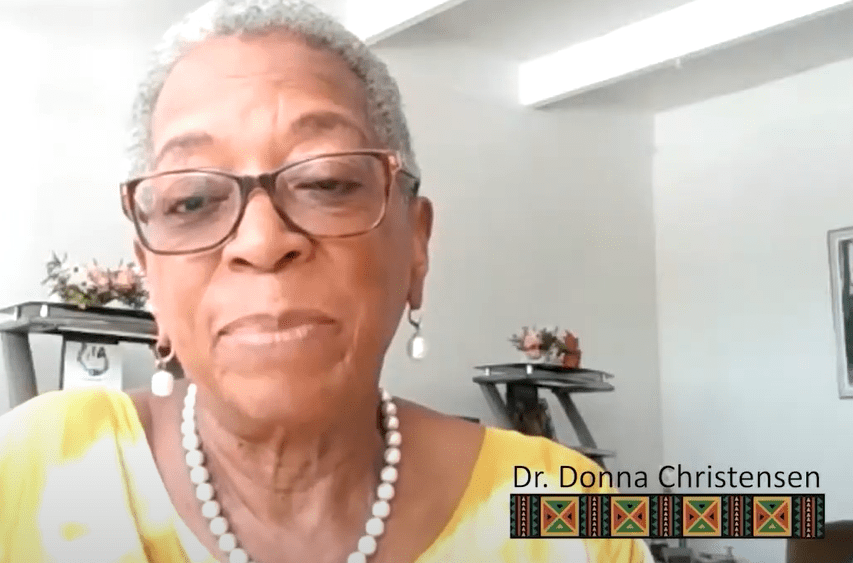
The Division of Virgin Islands Cultural Education and the Legislature of the U.S. Virgin Islands have launched a new set of lesson plans and resources to spark conversations on leadership, justice and health inequality. As part of the rollout, former Delegate to Congress Donna Christensen delivered a lesson on health equity.
Christensen, the first female physician to serve in Congress, the first woman to represent an offshore territory and the first woman delegate from the U.S. Virgin Islands, opened her talk by highlighting the legacy of former Gov. Melvin Evans.
The program, titled “Creating a Progressive Virgin Islands: Learning of Blyden and Pan-Africanism, Health Equity and Melvin Evans, and Imagining a Just Future,” is part of the VIDE GoOpenUSVI platform and offers lesson plans and video vignettes for students and educators. Materials are available online.
According to the GoOpenUSVI website, the module is “designed for educators who wish to engage their students in a dynamic and comprehensive study of Virgin Islands history, leadership, and social justice” and is also a “flexible framework that can be adapted for students in grades 9-12.”

The site notes that “Blyden’s vision for Black people to ‘collect the scattered forces of the race’ and establish a ‘great center’ finds a parallel in Evans’s efforts to build a more equitable and self-reliant healthcare system for the people of the Virgin Islands. The module encourages students to see how a grand philosophical idea can be translated into tangible, community-level change and inspires them to become the next generation of leaders who will shape a just future.”
“He was not only the first delegate from the Virgin Islands of African descent, but he was also the first Black doctor to ever have served in the history of the Congress,” Christensen said of Evans.
Evans’s career was marked by public service and a commitment to health equity. After graduating as valedictorian from Charlotte Amalie High School, he earned undergraduate and medical degrees magna cum laude from Howard University. He went on to serve in the United States Public Health Service and held numerous medical leadership roles in the Virgin Islands, including commissioner of health and physician in charge at the Frederiksted Hospital, now known as Gov. Juan F. Luis Hospital.
As governor and later as the Virgin Islands’ first delegate to Congress from 1979 to 1981, Evans championed legislative reforms to improve education and health care in the territory. According to Christensen, he secured federal funds for public education, introduced measures to address the shortage of doctors and advocated for the construction of new hospitals.
“I firmly believe that the 120,000 people of the U.S. Virgin Islands, in addition to the 1.5 million tourists who visit annually to our islands, must be provided with the adequate medical assistance to which they are entitled,” Evans once told colleagues on the House floor.
Evans’s vision for accessible health care in the territory mirrors Christensen’s, as the Virgin Islands continues to grapple with persistent disparities. “So when I went to Congress, it was 16 years after Dr. Evans left, I was the first female physician ever to serve in the Congress, and I took up the cause of equity,” Christensen said. “Mainly focusing on health as I promised my patients when I left, I would focus on health care.”
Christensen noted that the leading causes of death for Virgin Islanders during Evans’ time — heart disease, cancer, stroke and diabetes — remain the same today. She added that the territory has also experienced a rise in homicides and suicides since then.
“At the very basis of health disparities and health inequities is poverty,” Christensen said, underscoring the connection between economic hardship and health outcomes. The territory’s poverty rate hovers between 20 and 22 percent, according to census data, with 33 percent of children living below the poverty line according to child welfare reports.
She pointed to additional social determinants, including limited access to healthy food and transportation barriers. “Many parts of the country are … food deserts and there are transportation issues as well. So if there’s not a … good grocery store near you, if you don’t have good bus transportation, that’s another social determinant of health,” Christensen said. These barriers, she noted, make it difficult for many Virgin Islanders to access nutritious food and reliable care, perpetuating cycles of poor health and economic hardship.
Still, the territory has made progress in some areas. “Our maternal mortality is pretty much zero. So I’m very proud of that,” Christensen said. The infant mortality rate has also dropped significantly, from 13 deaths per 1,000 live births to 5.8, lower than the national average.
While poverty and access remain major challenges, Christensen said the roots of health inequities run deeper. She pointed to systemic racism as a fundamental force shaping outcomes in the Virgin Islands.
“In the United States, and to some extent here as well, the systems that create these social determinants are really based on racist policies that have created systems and institutions that perpetuate them,” she said, explaining how they affect everything from educational funding to health care access.
The effects, she added, are ongoing. “There is bias against people who are Black, people who speak a different language, who are foreign,” she said, describing how discrimination can lead to unequal treatment in medical settings.
Christensen emphasized that addressing disparities requires confronting the systemic racism that underpins them. “What we need to really do is remove all barriers to access to health care, which is quite an awesome task,” she said. “It means that we have to look at all of those social determinants and remove those that are impairing our ability to be healthy, and that’s when we’ll get to justice.”
She closed by encouraging the community to remain engaged. “I’m willing to continue this conversation because I know this has just been a quick overview,” Christensen said. “But I hope it has whetted your appetite to really look around and see what you think needs to be fixed in our territory — to make people more healthy, and to be well, and to have a high quality of life.”