


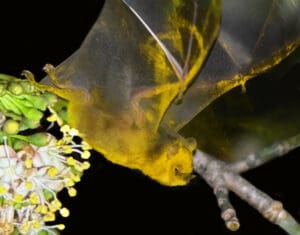
One morning at the Unitarian Fellowship meeting my friend Kim mentioned that the big kapok tree by her place nearby was in bloom, and invited us to come over that evening to check it out. We needed to wait until dark because the flowers only open up at night, to attract the nocturnal fruit bats that are their main pollinators.
This tree is huge, and dominates the skyline.
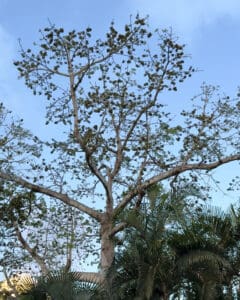
I had read that kapoks, also known as silk-cotton trees (Ceiba pentandra), were viewed as sacred trees by the Tainos, the early inhabitants of the Caribbean islands who came up from South America. The Tainos were probably traveling in dugout canoes made from thick kapok tree trunks, and carrying the seeds with them. Reportedly, the Tainos revered the bats attracted to the kapok tree flowers as the spirits of the dead that offered a connection between those still living and the world beyond.
I had never actually seen the bats showing up at one of the trees. The kapoks don’t flower very often, and then it’s not always okay to go around looking for bats at night, especially on other people’s property. So we were grateful for this invitation.

When my husband and I arrived after dinner, it was already dark, a bit late, and it was hard to figure out what was going on. Small areas of the tree were being lit up by other people holding flashlights, and bats were frantically flying around the flowers that were already open. Someone pointed and yelled out ‘there’s one’’ and then that bat quickly sped off and other ones whizzed by out of the shadows. As they flew around they were knocking off dead flower heads, which showered down on us, along with occasional bits of nectar-scented poop. Good to have a hat on.
I had my telephoto lens with me, which requires two hands, and I couldn’t hold a flashlight as well. Also, I am not skilled at shooting in the dark, and had trouble focusing on the spots people were pointing at before the bat and circle of light had moved on.
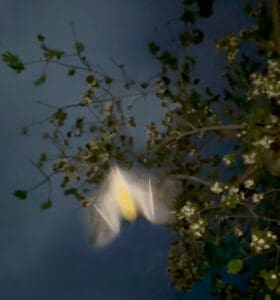
It was all very frustrating and confusing until the tenants on the third floor invited us to come up and look at the mid-level of the tree from their deck. Up there, the bats and flowers were much closer. And one of the tenants was kind enough to hold her flashlight on a few nearby bats long enough for me to get some in-focus photos of them drinking nectar from the center of opened flowers.
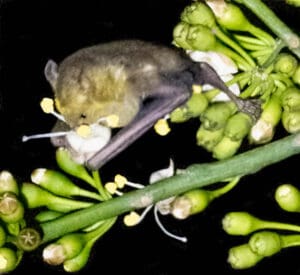
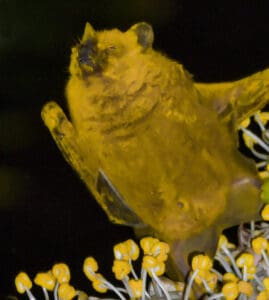
By about half an hour after we arrived, the bats seemed to slow down, maybe because they had already drunk a good bit of nectar from the flowers. Instead of zooming around like crazy, they started dropping down and lying on top of clumps of the opened flowers with anthers sticking up full of pollen.
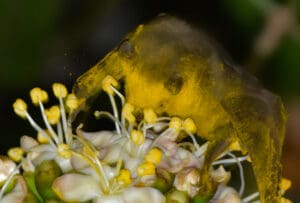
By then the bats’ faces and brown fur were covered with the yellow pollen.
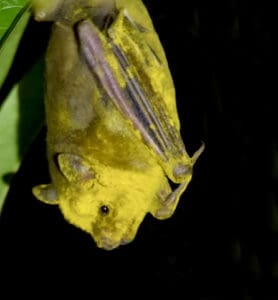
The blooming and pollination process lasts for a few weeks as different sets of flowers on the tree open sequentially. Even though it seemed like there might have been over 100 bats coming to feed, they needed to keep coming back to get around to pollinating all the flower bunches as they opened. The tree had to produce a lot of nectar to keep them coming. Once this frenzy of activity was finished, it might be years before the tree would have the strength to bloom again.
After that first night I went back a few more times to try to understand more about what was happening, arriving well before dark to be ready when the bats started coming.
I prepared by going to the hardware store to get a strong flashlight. They recommended one called ‘Big Larry’ and I enlisted my husband to hold it steady while I tried to get photos of the bats in flight. The people with the balcony were no longer there, so I tried to find a good viewing spot from the ground. There were some relatively low-hanging branches with flowers, but unfortunately, Big Larry’s beam could not really reach that far.
The next day I went back and found an even stronger flashlight – all business, no nickname.
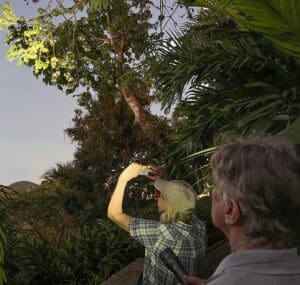
That night I invited the visiting speaker for the Unitarian Fellowship to come with me, because she had missed the first night’s visit. It was particularly thrilling this time because when the bats came several of them swooped down low and circled us. In the dark I heard her exclaim “Mon dieu, il m’a touché”. When I looked over she was rubbing her arm and said she was so surprised she lost her English and reverted to her childhood French. Another night I promised a different tree-loving friend ‘a life-changing experience’ and she was not disappointed.
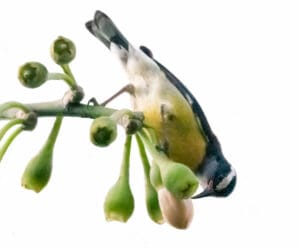
The bats were not the only creatures attracted to the tree’s flowers. When I went by one day in the late afternoon, I could see that bananaquits were investigating the buds. Some bananaquits seemed to be trying to pry open the flower’s tips. Others were more aggressive, poking their sharp beaks into the sides of the flowers as a short cut to getting at the nectar sac without providing any pollination services in exchange.
Later on, hummingbirds tried to sneak their long, skinny tongues into the flowers, just as the petals started to crack open.
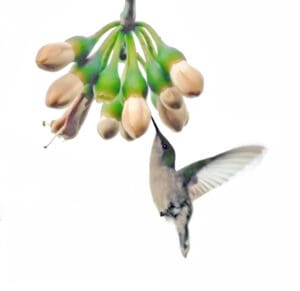
At dusk, hummingbird moths and bees gathered around as the scent of the opened flowers started spreading through the area. I though the bees would be sleeping by then, but I guess this was an opportunity worth staying up for.
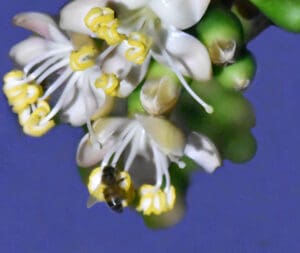
What an adventure to stand underneath this marvelous tree at dusk and join the wild company drawn to its exuberant blossoming.
And then, when it got dark and the bats arrived, there was a wild frenzy that made my heart race. My time there certainly felt like a spiritual experience, connecting me with so many other ways of being in the world, in the night, on this island.
Gail Karlsson is the author of a photo book Looking for Birds on St. John, as well as two other books about nature in the Virgin Islands – The Wild Life in an Island House, and a guide book Learning About Trees and Plants – A Project of the Unitarian Universalist Fellowship of St. John. Follow her on Instagram @gailkarlsson and at gvkarlsson.blogspot.com.