

During the first week of January, Gov. Albert Bryan Jr. vetoed six bills. Among them was Bill Number 33-0364, which sought to create a Virgin Islands Indigenous Tribe identification card for those who identify as Taino, Carib, Kalinago or any other Caribbean indigenous group.
The governor’s veto engendered little public conversation, but it was a setback for Maekiaphan Phillips, a St. Thomas woman who has been pushing for tribal recognition from the Virgin Islands government for eight years.
Phillips has been named the “kasike” (“cacique” in Spanish) or “chief” of the Guainia Taino Tribe of the Virgin Islands, the first named chief in the Virgin Islands in hundreds of years. “We thought it best to link our tribal name to our Taino brothers and sisters in Puerto Rico; Guainia also links us back to the Amazon and Venezuela,” she said.
For those who are unfamiliar with the term “Taino,” it refers to “the Arawakan-speaking peoples of the Caribbean who arrived from South America over the course of 4,000 years,” according to an article in National Geographic.

Currently in Puerto Rico, the Dominican Republic, Cuba and now the Virgin Islands, the term “Taino” is generally preferred over the term “Arawak.”
This is the first in a four-part series about Taino culture and history as it relates to the Virgin Islands.
Taino Descendants Challenge Extinction Theory
If you thought that Taino people are extinct, you’re not alone.
“The Taino were declared extinct shortly after 1565 when a census shows just 200 Indians living on Hispaniola, now the Dominican Republic and Haiti,” according to National Geographic.
Like many other indigenous peoples, the Taino succumbed to diseases from contact with the Europeans. Within a generation or two of the arrival of the Spanish in the Caribbean in the late 15th century, as many as three million people died. That represents an estimated 85 percent of the indigenous people of Cuba, Hispaniola and Puerto Rico, according to an article in the Smithsonian by Robert M. Poole.
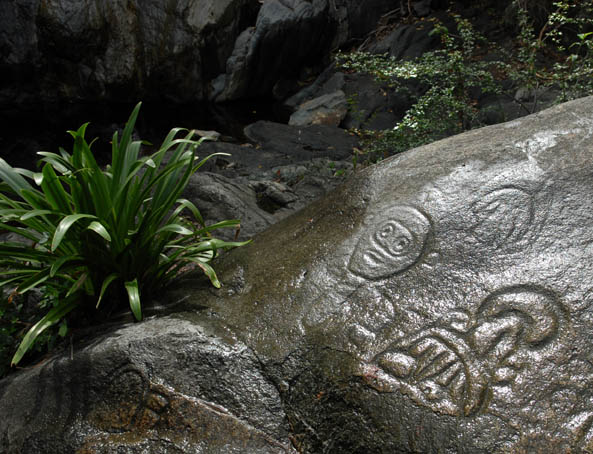
Native Indian populations with intact cultures from centuries ago may have disappeared, but remnants of their presence continue to be visible, as can be seen in this video filmed in the Dominican Republic produced by Instituto Tecnológico de Santo Domingo.
The people in the video speak Spanish, not an old Taino language that disappeared centuries ago. However, the Smithsonian article notes that some words of Taino origin remain in wide use today, including “hurricane,” “hammock,” “barbecue” and “canoe.”
Although the vast majority of the Taino people died from diseases, from contact with Spanish colonizers, and the enslavement and genocide that followed, their genetic heritage did not. That’s something that thousands of people are discovering now with the availability of DNA home testing kits.
“By 1514, barely two decades after first contact, an official survey showed that 40 percent of Spanish men had taken Indian wives. The unofficial number is undoubtedly higher,” Poole wrote in Smithsonian Magazine.
The widespread presence of Taino heritage remained officially unrecognized by most scholars until Juan C. Martínez Cruzado, a biologist at the University of Puerto Rico, initiated an islandwide genetics study that was published in 2003.
“Taking samples from 800 randomly selected subjects, Martínez reported that 61.1 percent of those surveyed had mitochondrial DNA of indigenous origin, indicating a persistence in the maternal line that surprised him and his fellow scientists,” according to Poole.
The astonishing results from these early genetic studies led to more studies, and these studies inspired Maekiaphan Phillips to further research her Amerindian ancestry.
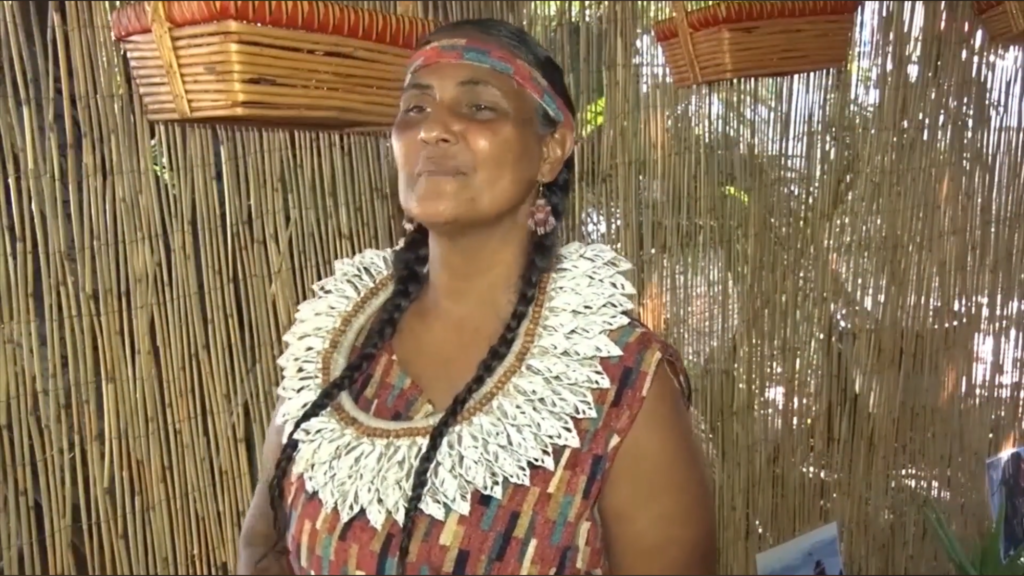
From genetic testing and interviews with relatives, Phillips learned more about her ancestors, many of whom lived on Vieques. “My father’s mother, Maria de la Cruz Bermudez, was a full-blooded Taino. My mother’s grandmother, Francisca Almestica Delgado, was Taino and Spanish. Her mother, Maria Delgado, was also closer to a full-blooded Taino.”
There are 81 families who can trace their heritage to her ancestors, Phillips said. Her great-grandmother, Francisca Almestica Delgado, was “kidnapped by a pirate” and transported to Tortola, according to her family’s oral history. It’s stories like this that increase the odds that many Virgin Islanders who identify as being African in origin also have Amerindian roots. That some may not be aware of this heritage is not entirely accidental.
For centuries, census records suppressed the ability of indigenous people to identify as such, according to the National Geographic article. Jorge Baracutei Estevez, who leads a Taino community group in New York, refers to this “erasure” of a people as “paper genocide.”
“Paper genocide means that a people can be made to disappear on paper,” Baracutei Estevez said. “The 1787 census in Puerto Rico lists 2,300 pure Indians in the population, but on the next census, in 1802, not a single Indian is listed. … For a long time, there was no Indian option for people from Latin America – you were either Hispanic, white, Black or a mixture. When the Indian or indigenous option was placed in the Puerto Rican census, 33,000 people identified as Indian.”
One St. John resident, who was raised in Puerto Rico and the Virgin Islands, discovered through genetic testing that in addition to European and African ancestors, she also has ancestors who were Taino. Priscilla Hintz Rivera Knight, the co-owner of Bajo el Sol Gallery, said she can remember her grandmother’s treasured collection of syncretic spiritual objects; some referenced Christian belief and some were related to African spiritual practice. It was only recently, when she started reading about Taino culture, that she realized that some of the objects were most closely related to Taino practices.
“Puerto Ricans are very adamant about their European, African and Taino heritage,” said Hintz Rivera Knight. “They identify with all three. It would be interesting to ascertain how many Virgin Islanders have Taino heritage. I would encourage more academic research as it relates to our Virgin Islands population.”
Hintz Rivera Knight points out that our modern notions of borders were not adhered to by the early inhabitants of the Caribbean. Archaeological discoveries are continuing to shed light on the connections among populations throughout the entire Caribbean.
The recent affirmation of Taino ancestry is an immense source of pride for Phillips. “I am happy that it has all come full circle and proven to many that we are not extinct. We are very much a part of the Caribbean, and it is great that we have [studies] to prove it to those outside of here,” she said.